
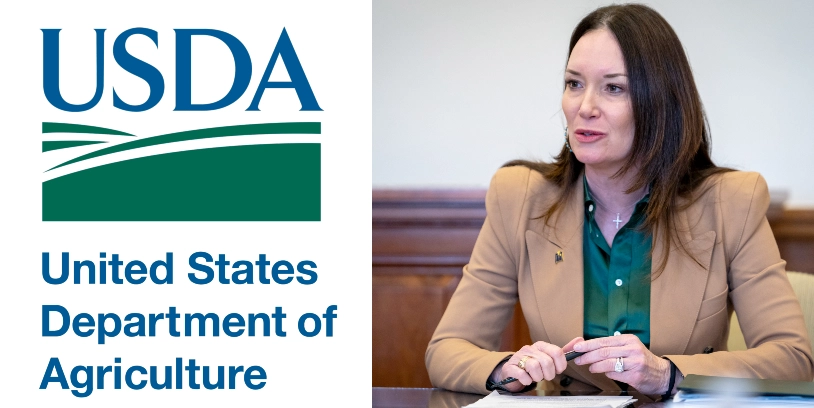
U.S. Secretary of Agriculture Brooke L. Rollins unveiled a sweeping reorganization of the U.S. Department of Agriculture this week, marking a return to the agency’s core mission: supporting American agriculture.
The announcement, which affects thousands of federal workers, restructures USDA operations by consolidating offices, reducing staff through voluntary retirements, and relocating agency personnel from Washington, D.C., to five regional hubs.
The goal, Rollins said, is to make the Department leaner, more effective, and closer to the communities it serves.
Rollins Cites Overspending, Mismanagement
Rollins said the USDA had grown bloated in recent years, with workforce expansion outpacing financial resources. Salaries increased by 14.5% and employee headcount rose by 8% over the four years, yet services to farmers and ranchers did not improve.
“We found a bloated, expensive, and unsustainable organization,” Rollins said. “President Trump tasked us with restoring accountability, and that’s exactly what we’re doing.”
The USDA’s footprint in the National Capital Region, which includes over 4,600 employees, will be significantly reduced. Rollins cited underused buildings, high operating costs, and billions in deferred maintenance as factors behind the realignment.
New USDA Hubs in Five Cities
To bring operations closer to agricultural communities, the USDA will relocate staff to five regional hubs: Raleigh, Kansas City, Indianapolis, Fort Collins, and Salt Lake City. These locations were selected for their lower cost of living and existing presence of the USDA.
Currently, D.C.-based USDA buildings, such as the South Building and the Beltsville Agricultural Research Center, face significant maintenance backlogs. The South Building alone requires $1.3 billion in repairs and houses fewer than 1,900 employees, less than a third of its capacity.
Once the move is complete, no more than 2,000 USDA employees will remain in the capital. Critical functions will continue in D.C., but many headquarters and support staff will transition to the new hubs in a phased process over the coming months.
Related Article: USDA’s New Secretary Unveils Drastic Spending Cuts
USDA Reorganization to Prioritize Mission, Trim Bureaucracy
The USDA reorganization follows four guiding principles:
- Align workforce with budget and priorities
- Move operations closer to constituents
- Eliminate unnecessary bureaucracy
- Consolidate overlapping support roles
Rollins emphasized that all mission-critical services—especially those related to public health, food safety, and wildfire response—will continue uninterrupted. Earlier this year, USDA exempted 52 national security and public safety positions from the federal hiring freeze to ensure continuity.
“We’re not cutting where it counts,” said Rollins. “We’re strengthening the parts of USDA that truly serve America’s farmers and ranchers.”
Voluntary Workforce Reductions Underway
As part of the reorganization, USDA offered voluntary retirement and resignation programs. So far, 15,364 employees have accepted, easing the burden of downsizing and avoiding layoffs.
These measures, Rollins said, will help ensure the Department can operate within its budget while maintaining its ability to serve rural America.
“This is about doing right by the American taxpayer and the agricultural community,” she said. “We’re reshaping USDA into a more accountable, responsive, and mission-focused agency.”
Long-Term Reform Process
This reorganization is the first phase of what Rollins called a “multi-month transformation.” Over the next 30 days, USDA leaders will provide detailed guidance to staff affected by relocations. Additional phases are expected to address space utilization and mission alignment.
Despite the changes, USDA will retain a federal presence in the capital for every mission area. Buildings such as the Whitten and Yates buildings, as well as the National Agricultural Library, will remain in use as needed, with optimization plans still under review.
Rollins concluded: “American agriculture feeds, clothes, and fuels this country—and USDA must be structured to reflect that. We’re cutting waste and getting back to what matters: supporting our farmers, ranchers, and producers.”