
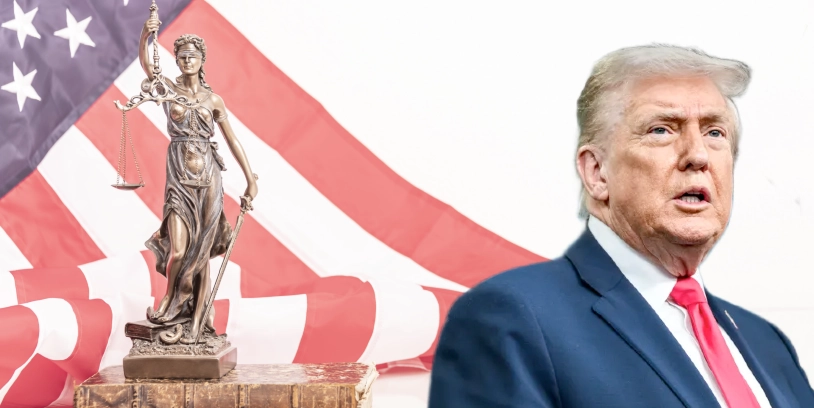
The Supreme Court struck down most of the Trump tariffs, ruling that the U.S. President exceeded his authority by imposing them under an emergency economic law without explicit congressional approval.
In a 6-3 decision issued Thursday in Learning Resources, Inc. v. Trump, the court held that the International Emergency Economic Powers Act, or IEEPA, does not grant the president power to impose tariffs. Chief Justice John Roberts wrote that the Constitution assigns taxing authority to Congress alone.
The ruling vacates a lower court decision in one case and affirms another, Trump v. V.O.S. Selections, Inc., which also rejected the tariffs.
Court Says Congress Controls Tariff Power
Roberts emphasized that Article I of the Constitution gives Congress the power to “lay and collect Taxes, Duties, Imposts and Excises.” He wrote that tariffs clearly fall within that taxing authority.
The administration had argued that IEEPA allowed the president to “regulate” importation during a national emergency. Trump invoked the statute after declaring emergencies related to drug trafficking and trade deficits.
However, the court rejected that reading. Roberts wrote that IEEPA does not mention tariffs or duties. He concluded Congress would have spoken clearly if it intended to delegate such sweeping authority.
Moreover, the court cited the “major questions” doctrine. It reasoned that Congress does not hide decisions of vast economic and political significance in vague language.
Justice Elena Kagan, joined by Justices Sonia Sotomayor and Ketanji Brown Jackson, agreed with the outcome but said standard statutory interpretation sufficed.
By contrast, Justices Clarence Thomas and Brett Kavanaugh dissented.
Related Article: Poll finds Americans Blame Trump Policies for High Grocery Prices
Trump Tariffs Reshaped Food Supply Chains
The decision carries major implications for the U.S. food industry, which absorbed sharp cost increases under the Trump tariffs.
In 2025, the administration imposed 25% duties on most Canadian and Mexican imports and 10% to 145% duties on many Chinese goods. Those measures applied broadly, including to food products, ingredients, and packaging materials.
The National Retail Federation repeatedly warned that the Trump tariffs would raise consumer prices. In public statements and letters to federal officials, the group said retailers faced higher costs on imported produce, seafood, spices, and kitchen equipment.
Similarly, the National Grocers Association told lawmakers that independent supermarkets operate on thin margins and cannot absorb sudden cost spikes. The association argued tariffs function as taxes paid by American importers, not foreign governments.
The U.S. Chamber of Commerce also criticized the Trump tariffs. It stated that broad-based tariffs disrupt supply chains and increase prices for families and small businesses.
Furthermore, the Consumer Brands Association warned that food manufacturers rely on globally sourced ingredients, including cocoa, coffee, and certain fruits not widely grown in the United States.
According to the U.S. Department of Agriculture, the United States imports significant volumes of fresh produce from Mexico and Canada, especially during the winter months. Industry analysts said tariffs on those imports translated quickly into higher shelf prices.
Meanwhile, the Congressional Budget Office reported in 2025 that new tariffs would increase inflation in the short term and reduce household purchasing power.
Industry Groups Welcome Ruling
After the decision, several trade groups signaled relief. Retail and food industry advocates have long argued that Congress, not the White House, should set tariff policy.
The International Fresh Produce Association (IFPA) welcomed the Supreme Court’s decision clarifying the limits of IEEPA and reaffirming that broad, country-specific tariffs fall outside its intended scope.
“The global trade of fresh produce is essential to the health and well-being of people in every nation, and today’s ruling helps restore predictability to a uniquely complex, seasonally driven marketplace. IFPA does not believe tariffs should be used as a default response to every trade concern facing the United States, nor should this ruling simply prompt a shift to other tariff authorities.”
They contend predictable trade rules help grocers plan seasonal purchases and negotiate contracts. By contrast, frequent tariff changes complicate inventory management and pricing strategies.
The court noted that no president had used IEEPA to impose tariffs in its nearly 50-year history. That lack of precedent, Roberts wrote, underscored the extraordinary nature of the Trump tariffs.
Now, legal experts expect Congress to revisit debates over trade authority. Lawmakers may clarify the scope of emergency powers or consider new guardrails.
For food retailers and manufacturers, however, the immediate focus centers on cost stability. If the ruling curbs abrupt tariff shifts, companies could gain greater certainty in sourcing and pricing.
The Supreme Court’s decision reasserts congressional control over trade taxes. In doing so, it reshapes the legal landscape that enabled the Trump tariffs and reverberated across America’s food supply chain.