
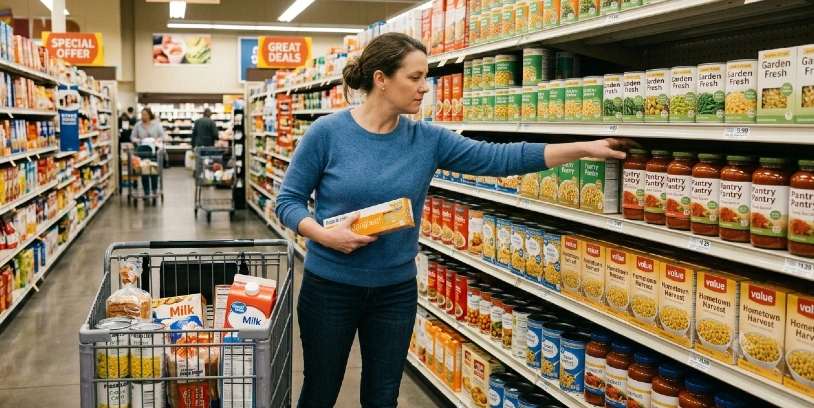
Store brands are pulling further ahead in the fight for U.S. shopping carts. New midyear data from the Private Label Manufacturers Association (PLMA) show private label products outsold national brands in the first half of 2026, reaching a record store-brand market share.
The findings are based on exclusive data from research firm Circana. They point to a steady shift in how Americans shop, even as overall grocery spending cools.
Store Brands Outsell National Brands Nationwide
According to PLMA, store-brand unit sales rose 0.2% during the six months ending June 14. Meanwhile, national-brand unit sales fell 0.5% over the same period last year. That 0.7-point spread pushed store-brand unit market share to 23.8%, a record high for the category, Circana reported.
Unit sales track how many individual products move off shelves. Dollar sales, by contrast, measure total revenue, and the two metrics tell different stories this year.
The momentum isn’t limited to a handful of aisles, either. Circana’s data covers 166 food categories, including store brands, and 52% posted private-label unit growth over the 52 weeks ending June 14. Of the 164 nonfood categories, 39% showed the same trend.
Pet Care and Beverages Lead the Charge
Some departments are outperforming the rest of the store by a wide margin. Pet Care topped Circana’s list, with store brand units climbing 4.8% over the 52-week period. Beverages followed at 1.8% growth, and Refrigerated rounded out the top three at 1.5%.
Shoppers haven’t abandoned stores altogether, but many have pulled back on how much they spend per trip. That caution has weighed on both national and private brands. However, store brands still beat their national counterparts in unit sales during five of Circana’s six monthly reporting windows so far this year.
Related Article: Private Label’s Big Opportunity: Latino Shoppers
Dollar Sales Tell a More Complicated Story
Revenue numbers paint a murkier picture. Store-brand dollar sales stayed flat year-to-date, while national-brand dollar sales grew 2.2% in the same category, PLMA reported. That left store-brand dollar share at 21.2%, just shy of its own record.
Industry analysts caution against reading too much into that dollar figure. Tariff policy can distort revenue trends. Changing national brand pricing strategies also affect revenue trends. Unit sales are a more reliable gauge of true consumer preference.
PLMA President Peggy Davies pointed to pricing whiplash across the national brand landscape as the reason for the gap. Some manufacturers are cutting prices to win back customers who defected to private label, she said, while others are raising prices to cover higher fuel, ingredient and supply chain costs.
“Unit sales remain the best measure of consumer choice, and Circana’s midyear results, including a record 23.8% unit market share for store brands, underscore the continued strength and growing appeal of private label,” Davies said, according to PLMA.
Consumer Loyalty to National Brands Is Fading
Separate research backs up the trend PLMA is tracking. A survey from consumer insights firm Zappi found the share of shoppers who say they buy only national brands dropped from 21% to 10% in less than a year. More than 90% of respondents told Zappi they’ve changed their shopping habits because of rising costs.
That shift is forcing a reckoning inside major consumer packaged goods companies, said Natali Kelly, Zappi’s chief marketing officer.
“The era of growth driven by price increases is coming to an end,” Kelly said, per Zappi’s findings. “For CPG leaders to transform their businesses, they will need to compete on value instead of price, innovating and simplifying their product portfolios in the process.”
Kelly’s research found nearly 70% of consumers would accept fewer product options if it meant lower prices, a signal that brand loyalty alone may no longer justify premium pricing.
“This isn’t a post-pandemic correction,” Kelly added. “It’s a structural reset, and brands still betting on loyalty to absorb their next price increase may be the last to realize it.”
What This Means for Retailers
The data suggests store brands have moved past their pandemic-era bump and settled into a durable growth pattern. For grocery retailers, the numbers offer a clear signal: private-label investment is paying off, particularly in categories like pet care and beverages, where growth is outpacing the rest of the store.
PLMA, founded in 1979, represents more than 5,200 member companies across over 80 countries, with executive offices in New York and International Council offices in Amsterdam.