
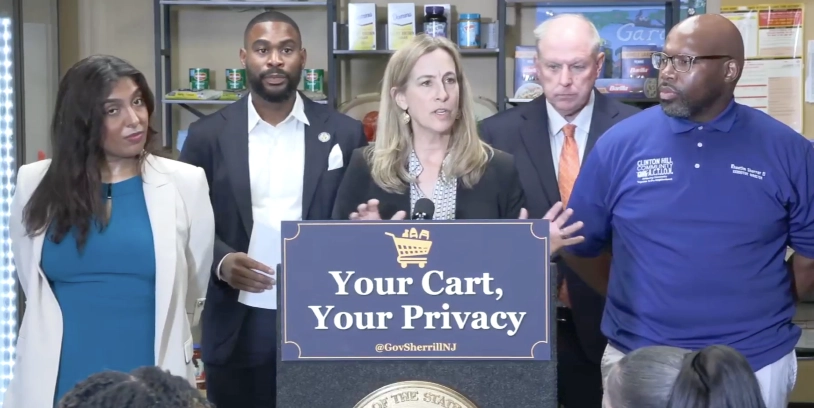

Governor Mikie Sherrill signed the Fair Price Protection Act into law this week, making surveillance pricing illegal at New Jersey grocery stores. The Governor’s office announced the signing in a press conference, framing the law as a direct response to rising food costs across the state.
The new statute bars retailers from using a shopper’s personal data, including browsing history, location, or past purchases, to charge that shopper a different price than someone else pays for the same item. Supporters call it one of the strongest consumer protection laws of its kind in the country.
What the Fair Price Protection Act Does
Surveillance pricing relies on algorithms that predict how much an individual shopper will tolerate paying, then set a price around that prediction. Retailers have always adjusted prices for market conditions. This practice goes further: it targets the person, not just the moment.
“New Jersey families are already feeling the pressure of higher costs,” Sherrill said. “The last thing they need is companies secretly using their personal data to charge them more than someone else for the exact same product.”
The law leaves loyalty programs and standard discounts untouched. Grocers can still reward repeat customers or run sales. What they can’t do, starting next year, is use personal data to quietly set a higher baseline price for someone the algorithm flags as a bigger spender.
A one-year moratorium on new electronic shelf labels comes bundled into the bill as well. The New Jersey Innovation Authority will spend that year studying how the digital price tags affect shoppers before regulators decide whether to expand their use.
A State Attorney General Ready to Enforce
Attorney General Jennifer Davenport pledged to hold retailers accountable under the new rules. “The price New Jersey families pay at the grocery store should be based on the cost of a product, not on what invasive data collection suggests they may be willing to pay,” Davenport said in a press release.
That enforcement threat carries real weight. New Jersey Monitor reported that the law lets both the attorney general and individual consumers sue businesses that violate it, with penalties reaching thousands of dollars per offense once the statute takes effect.
Related Article: AI in Supermarkets Is Not Here to Erase Jobs, It’s Here to Transform Them
Grocers Warned Sherrill Before She Signed
The bill didn’t reach Sherrill’s desk without friction. Abasto Media reported earlier this week that the National Grocers Association pushed for last-minute changes, warning the governor that a broad ban risked sweeping up loyalty programs and other discounts shoppers actually want. Independent grocers argued the bill’s language needed narrowing before becoming law.
Labor groups pushed the opposite direction. UFCW International Vice President Ademola Oyefeso praised the signing, calling the shelf-label moratorium a needed check on technology he says grocery chains are rushing to install nationwide.
Senator Joe Cryan, a bill sponsor, echoed that urgency, describing surveillance pricing as an exploitation of “intrusive” algorithms at a moment when families are already stretched thin.
That tension between retailers and worker advocates isn’t unique to New Jersey. It’s shaping up as the defining fight over grocery technology nationally.
New Jersey Joins a Small but Growing List
Maryland passed the first state-level surveillance pricing ban in April, though experts flagged loopholes that could blunt enforcement. Connecticut followed in June. New Jersey now makes three, and its law goes further than either predecessor by pairing the pricing ban with the shelf-label pause.
New York, meanwhile, already requires companies to disclose when an algorithm set a price. This disclosure rule reportedly helped expose surveillance pricing practices at a major newspaper’s subscription service, according to Gizmodo. That state’s legislature has since passed its own tougher ban, which awaits the governor’s signature.
Momentum is building beyond individual statehouses, too. More than 50 bills addressing algorithmic pricing had been introduced across 26 states, and U.S. Rep. Frank Pallone has opened a federal inquiry into whether major retailers and pharmacies use similar data-driven pricing tactics.
What Comes Next for Grocers
The Fair Price Protection Act takes effect in mid-2027, giving retailers time to review how they collect and use shopper data. For now, loyalty cards, coupons, and seasonal sales stay exactly as they are.
For the broader grocery industry, New Jersey’s move raises the stakes. Other legislatures are watching closely to see whether a full pricing ban, paired with a hard pause on next-generation shelf technology, holds up in practice. If it does, more states are likely to follow.