
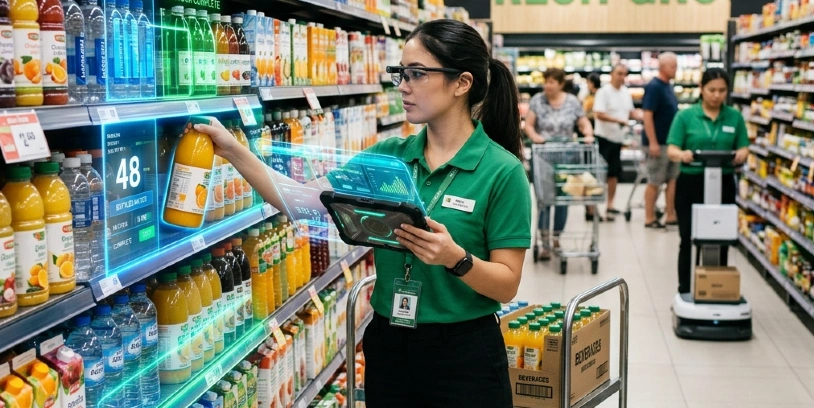
A ghost haunts store aisles: AI in supermarkets will eliminate thousands of jobs. However, Juan Manuel Saravia, founder of Ohla AI, a company specializing in operational efficiency for large consumer goods multinationals, dispels that fear with data and insight.
“Quite the opposite,” Saravia stated in an interview with Abasto magazine. “What it will do is substantially increase the efficiency of the people who restock shelves today.”
At Least a Decade to Go for AI in Supermarkets
The executive was unequivocal during his speech at the 4th Latin Consumer Summit, held in Miami: robots will not replace shelf-stocking workers in the short term. According to his estimates, it will take between 10 and 15 years for that transition to occur on a large scale.
In the meantime, AI in supermarkets will act as an amplifier of human talent. Repetitive and fully automatable tasks, those that currently consume valuable hours of field teams’ time, will give way to intelligent processes. The worker isn’t disappearing; they’re evolving.
Millions at Stake on Every Shelf
Behind every package of tortillas or can of tuna that a consumer picks up from the shelf lies a multimillion-dollar operation. Consumer goods companies allocate enormous resources to ensure that products are in the right place at the right time.
Saravia emphasizes that AI in supermarkets can radically transform this dynamic: saving time, reducing errors, and optimizing the resources that drive this invisible chain between the manufacturer and the shopping cart.
Related Article: How AI and Smart Carts Are Transforming Grocery Shopping
The First Step: Understand Your Processes
So, where do store owners and operations managers start on their AI in supermarkets journey? Saravia’s answer is surprisingly simple: ask.
“Make a list of the processes you’re currently running and quantify how many hours are spent on each one,” he recommends. Only then, he says, is it possible to identify what can be eliminated, what can be optimized, and what can be automated.
Without that clear roadmap, any investment in technology risks becoming a waste of money.
The Transition Has Already Begun
AI in supermarkets isn’t a promise for the future; it’s a reality of the present that the most competitive retailers are already incorporating into their businesses. The window of opportunity to prepare is open, but it won’t remain that way indefinitely.
Saravia’s advice doesn’t require large budgets or technical expertise to get started. It requires something more difficult: the willingness to look inward, understand how the business really works, and act before others do.