

Grocery shelves are moving slower this year, and the numbers back it up. A new analysis from Bain & Company, built on NielsenIQ data, finds that the U.S. grocery slowdown has entered a sharper, more decisive stage.
Shoppers are not just trading down anymore. They are buying fewer items altogether, and the shift is showing up in every region of the country.
Bain and NielsenIQ shared the findings, describing a grocery sector where volume, not just price, has become the story.
Unit Sales Keep Falling, Even as Prices Climb
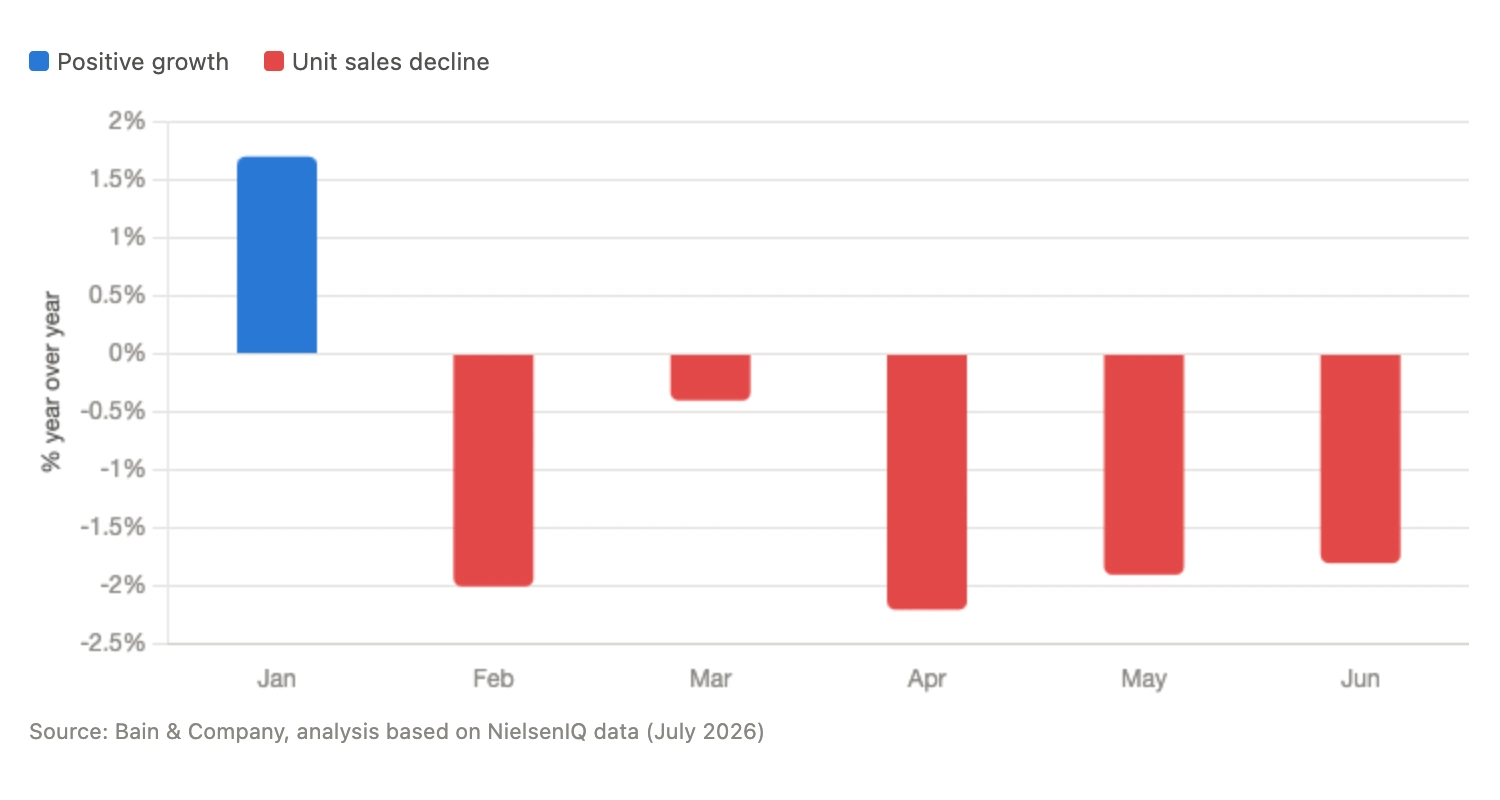
According to Bain’s analysis, national grocery unit sales fell 1.8% year-over-year in June. That marks a nearly two-percentage-point swing from June 2025, when unit growth was nearly flat at just 0.1%.
The pullback did not happen overnight. Bain traces the start of the downturn to mid-2025, when negative unit growth first appeared. From there, the trend hardened. Since February, units sold have dropped by roughly 2% year-over-year in most months through June, Bain and NielsenIQ report.
Grocery Dive, which reviewed the same analysis, adds regional detail: the decline hit hardest in the West, where June unit sales dropped 3%, while the Northeast saw a milder 1.3% slide. Even so, no region escaped the trend.
Meanwhile, prices have not eased up. Grocery bills continue climbing at a 2% to 3% annual clip, Bain finds, so inflation can no longer mask the drop in what shoppers actually carry out the door.
Why Consumers Are Buying Less
No single event triggered the slowdown, Bain’s report concludes. Instead, pressure built steadily on household budgets and intensified through 2026.
Several forces are converging at once. SNAP participation among lower-income households dropped sharply in late 2025 as benefits tightened, adding new strain for that group. Then, in March, gas prices jumped 20% nationally, squeezing weekly budgets already stretched thin by years of inflation. Grocery prices alone have climbed a cumulative 33% since 2019.
Consumers are responding in ways that show up directly in the data. Bain’s Consumer Lab pulse survey found 80% of Americans are actively trying to spend less, and 28% are specifically cutting back on groceries. Among that group, 56% are trading down to cheaper brands, 49% are simply buying fewer items, and 44% are leaning more on coupons and promotions.
Two additional trends are quietly reinforcing the pullback. More shopping has moved online, where smaller basket sizes are the norm. And rising use of GLP-1 weight-loss medications is trimming grocery demand too. Bain reports that 30% to 40% of users are actively cutting back on groceries as a result.
Bain’s broader Consumer Health Index tells a similar story. The composite outlook only recently climbed back to neutral after sliding for much of the past year. Spending intent among lower- and middle-income households still sits at or below its long-term average.
A tax-refund season worth roughly $50 billion more than last year, along with leftover pandemic-era savings, has kept overall spending from falling further. Still, high gas prices and persistent inflation keep working against that cushion.
Related Article: Imminent Closure of Seven Save A Lot Chicago Locations
Grocery Has Become a Share Game
For retailers, the shift changes the competitive math. Bain finds that value-focused players, discounters, dollar stores, mass retailers, and club chains are picking up shoppers and trips as more people trade down. But even they are not immune to the broader unit slowdown, the report notes.
That leaves grocers competing harder for a shrinking pool of trips. CNBC, which reviewed the Bain findings separately, quoted Kurt Grichel, head of Bain & Company’s Americas Retail practice, illustrating the squeeze with a simple comparison: a stock-up trip that cost $300 in 2019 now runs closer to $400, enough to trigger sticker shock even among higher-income shoppers.
Bain’s report points to a clear path forward. Grocers that sharpen pricing on the items shoppers notice most and use promotions, loyalty programs, and private brands with precision stand the best chance of building a value story customers trust and return for.
“The data is unambiguous: U.S. grocery is in a genuine volume contraction, and the path back to growth is not just about low prices, but a value story that shoppers believe in and come back for,” Grichel said in the Bain and NielsenIQ release.
What It Means for the Industry
The takeaway for supermarket and food industry leaders is straightforward: pricing power alone will not carry sales through this stretch. Until gas prices ease and inflation cools further, the pressure on household budgets and on grocery volumes looks set to continue. For now, the grocers and manufacturers that adjust their value proposition fastest are the ones best positioned to gain ground once conditions eventually turn.