
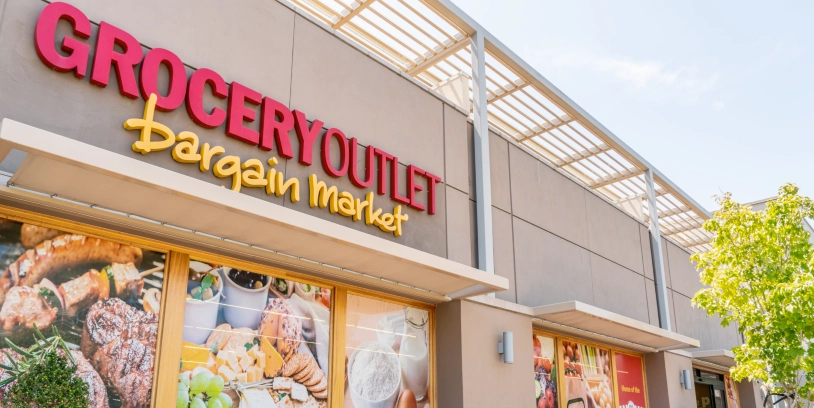
Jason Potter, president and CEO of Grocery Outlet Holding Corp., announced the closure of 36 underperforming Grocery Outlet stores and unveiled a new plan to increase operational profitability.
Upon presenting the company’s fourth-quarter and fiscal-year 2025 financial results, Potter outlined the strategic plan to improve operational efficiency, increase profitability, and strengthen cash flow generation.
The executive said the company aims to deliver clearer value to customers and optimize the in-store experience, while adjusting its store network for future growth.
36 Underperforming Stores to Close
The Optimization Plan calls for the closure of 36 financially underperforming stores across Grocery Outlet’s 16-state footprint.
The plan includes terminating or subleasing store leases and distribution center facilities no longer in use. The company will also end agreements with independent operators for affected locations.
The company expects to substantially complete these closures during fiscal 2026. As part of the plan, Grocery Outlet recorded $110 million in non-cash impairment charges on long-lived assets associated with the stores. The company estimates restructuring costs of $14 million to $25 million this fiscal year, including lease termination fees and bad-debt expenses.
Financial Results Show Urgent Need for Optimization
Grocery Outlet’s fourth-quarter fiscal 2025 net sales increased 10.7% to $1.22 billion, including $82.4 million from an extra 53rd week. However, comparable store sales declined 0.8% over 13 weeks.
The decline reflected a 1.7% drop in average transaction size, partially offset by a 0.9% increase in the number of transactions.
The company reported an operating loss of $234.8 million, including $110.2 million in non-cash impairments of long-lived assets and $149.0 million in goodwill impairments. Net loss totaled $218.2 million, or $(2.22) per diluted share, compared with net income of $2.3 million last year. Adjusted net income rose 28.8% to $18.7 million, while adjusted EBITDA reached $68 million, or 5.6% of net sales.
Fiscal 2025 full-year results reflected $4.69 billion in net sales, up 7.3% from 2024, and a 0.5% increase in comparable store sales.
Despite growth in sales, Grocery Outlet posted a net loss of $224.9 million, or $(2.30) per share, citing $149 million in goodwill impairment and restructuring charges.
Focus on Operational Efficiency and Cash Flow
The Optimization Plan is part of a broader effort to improve Grocery Outlet’s operating model. Potter emphasized initiatives, including advancing store refresh programs, restoring value perception, and reshaping new store growth strategies.
Cash flow improved significantly during fiscal 2025, with $222.1 million in net cash provided by operating activities, up from $112 million the previous year. Capital expenditures totaled $220.3 million, reflecting new store openings and supply chain investments.
The company expects that inventory markdowns during store closures will reduce fiscal 2026 gross profit by $4 million to $6 million. Yet, the plan aims to increase long-term returns on capital and strengthen the overall store network.
Outlook and Growth Plans
Looking ahead, Grocery Outlet projects opening 30 to 33 new stores in fiscal 2026. Net sales are expected between $4.60 billion and $4.72 billion, with comparable store sales remaining flat or declining slightly. Gross margin should range from 29.7% to 30.0%, while adjusted EBITDA is projected at $220 million to $235 million. Diluted adjusted earnings per share are estimated between $0.45 and $0.55.
Potter concluded, “We have identified the core challenges, and now we have the right plans and the right team to execute them. These Grocery Outlet store closures are a difficult but necessary step toward long-term growth and profitability.”