
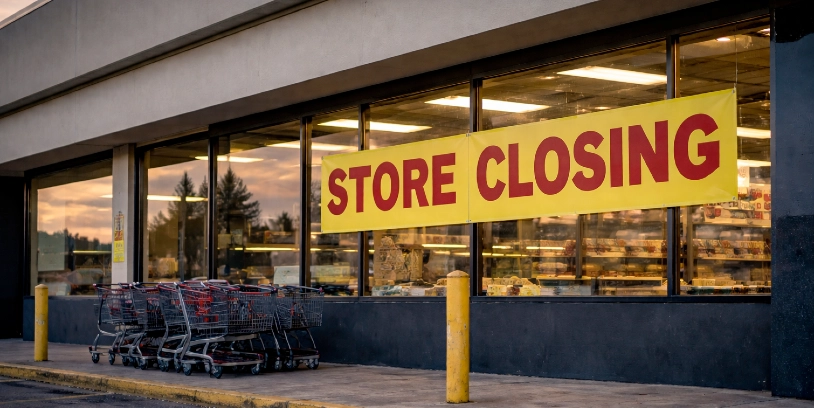
U.S. grocery store closures will continue reshaping the retail landscape in 2026 as chains tighten operations to protect profitability. Although analysts expect the pace of shutdowns to slow slightly, store closures will still outnumber openings, sustaining pressure on lower-income neighborhoods and regional food access.
Retail analytics firm Coresight Research projects 7,900 U.S. store closures across retail sectors in 2026, down 4.5% from 2025. Meanwhile, retailers plan roughly 5,500 openings. The net contraction underscores structural change rather than temporary retrenchment.
Several national media outlets have tracked the shift. Grocery Dive described 2025 as another difficult year for physical retail, citing consolidation and underperforming locations. Forbes reported that store closures across retail remain historically elevated, even as digital sales growth stabilizes.
Corporate Restructuring Intensifies U.S. Grocery Store Closures
Major supermarket operators continue adjusting footprints. Kroger confirmed plans in multiple markets to shut down underperforming stores while reinvesting in remodels and higher-volume locations. Regional outlets such as the Milwaukee Journal Sentinel and the Houston Chronicle documented closures tied to long-term efficiency goals.
Discount grocer Aldi and other operators have also exited select urban locations where margins narrowed. At the same time, some experimental formats have retreated. Coverage from local outlets highlighted abrupt closures of certain Amazon Fresh locations, signaling recalibration rather than unchecked expansion.
Executives argue that consolidation strengthens balance sheets. However, communities left behind face fewer shopping options and weaker price competition.
Food Deserts and Rising Inequality
The U.S. Department of Agriculture estimates that 17.1 million Americans live in low-income, low-access census tracts. When U.S. grocery store closures hit these neighborhoods, the consequences extend beyond retail.
According to the U.S. Census Bureau, the national poverty rate stood at 10.6% in 2024. In cities such as Milwaukee, poverty rates exceeded 22%, intensifying vulnerability to store shutdowns.
Health researchers at the American Cancer Society emphasize that improved access to healthy food is associated with better diet quality and lower risk of chronic disease. Meanwhile, studies published in Preventing Chronic Disease emphasize that stronger transit systems can help mitigate food access barriers in areas where supermarkets disappear.
In practical terms, families without reliable transportation travel farther for groceries, pay more at convenience outlets, or shift to less nutritious alternatives.
Related Article: Relief Fund Aims to Save Latino Small Businesses in Minnesota
Economic Headwinds Behind the Shift
Although inflation has cooled relative to its 2022–2023 peak, operating expenses remain elevated. Labor costs, insurance premiums and supply chain volatility continue squeezing margins. At the same time, consumers exhibit heightened price sensitivity and trade down to discount formats or private-label products.
Retailers respond by concentrating investment in high-performing stores and digital fulfillment infrastructure. Analysts from Coresight Research note that omnichannel strategies now dominate expansion planning. However, online grocery penetration still varies by income bracket and geography, limiting its ability to replace physical stores in vulnerable communities.
Approved Funding President Shmuel Shayowitz told financial media that reduced brick-and-mortar competition may translate into fewer choices and potentially higher prices for shoppers.
Outlook for 2026
The trajectory of U.S. grocery store closures suggests stabilization rather than reversal. Store counts may decline at a slower pace, but footprint rationalization will likely continue throughout 2026.
Municipal leaders in affected cities have explored grant programs, zoning adjustments and early-notice requirements to soften the blow of closures. Whether those efforts scale nationally remains uncertain.
What is clear: the grocery sector is not collapsing, but it is consolidating. For communities already on the edge, the difference between a strategic closure and a full-blown food desert can determine long-term economic and public health outcomes.