
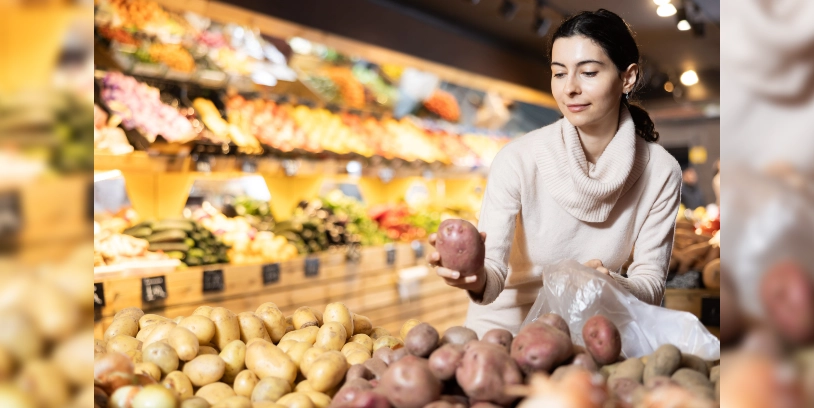
Rising food prices are rewriting the American grocery list, and tight grocery budgets are driving the change.
A new survey of 2,000 U.S. shoppers found that 31% of Americans now cook at home much more than they did a year ago. Squeezed budgets are the reason, according to the survey.
The poll, conducted by Talker Research on behalf of the Idaho Potato Commission, shows how grocery budgets are reshaping what lands in American carts, and what stays on the shelf.
Nearly a third of Americans (26%) now pick ingredients that work across multiple meals. That’s a direct response to shrinking grocery budgets.
The New Math of Grocery Budgets
- Shoppers say $100 should stretch further than it does.
- Respondents told researchers that a $100 grocery budget should cover almost two more meals than it currently does.
- Meat and poultry eat up the largest share of that budget.
- Sixty percent of respondents named it their top expense.
- Dairy and eggs rank second; 30% of shoppers named it their No. 2 expense. Frozen meals and convenience food follow at 22%.
What Shoppers Really Want
Value now drives every decision at the shelf.
Minimizing food waste tops the list, with 73% of respondents calling it a priority. Shelf life follows closely at 72%, and nutritional value per dollar rounds out the top three at 71%.
Meal planning has changed, too. Sixty percent of shoppers build their weekly plans around ingredient overlap.
And 63% say an ingredient’s ability to work across breakfast, lunch and dinner strongly influences whether it earns a regular spot in the cart.
Potatoes Reclaim Their Spot in the Cart
One ingredient stands out above the rest: the potato.
Respondents named potatoes the most versatile staple, with 40% choosing it, more than any other ingredient.
Shoppers also report leaning harder on a handful of pantry staples over the past year. Eggs lead at 38%, followed by potatoes at 37%, rice and pasta at 35%, and beans at 27%.
Among regular potato buyers, 67% believe the vegetable remains underrated.
“There’s a shift in how Americans grocery shop,” said Jamey Higham, president and CEO of the Idaho Potato Commission. “People are not only trying to spend less, but they are also trying to cook smarter. Shoppers are looking for ingredients that can do more with less.”
Related Article: Fresh Grocery Shopping Builds Trust for 91% of Buyers
Foods Making a Comeback
Tight grocery budgets are also softening old food aversions.
Thirty-three percent of respondents say they’ve actively reconsidered a food they once avoided. Red meat leads the comeback list at 32%, followed by white rice at 31%, potatoes at 30% and eggs at 29%.
Potatoes, specifically, are winning shoppers back. Forty-eight percent of respondents now view the vegetable more positively than they did a year ago.
Two factors drive that shift equally: budget and versatility.
Forty percent of respondents say potatoes stretch their grocery dollar better than other options. Another 40% say they discovered the ingredient does more across meals than they expected.
Among shoppers who reconsidered a once-avoided food, 38% cite the need for affordable options as they cook more at home.
Thirty-three percent simply realized the food was more versatile than they’d given it credit for.
A Trusted Staple, Rediscovered
The numbers back up the sentiment.
Among potato buyers, 82% rate the vegetable good or excellent for versatility across meal types. Another 82% say the same about its ability to feed a household on a budget. Seventy-five percent give it high marks for nutritional value.
“Idaho potatoes have always delivered on versatility and nutrition, and it’s encouraging to see consumers rediscovering the value potatoes have brought to the table for generations,” Higham said. “Sometimes the foods we come back to are the ones we’ve trusted all along.”
A Broader Industry Shift
This survey adds texture to a trend already rattling the grocery sector.
Abasto Media reported on July 24 that the U.S. grocery slowdown is deepening, citing Bain & Company data based on NielsenIQ figures. Grocery unit sales fell 1.8% in June from a year earlier, a sharp reversal after modest growth in 2025. Grocery items now cost roughly 33% more than they did in 2019.
That same Bain research found 80% of Americans are still trying to spend less on food, and 28% are actively cutting grocery spending. Among that group, 56% say they’re trading down to cheaper brands, 49% are buying fewer items, and 44% lean more on coupons and promotions.
Together, the two surveys paint a consistent picture. Grocery budgets aren’t just shrinking baskets — they’re reshaping what Americans consider a smart buy, and which old staples earn a second chance.
About the Survey
Talker Research surveyed 2,000 general population Americans with internet access on behalf of the Idaho Potato Commission. The survey ran online from June 12 to June 17, 2026.