
The switch from synthetic to natural food dyes will demand years of investment, new farmland and a unified federal rulebook, or risk chaos across the supply chain, according to new research from RTI International.
The nonprofit research institute conducted the study on behalf of the National Confectioners Association (NCA). Titled “Recoloring the U.S. Food Industry’s Future,” the report offers one of the first deep-dive looks at what it would actually take to scale naturally sourced colorants across the entire U.S. food system.
Researchers built the findings on more than 30 stakeholder interviews, retail scanner data, regulatory review and economic modeling. Their conclusion: replacing synthetic dyes isn’t a simple ingredient swap. It’s a full supply chain overhaul touching farms, factories, warehouses and store shelves alike.
Why the Natural Food Dye Shift Is Accelerating
Pressure has been building on multiple fronts. In April 2025, the FDA announced plans to phase out synthetic dyes, relying on industry commitments instead of formal rules. Two natural colorants, gardenia blue and galdieria extract blue, are approved, and regulators removed Red No. 3 from the market.
Meanwhile, states aren’t waiting around. West Virginia’s law banning FD&C colorants in food products is set to take effect January 1, 2028, even though a federal court has temporarily blocked enforcement. Companies are treating that date as a planning benchmark regardless.
Consumer habits are shifting too. Walmart says 90% of its private-label food products are now free of FD&C dyes. Twenty-four other food and beverage companies have pledged similar changes, according to the report.
Where the Bottlenecks Sit
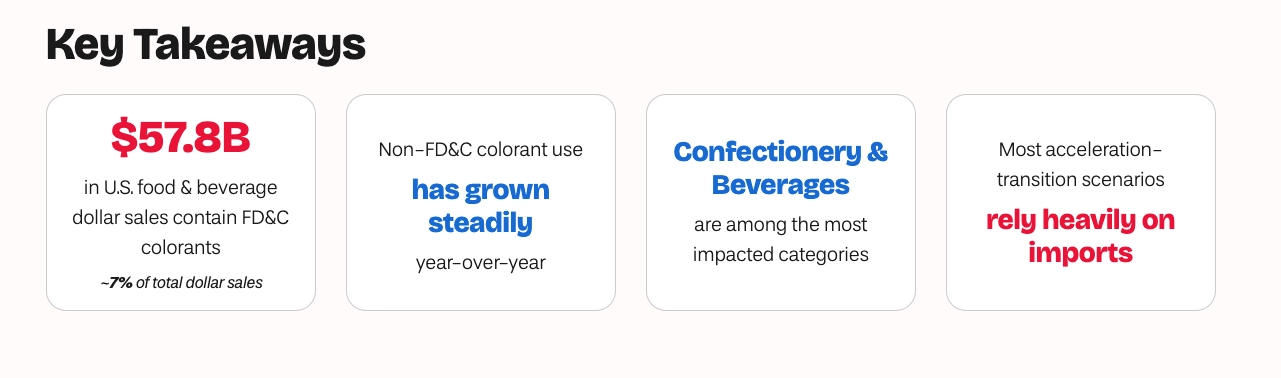
The RTI analysis found the toughest constraints cluster upstream — in farming, sourcing and international trade. Several ingredients depend almost entirely on foreign suppliers. Annatto is 98.2% imported. Saffron crocin sits at 99.8%. Butterfly pea ternatins reach 99.1%, with much of that supply tied to single countries like Brazil, Iran and Thailand.
That concentration creates real exposure. Tariff swings, droughts and geopolitical flare-ups could all disrupt the flow of ingredients American manufacturers now depend on for red, blue and green hues.
Domestic farming could theoretically fill some of the gap. But U.S. growers face steeper labor costs than competitors abroad, plus a shortage of high-pigment crop varieties and nearby processing facilities. Some crops, like black carrots, must be processed within days of harvest — a logistical hurdle for a fledgling domestic industry.
Related Article: FDA Approves Natural Food Colors, Moves to Ban Petroleum Dyes
Price Shocks Could Follow a Rushed Transition
RTI’s economic modeling paints a stark picture of what happens if the food industry moves too fast. Under a “baseline growth” scenario, natural colorant prices could climb roughly 53% by 2028. Push demand to four times current levels, a stress test meant to simulate an abrupt, system-wide ban on synthetic dyes, and average prices could soar past 1,000%.
Curcumin, from turmeric, showed the largest spike: up to 3,200% in the worst case. This is mainly because supply is concentrated in India and hard to scale quickly.
Manufacturing adds more cost. Natural pigments often require 10 to 100 times higher use levels than synthetic dyes and can cost up to 10 times more per unit. Reformulating a product can cost $50,000 to $500,000 after stability testing, sensory trials, and regulatory review.
A Call for National Standards
NCA President and CEO John Downs framed the findings as evidence that industry needs clarity before it can act.
“This research makes clear that replacing synthetic food dyes is far more than a reformulation challenge. It’s a supply chain transformation,” Downs said in the NCA announcement accompanying the report. “Companies need regulatory certainty before they can make the long-term investments required to expand supply, strengthen domestic manufacturing, and ensure products remain safe, affordable, and available for consumers.”
The report echoes that call, urging a uniform, science-based federal standard rather than the current patchwork of state laws. Without it, researchers warn, companies risk stranded inventory, inconsistent compliance, and higher costs passed down to shoppers.
RTI’s recommendations extend across the supply chain — from crop insurance reforms for farmers growing colorant feedstocks, to contract farming agreements for suppliers, to dedicated reformulation teams for manufacturers. Retailers, the report notes, will need to manage shelf placement and lighting to offset the visual fading common in natural pigments.
The full report, along with an executive summary and stakeholder briefs, is available through the National Confectioners Association at CandyUSA.com/NaturalColors.