
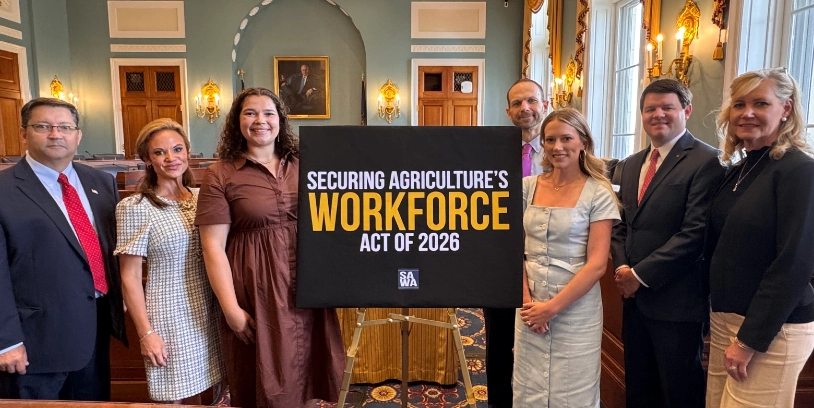
More than 400 agricultural organizations threw their support behind a sweeping agricultural workforce reform bill introduced in the House last week, according to a press release from the Ag Wage Reform Coalition.
House Agriculture Committee Chairman G.T. Thompson formally introduced the Securing Agriculture’s Workforce Act, known as SAWA, on July 1. The coalition called the show of unity one of the broadest in recent memory for farm labor policy, per its statement.
A Show of Force on Capitol Hill
The backing spans producers, commodity groups, state and national associations, and agribusinesses from across the country, the coalition said in its release. That breadth signals rare alignment across a fractured policy landscape.
Dozens of agricultural leaders traveled to Washington last week to meet with lawmakers. They also joined a Capitol Hill press conference marking the bill’s introduction, according to the release. Their presence, organizers said, reflected the industry’s shared urgency around building a stable, legal workforce.
Chris Butts, spokesperson for the Ag Wage Reform Coalition and executive vice president of the Georgia Fruit and Vegetable Growers Association, framed the moment as a turning point.
“Today’s introduction is the result of years of collaboration and countless conversations among agricultural organizations, growers and congressional leaders,” Butts said, according to the coalition’s statement. “The support of more than 400 organizations sends a clear message: agriculture is united behind the need for meaningful workforce reform.”
From there, the coalition credited Thompson and the bill’s bipartisan sponsors for pushing the legislation forward.
Why Growers Are Pushing for Change
Specialty crop growers have wrestled with rising labor costs for years. Workforce shortages and regulatory uncertainty have piled on, according to the release, threatening the long-term competitiveness of U.S. agriculture.
Coalition members argue SAWA addresses those pressures head-on. The bill would create a more predictable workforce system while protecting domestic food production, according to the release.
Several provisions anchor the legislation, per the coalition:
- Modernizing the H-2A agricultural guest worker program
- Expanding workforce availability to match employer needs
- Codifying the current Adverse Effect Wage Rate methodology for long-term wage certainty
- Streamlining application, certification and hiring processes
- Cutting administrative burdens while preserving worker protections
Together, these changes aim to replace a patchwork system with something growers can actually plan around.
Related Article: Study Reveals Economic Impact of U.S. Produce Industry
Momentum Meets a Longer Road Ahead
The coalition emphasized that the bill reflects years of dialogue between agricultural stakeholders and policymakers and incorporates recommendations drawn directly from growers and employers nationwide, according to the release.
Still, Butts was careful not to declare victory. “Introducing the bill is an important step, but our work is far from finished,” he said, per the release. “We encourage Congress to build on this momentum and move this legislation forward.”
He added that farmers, farmworkers, rural communities and consumers all stand to benefit from a system that works better for everyone.
The coalition also thanked the hundreds of organizations that signed letters of support, met with lawmakers, and showed up for the Capitol Hill announcement.
Looking ahead, Butts pointed to unity as the coalition’s core strength. “The momentum we’ve built together demonstrates what’s possible when organizations across commodities, states and regions unite behind a common goal,” he said, according to the statement.
About the Coalition
The Ag Wage Reform Coalition represents 36 organizations across nine states, spanning more than 25 agricultural commodities and, by its own estimate, over $1 trillion in annual economic impact.