
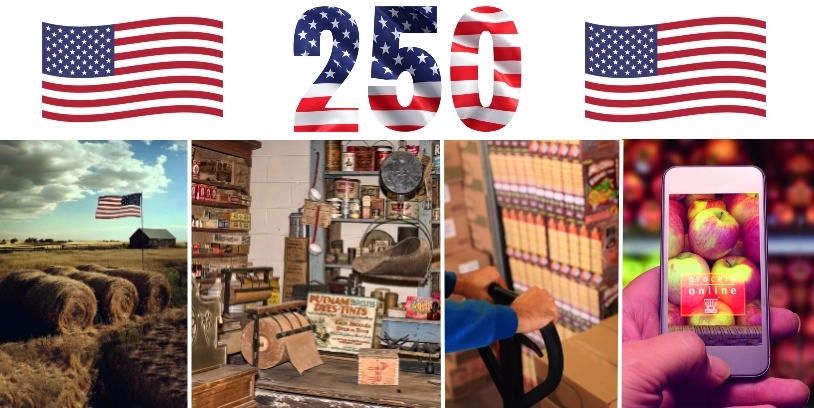
We trace the history of the grocery store in the United States back to July 4, 1776, the day the delegates from the 13 colonies signed the Declaration of Independence. At that moment, most of the inhabitants of the nascent nation obtained their food in the same way they had for generations: at bustling public markets, in general stores where the shopkeeper served customers from behind a counter, or directly from their own farms.
No one, on that hot summer day in Philadelphia, could have imagined that two and a half centuries later, their descendants would do their shopping in gigantic steel-and-glass warehouses, with more than 31,000 different products at their disposal, or with a single click from the comfort of their living room sofa.
The history of the American grocery store is, in many ways, the history of the nation itself: a saga of ingenuity, crises, wars, innovation, and, above all, an insatiable appetite, both literal and figurative, for reinventing itself.
The Early History of the American Grocery Store
(1776–1850)
In the early years of the new nation, food procurement was an intimate and labor-intensive affair. Markets were the social heart of every community: in Boston, the public market had existed since 1634; in Philadelphia, since 1682.
Travelers passing through those marketplaces described scenes teeming with life, with farmers, merchants, and intermediaries vying for space to sell meat, bread, flour, vegetables, and imported spices.
The general store was the quintessential commercial institution. Customers did not choose their own items: they gave the shopkeeper a verbal or written list, and he would gather the items from shelves and barrels located behind the counter.
Most transactions were made on credit, with payment deferred until the end of the harvest or the season.
The Birth of a Giant: A&P and the Chains
(1850–1916)
The country was expanding westward. Railroads began connecting distant territories and made it possible to transport food at unprecedented speeds.
The second half of the 19th century brought the Industrial Revolution and, with it, the mass expansion of the food trade. In 1859, the Great Atlantic and Pacific Tea Company, the famous A&P, was founded, beginning by selling imported tea and coffee at lower prices by eliminating intermediaries.
It was the first major grocery chain in American history. By 1929, it operated more than 15,000 stores, becoming one of the few companies in the world with annual revenue exceeding $1,000 million.
Around the same time, names emerged that still resonate today in every corner of the country: Kroger (founded in Cincinnati in 1883) and Safeway (which took its current form in 1926, when banker Charles Merrill of Merrill Lynch spearheaded the merger of several chains in the West).
However, all these stores were tiny, between 500 and 600 square feet, and continued to operate under the old model of a counter and a clerk.
Related Article: 2026 Top 100 Retailers: NRF Releases Ranking
The Shopping Cart Revolution: Piggly Wiggly and Self-Service
(1916)
On September 6, 1916, a salesman from Memphis named Clarence Saunders opened the doors to a store that would forever change the way the world buys groceries.
He christened it with the most unusual name in the history of retail: Piggly Wiggly.
When asked why he chose that name, Saunders would reply mischievously, “So that people would ask exactly that question.”
What was truly revolutionary wasn’t the name, but the concept: for the first time, customers could grab a basket and walk the aisles themselves, selecting their own products from open shelves.
There were no clerks to assist them; prices were marked on each item. Self-service wasn’t just more efficient; it was cheaper, and consumers embraced it enthusiastically.
By 1923, the chain had 1,268 stores nationwide, with annual sales of $100 million.
The Birth of the Supermarket Out of Desperation
(1930)
The Great Depression, which destroyed millions of jobs and fortunes in the wake of the 1929 crash, was, paradoxically, the catalyst for one of the most important innovations in modern retail.
In August 1930, an executive named Michael Cullen, rejected by his superiors at Kroger, who wouldn’t even read his proposal, opened the first supermarket as we know it today on his own: the King Kullen, in Queens, New York.
With 6,000 square feet of floor space, merchandise stacked on inexpensive metal shelves, and rock-bottom prices, the store generated more than $10,000 in its first week. Cullen unashamedly billed it as “the world’s largest food market.”
War, Rationing, and the Box of Macaroni
(1940–1945)
World War II put the food industry to the test like never before. Beginning in 1942, the federal government rationed sugar, coffee, meat, cheese, butter, and other staples.
Housewives learned to stretch every pound of meat and to cultivate “victory gardens” in their backyards.
Against this backdrop of scarcity, a culinary legend was born: Kraft sold 50 million boxes of its famous powdered macaroni and cheese during the war years, with two boxes purchasable with a single ration coupon. It was cheap, quick, and filled stomachs.
The Golden Age of the Supermarket and the Barcode Scanner
(1950–1980)
The postwar period brought prosperity, suburbanization, and automobiles. The modern supermarket flourished: large stores with parking lots, fluorescent lighting, and aisles that seemed endless.
In 1967, the first Trader Joe’s opened in Pasadena, California, offering private-label products at prices unusually low for a specialty store.
The great technological revolution came in the summer of 1974: the world’s first barcode scanner was installed at a Marsh supermarket in Troy, Ohio. The first item ever scanned in retail history was a pack of Wrigley’s gum.
From that moment on, inventory management and the checkout process were never the same again.
The Trillion-Dollar Industry and the Digital Future
(1990–Present)
The modern chapter in the history of the American grocery store is a trillion-dollar one. Today, the U.S. supermarket industry is one of the largest in the world. In 2025, consumers, businesses, and government entities spent $2.51 trillion on groceries.
According to The FMI – Food Industry Association, total supermarket sales in 2024 exceeded $1 trillion, with approximately 45,575 stores nationwide.
The average supermarket is 42,453 square feet and offers consumers nearly 31,795 different products. Walmart, with more than 4,700 stores, dominates the sector, with annual global revenue exceeding $ 572 billion.
The 21st century has brought with it a new revolution: the digital supermarket.
In 2024, U.S. consumers spent nearly $59,000 million on grocery purchases through Walmart’s online platform. 7.1% of all supermarket sales are now made online, and 35% of in-store transactions are completed at self-checkout lanes, a digital echo of Clarence Saunders’ old Piggly Wiggly.
That is the arc of the history of the American grocery store: in 250 years, the United States has gone from the grocer who jotted down his customers’ debts in a notebook to the algorithm that predicts what you’ll put in your shopping cart next week.
The family dinner table has changed, flavors have become globalized, and the supply chain spans every continent. But the original driving force remains the same as that which fueled those colonial markets of 1776: feeding a nation that never stops growing.