
Key Takeaways
- Every January 6, families enjoy the Rosca de Reyes, a tradition with deep historical roots from Roman and European customs.
- The Rosca de Reyes recipe includes a soft bread shaped like a ring, symbolizing the circle of God’s love and the gifts of the Wise Men.
- Whoever finds the hidden figurine inside the bread becomes the godparent and is responsible for treating others to tamales on Candlemas.
- Making the Rosca requires careful preparation and kneading to ensure it turns out soft and fluffy, avoiding common mistakes.
- Customize your Rosca with fillings like pastry cream or chocolate, and serve it traditionally with hot chocolate or atole.
Every January 6, many families gather to slice the Rosca de Reyes, hoping to find the baby figurine hidden inside. If you’re looking for an easy but delicious Rosca de Reyes recipe, you’ve come to the right place. Keep reading!
Below, you’ll find step-by-step instructions. We’ll also tell you where this tradition comes from, what each decoration represents, and why the person who finds the figurine has to treat everyone to tamales.
Best of all, you’ll make a soft, fragrant bread using ingredients that are easy to find at the supermarket. Ready to prepare a sweet bread your family will never forget?
Table of contents
The History of Rosca de Reyes
Although it’s closely associated with Mexico today, the tradition has very ancient roots. Its history combines Roman festivals, medieval European customs, and traditions that were later adapted in the Americas.
From the Roman Saturnalia to the Middle Ages
Pastry chef Christian Escribà, quoted by elDiario.es, traces its origins to Saturnalia, an ancient Roman festival dating back to the second century BC and dedicated to the god Saturn.
After the fall of the Roman Empire, the bread took on its characteristic round shape and became a traditional Epiphany dessert. It later spread throughout France and Spain.
According to Mexico’s Agrifood and Fisheries Information Service, this European tradition began in the 14th century. In France, its equivalent is known as galette des rois.
In Spain, the custom arrived with Philip V, the first Bourbon king. As Euronews explains, he celebrated Epiphany in Madrid in the traditional French style, complete with a roscón.
Its Arrival in Mexico
The tradition was introduced to Mexico by the Spanish during the colonial period. Over the centuries, it incorporated local ingredients and became an iconic part of January 6 celebrations.
Its popularity is enormous. In fact, in 2016, Mexico City’s Zócalo distributed a massive 1,440-meter-long Rosca de Reyes among 200,000 people, according to the EFE news agency.
Today, the tradition is also celebrated in the United States, where numerous bakeries sell Rosca de Reyes throughout January. Of course, making one at home is a special way to celebrate with family.
What Each Element of the Rosca Represents
Every part of the roscón has a special meaning. Once you understand these symbols, you’ll realize that eating this sweet bread is about more than enjoying a dessert. It’s also about remembering a story passed down from grandparents to grandchildren.
The Symbols Hidden in the Bread
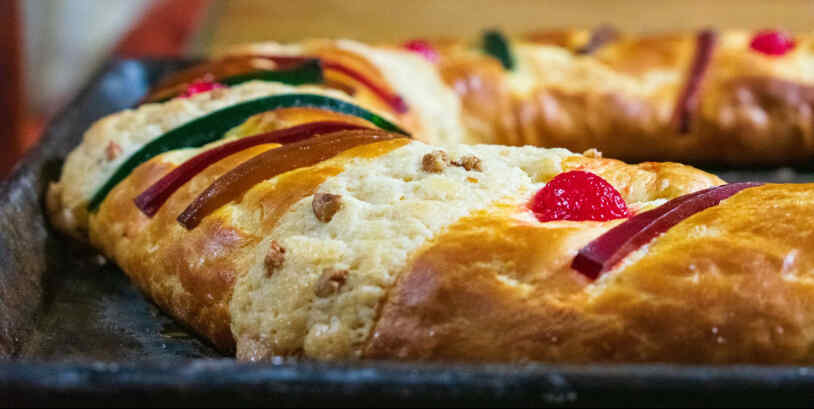
The Rosca de Reyes represents the Epiphany, the moment when the Three Wise Men find baby Jesus. According to a guide from the National Autonomous University of Mexico (UNAM), each element has its own meaning:
- Circular or oval shape: Represents the infinite circle of God’s love, which has neither beginning nor end.
- Candied fruit: Symbolizes the jewels in the crowns of the Three Wise Men.
- The hidden figurine: Represents baby Jesus and recalls how Joseph and Mary hid him from King Herod.
- The sugar crust: Adds decoration and a sweet, crunchy touch.
In the past, the bread was decorated with acitrón, a sweet made from the biznaga cactus. However, the National Autonomous University of Mexico has warned that the plant is endangered. For this reason, ate, a traditional Mexican fruit paste, is now used instead.
The Baby Jesus Figurine, Candlemas, and Tamales
In Mexico, whoever finds the baby Jesus figurine inside the bread becomes its godparent. This means they must look after the figurine until February 2, Candlemas Day, and take it to be blessed.
On that same day, the godparent treats everyone who shared the Rosca to tamales and atole. This brings the holiday season that begins with the December posadas celebrations to a close.
Candlemas commemorates the presentation of Jesus at the temple, 40 days after his birth. In some families, the godparent also dresses the figurine in new clothes.
However, traditions vary from one family to another. For example, in some households, the person who finds the baby only has to provide the tamales. In others, they must organize the entire Candlemas celebration.
Homemade Rosca de Reyes Recipe: Step by Step
Making a homemade roscón takes time, especially because the dough needs to rest and rise. Even so, the process is simple. Set aside about four hours and get everything organized before you begin.
Ingredients for One Large Rosca
This recipe makes one large ring-shaped bread that serves ten people. Use room-temperature ingredients because they help the dough rise more effectively. You’ll need:
- All-purpose flour: 4 cups (about 500 grams), plus a little extra for the work surface.
- Active dry yeast: 1 packet (1/4 ounce or 7 grams).
- Warm milk: 1/2 cup, between 105 and 110°F.
- Sugar: 1/2 cup for the dough.
- Eggs: 4 large eggs, plus 1 for the egg wash.
- Unsalted butter: 1/2 cup (1 stick), softened.
- Flavorings: Zest of 1 orange, 1 tablespoon orange blossom water, and 1/2 teaspoon salt.
- Sugar crust: 1/2 cup flour, 1/2 cup powdered sugar, and 1/2 cup vegetable shortening.
For decoration, get strips of quince or guava ate, figs in syrup, and red cherries. You’ll also need one or more oven-safe ceramic baby Jesus figurines.
If you live in the United States, you can usually find orange blossom water and the figurines at Latin grocery stores. You can also find more ideas for stocking your pantry at Abasto.
Prepare and Knead the Dough
First, dissolve the yeast in the warm milk along with one tablespoon of sugar. Wait about ten minutes until it becomes foamy. This indicates that the yeast is active.
Next, combine the flour, remaining sugar, and salt in a large bowl. Then add the eggs, orange zest, orange blossom water, and yeast mixture. Make sure everything is thoroughly combined.
Knead for about ten minutes, gradually adding the butter. The dough will be sticky at first, but don’t worry. With consistent kneading, it will become smooth and elastic.
Place the dough in a greased bowl, cover it, and let it rest in a warm place for approximately an hour and a half, or until it doubles in size. This step is essential for achieving a fluffy texture.
Shape, Decorate, and Bake
Now comes the fun part of the Rosca de Reyes recipe: shaping the bread. To do this, punch down the dough, roll it into a long cylinder, and join the ends to form an oval.
Next, place the ring on a greased baking sheet, cover it, and let it rest for another 45 minutes. Meanwhile, mix the flour, powdered sugar, and vegetable shortening to prepare the sugar crust.
Once the resting time is over, brush the dough with beaten egg. Decorate it by alternating strips of sugar crust, ate, figs, and cherries. Gently press each decoration into the dough so it stays in place during baking.
Finally, bake at 350°F (about 175°C) for 25 to 30 minutes, until golden brown. Once it’s out of the oven, and well before slicing it or hiding the figurines inside, let it cool on a wire rack.
Tips for Making Your Rosca Soft and Fluffy
Although the Rosca de Reyes recipe is simple, a few details make the difference between a hard loaf and a soft, fluffy one. Take note before turning on the oven!
Common Mistakes to Avoid
When preparing your first Rosca de Reyes recipe, it’s normal to make a few mistakes. The good news is that they’re all easy to fix if you recognize them in time. Let’s take a look:
- Milk that’s too hot: It damages the yeast. Use a kitchen thermometer to check the temperature.
- Too much flour: Makes the bread dry and heavy. Add only the amount needed.
- Not enough resting time: Without sufficient time to rise, the dough will become dense.
- An oven that hasn’t been preheated: Causes uneven baking.
- Overbaking: Remove the bread as soon as it turns golden brown to prevent it from drying out.
Another useful trick is the finger test. Gently press the rested dough with your finger. If the indentation slowly springs back, it’s ready to bake. If it springs back immediately, it needs more time.
Is your kitchen cold? Let the dough rise inside the turned-off oven with the light on. The reason is simple: the gentle warmth helps the yeast work properly.
Safety: Figurines and Raw Dough
If your figurines are made of plastic, don’t bake them inside the bread. Instead, use a knife to make a small opening and carefully insert them through the bottom of the cooled roscón.
Also, let your guests know that there are hidden figurines inside, especially if young children will be eating. This way, everyone can take smaller bites and avoid unexpected surprises or even choking hazards.
One last tip: don’t taste raw dough. The FDA explains that baking is what eliminates bacteria that may sometimes be present in flour and eggs, such as Salmonella.
Variations and Serving Suggestions
Once you’ve mastered the basic recipe, it’s easy to give your Rosca de Reyes your own personal touch. Many households experiment with different fillings and decorations without losing the spirit of the original tradition.
Filled Rosca and Other Versions
One popular option is to fill it with pastry cream, cream cheese, or whipped cream. Simply slice the cooled roscón horizontally and spread your chosen filling throughout the center.
There are also chocolate versions made with cocoa dough or covered in ganache. Some bakeries even offer vegan options made without animal-derived ingredients.
Prefer something lighter? In that case, reduce the amount of sugar in the crust or replace some of the butter with oil. Although the flavor will change slightly, the bread will still be wonderfully soft.
Hot Chocolate, Atole, and Storage
In Mexico, Rosca de Reyes is traditionally served with hot chocolate or atole. As Euronews explains, enjoying a slice this way with family is a common afternoon tradition in many parts of the country.
To keep it fresh, store it in an airtight container and eat it within two or three days. If it contains whipped cream or pastry cream, it’s essential to keep it covered in the refrigerator.
If it doesn’t have a filling, warm it in the oven at a low temperature for a few minutes. This helps restore its softness and its wonderful orange and orange blossom aroma. It’ll taste almost as if it just came out of the oven!