
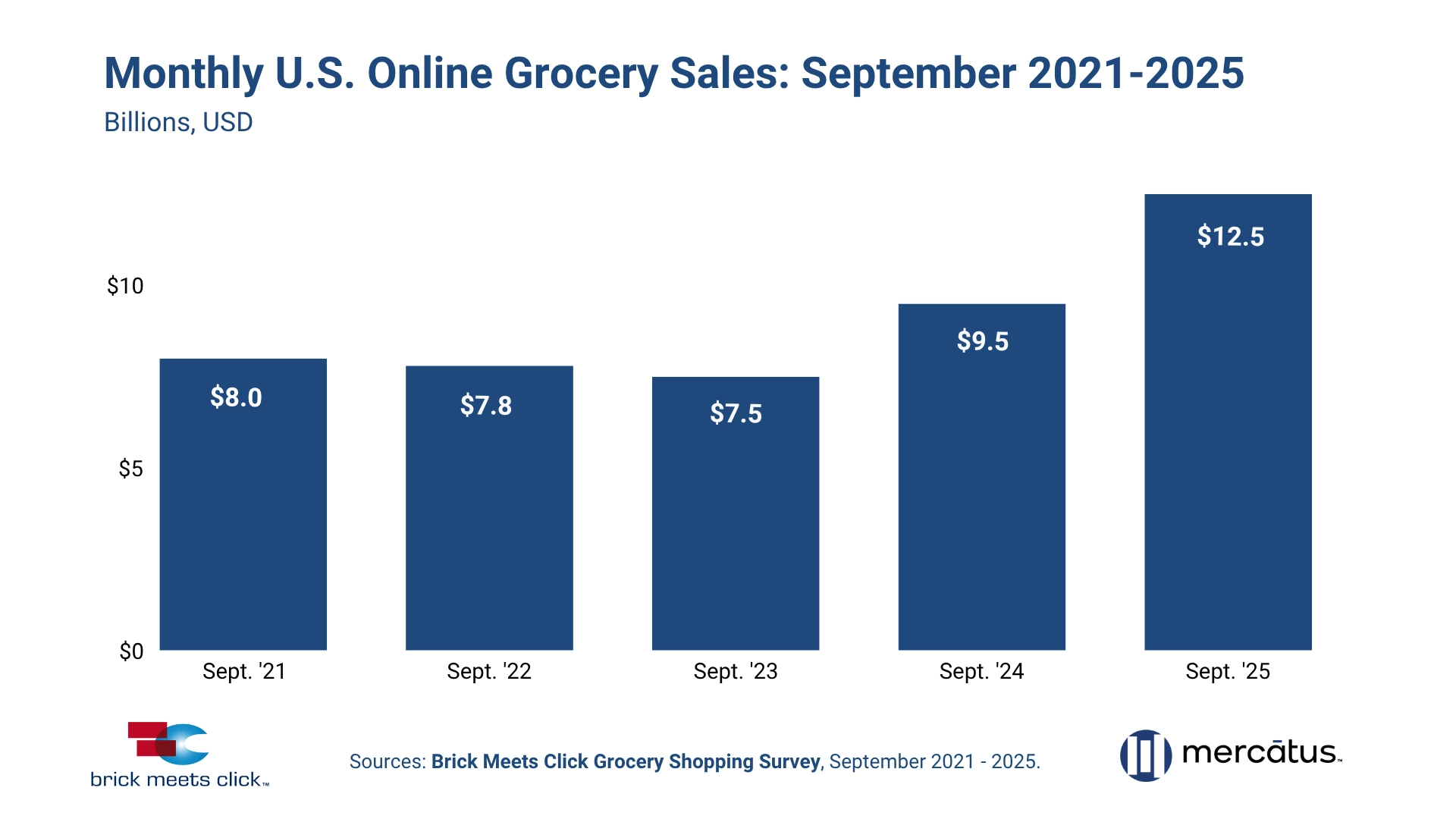
U.S. eGrocery sales growth surged to a new record in September 2025, reaching $12.5 billion — a 31% increase from the previous year — as more Americans embraced online grocery shopping at unprecedented levels, according to the latest Brick Meets Click Grocery Shopper Survey sponsored by Mercatus.
Record eGrocery Shoppers Drive Unprecedented Growth
A record number of monthly active users fueled September’s results. The overall base of eGrocery shoppers rose nearly 13% year over year, the strongest expansion since the pandemic’s early surge.
Most of that growth came from reactivated customers who hadn’t ordered in several months. Every order method — Delivery, Pickup, and Ship-to-Home — posted gains, with Delivery setting a new high.
Older shoppers also played a significant role in this expansion. Consumers aged 60 and older accounted for nearly half of all new monthly active users, highlighting the growing digital adoption among retirees and older households.
More Frequent Orders Sustain eGrocery Momentum
According to the survey, order frequency rose for the thirteenth consecutive month, climbing 9% compared to the same time last year.
More customers placed three or more online orders in September, reflecting deeper engagement and confidence in eGrocery services.
Small metro areas showed the sharpest increase in frequency — nearly twice that of larger markets — suggesting suburban and secondary cities are becoming key growth engines for U.S. eGrocery sales growth.
Average Order Value Jumps Across Retail Formats
The combined average order value for Delivery and Pickup increased by nearly 8% year over year. Supermarkets, mass retailers, and dollar stores all recorded stronger spending per order.
Hard discounters and warehouse clubs led the charge, reporting the most significant spending surges. Ship-to-Home services, driven mainly by Amazon’s same-day fresh grocery expansion, also saw its average order value jump almost 11%.
These results confirm that customers are buying more online — and they’re spending more per trip than ever before.
Related Article: Shoptalk 2025: Key Retail Trends for Hispanic Retailers
Online Grocery Spending Gains Bigger Share of Wallet
September’s digital spending accounted for nearly 19% of all grocery dollars, a jump of 400 basis points from last year and the second-highest level on record behind only May 2020.
This rapid acceleration underscores a continued shift away from brick-and-mortar shopping. In-store grocery sales from January through September 2025 grew less than 1.5% year over year — half the growth rate of 2024.
For regional grocers, Brick Meets Click said, the shift poses new competitive pressures as major players dominate digital channels.
Walmart and Target Deepen Their Digital Advantage
“The results reveal cross-shopping rates with Walmart continued to expand significantly in 2025, and the rate for Target also increased year over year, even though it remains significantly lower than Walmart,” said David Bishop, Partner at Brick Meets Click.
Bishop noted that the share of grocery shoppers who also completed at least one eGrocery order with mass retailers jumped sharply in September. The finding signals mounting challenges for regional grocers struggling to maintain digital market share.
As U.S. eGrocery sales growth accelerates, Walmart and Amazon continue to strengthen their dominance through price competitiveness, delivery speed, and broad product availability.
Competitive Landscape Intensifies
The eGrocery sector’s strong September performance marks a decisive turning point for the U.S. grocery industry. With older demographics now fully engaged online and small metro areas driving frequency gains, experts say retailers must expand digital convenience or risk losing relevance.
Mercatus and Brick Meets Click anticipate continued double-digit growth into the fourth quarter, driven by consumers preparing for holiday gatherings and increased home delivery orders due to winter weather.
Retailers that invest in digital fulfillment, data personalization, and frictionless shopping experiences are most likely to thrive as U.S. eGrocery sales growth reshapes the grocery economy heading into 2026.