
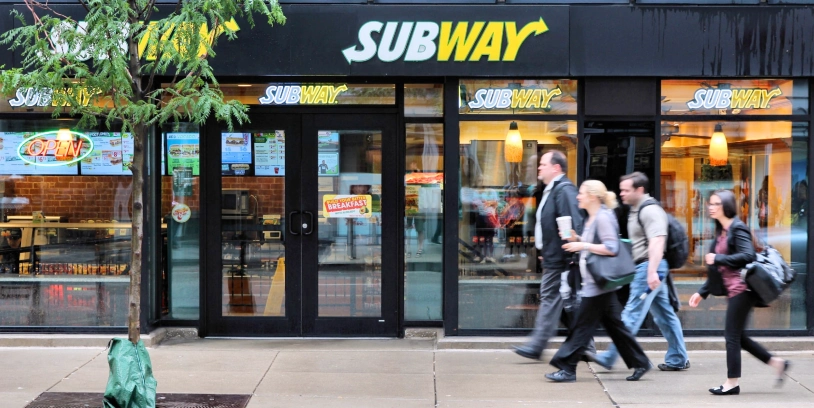
Subway closures rattled the fast-food industry in 2025. The sandwich giant shut a net 729 U.S. locations — its steepest single-year drop since 2021.
That staggering number marks the chain’s 10th consecutive year of domestic decline. The revelation comes from a franchise disclosure document released April 30.
Furthermore, the total U.S. store count has now fallen to roughly 18,773 locations. Just a few years ago, that figure sat above 22,000.
Several business-focused media outlets analyzed the impact of the massive closure of Subway locations in 2025.
A Decade of Subway Closures the Industry Can’t Ignore
The chain peaked at more than 27,000 U.S. restaurants in 2015. Since then, Subway has consistently shed hundreds of locations annually, according to QSR Magazine.
Between 2016 and 2025 alone, Subway closed a net 8,345 restaurants nationwide. Restaurant Dive notes that the figure alone would rank among the five largest chains in the United States.
Meanwhile, the company opened 499 new locations in 2025. Nevertheless, closures significantly outpaced new additions, resulting in a steep net loss.
Profits Rise Even as the Footprint Shrinks
Despite the dramatic contraction, Subway’s financials tell a surprising story. The company reported $688 million in net income in 2025, according to the franchise disclosure filing reviewed by FOX Business.
That figure represents a sharp jump from $397 million in the prior year and just $15 million in 2023. Consequently, profitability has surged even as the physical footprint contracts.
However, total franchise revenue moved in the opposite direction. It fell more than 6% to $767 million, signaling ongoing pressure on the franchise model itself.
Additionally, the filing identified roughly 792 locations temporarily closed as of Dec. 31, 2025. Subway expects many of those shuttered units to reopen in 2026.
The “Rightsizing” Strategy Driving Subway Closures
Subway executives frame the wave of closures as a deliberate, strategic move. The company calls it “rightsizing”, a calculated effort to place restaurants in optimal locations.
“In the U.S., Subway is focused on ensuring restaurants are in the right locations with the real estate, visibility, and operations that set franchisees up to succeed long-term,” a Subway spokesperson told QSR Magazine.
The company adds that the strategy appears to generate real results. Operational improvements are showing up across the system, with restaurant evaluation scores and Google review scores both reaching two-year highs, Subway said.
In essence, the chain favors fewer, stronger-performing stores over a bloated network of underperforming units.
Related Article: Retailers: New SNAP Stocking Rules Begin Fall 2026
Weak Unit Economics Fuel Franchise Strain
One persistent challenge continues to pressure Subway’s domestic operation: low average unit volume. Industry data from Circana estimates the average Subway location generates approximately $500,000 in annual sales.
That figure falls well below competitors. Jersey Mike’s, for instance, reported an average unit volume of roughly $1.4 million for traditional franchised restaurants, per its own franchise disclosure document, as noted by Restaurant Dive.
Jimmy John’s also outperforms Subway’s per-unit sales, posting an average unit volume of about $1 million. Both rival chains actively grew their store systems in 2025.
Those competitive gaps partly explain why Subway franchisees continue to exit. Oversaturated markets and thin unit economics historically drove the brand’s long decline, Restaurant Dive reported.
A Value Push to Win Back Customers
To counter declining same-store sales and intensifying competition, Subway launched a new value platform. The brand now offers 15 menu items priced under $5, shifting away from limited-time promotional deals.
The move directly targets value-focused rivals such as McDonald’s and KFC, which have aggressively promoted affordable meal options. Subway’s fresh-ingredient positioning gives it a potential differentiator in that pricing battle.
Moreover, Subway announced investments in lower-cost restaurant remodels. These renovations aim to modernize locations with a fresh look built on the brand’s “Fresh Forward” image work, according to QSR Magazine.
The company also highlights accelerating third-party delivery as a growth driver. Executives say its delivery business is expanding and generating new revenue for franchisees across the system.
International Growth Contrasts with Domestic Subway Closures
While U.S. locations shrink, Subway’s international business tells a starkly different story. The chain opened more than 1,000 locations worldwide in 2025, according to QSR Magazine.
Additionally, Subway signed six international master franchise agreements last year, spanning 10 countries. Those markets include Sweden, Finland, Denmark, Norway, Spain, Portugal, Qatar, Azerbaijan, the Dominican Republic, and South Korea.
Two more agreements followed in early 2026, covering Panama and Taiwan. The brand’s international pipeline now includes commitments for more than 12,000 future units backed by over 30 master franchise agreements.
That global momentum suggests the Subway model remains viable, just not in the same oversaturated domestic markets it once dominated.
Still America’s Largest Chain, For Now
Despite losing nearly 3,500 locations since 2021, Subway retains the top spot among U.S. restaurant chains by store count. Starbucks ranks second with 16,860 U.S. locations at the close of its fiscal 2025. McDonald’s follows with 13,706 restaurants, per QSR Magazine.
Yet that lead continues to erode. Subway’s franchise disclosure documents project only 100 new U.S. openings in 2026. Hundreds more closures remain likely.
The chain reported 93 signed franchise agreements that have not yet been converted into open restaurants. That modest pipeline reflects cautious domestic expansion as Subway prioritizes quality over quantity.
For now, Subway continues to navigate a pivotal transformation, one measured not by the number of locations it opens but by the strength of the ones it keeps.