Store brand sales continued to outpace national brands in 2026, lifting private label to a record unit share.
According to the Private Label Manufacturers Association (PLMA), store brand units rose 0.1% through Nov. 1. National brands, by contrast, dropped 0.9% over the same 10 months.
That one-point gap matters. As a result, retailer-owned products now account for 23.7% of all units sold, a figure PLMA calls a new record.
The data comes from Circana, PLMA’s market research provider. Moreover, it arrives just as the industry gathers near Chicago for its biggest annual event.
Unit Gains Drive Store Brand Sales Momentum
Volume tells the clearest story. Store brands beat national brands in unit sales during 10 of 11 reporting periods this year.
As a result, private label has steadily chipped away at its rivals’ share.
Dollars, however, paint a more mixed picture. Store brand revenue rose 0.3% year to date, and dollar share sits at 21%.
National brands, meanwhile, lost units but grew dollar sales 1.9%. PLMA attributes that gain largely to aggressive pricing strategies.
In other words, shoppers bought fewer name-brand items but paid more for each one.
| BY THE NUMBERS: | 2026 YTD through Nov. 1 |
|---|---|
| Store brand unit sales: | +0.1% |
| National brand unit sales | -0.9% |
| Store brand unit share: | 23.7% (PLMA record) |
| Store brand dollar sales: | +0.3% |
| National brand dollar sales: | +1.9% |
| Store brand dollar share: | 21% |
Pet Care and Beverages Lead the Aisles
Looking closer, Circana tracks 11 product departments for PLMA. For the 52 weeks ending Nov. 1, five posted store brand unit gains.
Pet Care led the way, up 2.8%. Beverages followed at 2.3%, while Refrigerated added 1.9%.
General Food and Frozen each edged up 0.3%.
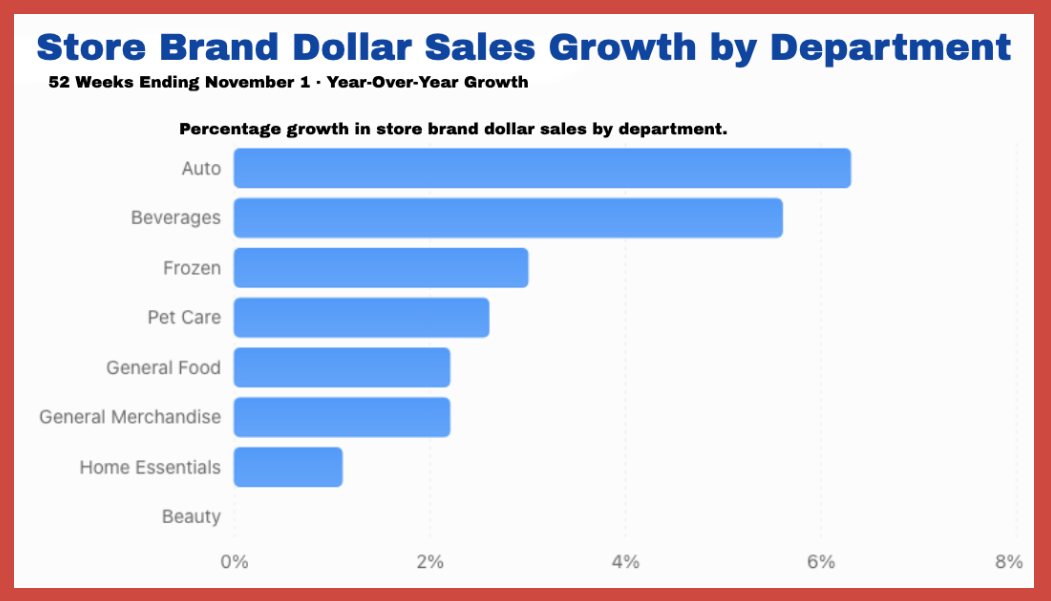
On the revenue side, seven departments grew. Auto led with a 6.3% jump, followed by Beverages at 5.6%.
Frozen climbed 3%, and Pet Care gained 2.6%. General Food and General Merchandise each rose 2.2%.
Home Essentials added 1.1%, while Beauty held steady.
Notably, Pet Care and Beverages appear on both winners’ lists. That pattern echoes 2025, when Pet Care also ranked as the top unit performer.
Related Article: How Independent Grocers Win Private Label
Shoppers Pocket $20.5 Billion in Savings
Savings remain a key engine behind store brand sales. By midyear, U.S. shoppers had saved $20.5 billion by choosing store brands over national labels.
That estimate comes from a PLMA analysis of Circana data.
In the first half of 2026, the average store brand item sold for $4.14. By comparison, the average national brand item cost $4.79.
That 65-cent difference works out to about 14% per unit.
For budget-conscious households, those cents add up fast. PLMA also says shoppers are finding strong quality and performance alongside the lower prices.
“We bring virtually every food and non-food category together under one roof. For buyers, it’s one-stop sourcing.”
– Dan Weil, PLMA
A Sold-Out Show Floor
Meanwhile, the momentum is showing up on the trade show floor. PLMA’s 2026 Private Label Trade Show runs Nov. 15-17 in Rosemont, Illinois.
Held at the Donald E. Stephens Convention Center, this year’s event carries the theme “Store Brands Marketplace.”
It features some 3,061 booths, the most in the show’s history. It also brings together 1,927 exhibitors, 55 national pavilions, and 61 countries.
“As of today, every booth is sold,” said Dan Weil, PLMA’s senior director for the Chicago trade show.
“Our theme describes exactly what happens at the PLMA Show,” Weil added. “We bring virtually every food and non-food category together under one roof.”
Target and Ahold Delhaize USA Take the Stage
Two executives behind highly regarded own-brand programs will deliver separate keynote addresses.
John Conlin is senior vice president of merchandising, food and beverage at Target. Abby Cook serves as senior vice president of own brands for Ahold Delhaize USA.
Their presence underscores how central private label has become to retail strategy.
Volume Wins as the Price Battle Continues
Taken together, the numbers point to a steady shift rather than a sudden one. Store brand sales keep winning on volume, while national brands lean on price to protect revenue.
That split gives retailers an opening. Strong own-brand programs can capture shoppers who are counting every cent.
The trend also builds on a strong base. Last year, U.S. store brand sales reached a record $282.8 billion across all outlets, PLMA reported in January.
With 2026 running ahead on units, private label enters the final stretch of the year in a solid position.