
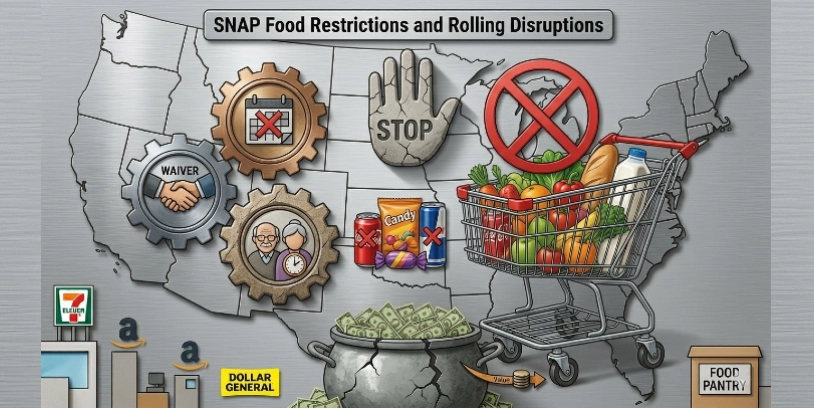
SNAP food restrictions sweeping across 19 states could wipe out up to $830 million in soda, candy, and energy drink sales by year’s end, according to new Numerator research.
The consumer data firm released its “SNAP in Transition” report, combining verified purchase data with a survey of over 1,000 SNAP households. Together, they paint a sharp picture of a program under significant structural pressure.
Three Disruptions Hit SNAP at Once
The program recently absorbed three simultaneous shocks. First, a government benefit blackout hit in November 2025. Second, states began rolling out Food Restriction Waivers. Third, the One Big Beautiful Bill Act (OBBBA) tightened participant eligibility nationwide.
The 43-day government shutdown — the longest in U.S. history — triggered immediate behavioral changes. Weekly grocery spending among SNAP households fell 10%, dropping from $233 to $210 between early and late October.
Consumers cut deferrable categories first. Hardware purchases dropped 18%, fast food restaurant desserts fell 10%, and beverages declined 6% during the four-week period ending Nov. 9, 2025.
Retailers felt the traffic pain acutely. 7-Eleven lost 18% of SNAP shopper visits, Amazon dropped 17%, and Shell, Circle K, and Wawa each recorded double-digit declines.
SNAP Food Restrictions Reshape Eligible Purchases
Food Restriction Waivers now represent the program’s most structural long-term change. By the end of 2026, 19 states will carry active waivers, covering roughly one-third of all SNAP participants, approximately 7.5 million households.
The restrictions target soda, candy, and energy drinks. Critically, these categories already see higher engagement in waiver states. In active FRW states, soft drinks were present in 23% of SNAP trips, compared with 18% in non-waiver states.
Candy showed similar patterns, 21% trip inclusion in FRW states versus 17% elsewhere. Energy drinks registered at 10% versus 8%. These numbers signal the restrictions arrive exactly where SNAP dollars flow most freely.
Consumers Plan to Adapt, But Sales Will Still Suffer
Shopper awareness is high. A notable 86% of SNAP households in FRW states say they already know restrictions are coming. Many plan to adjust their spending rather than go without.
For soda, 63% of SNAP consumers say they would spend non-SNAP dollars to keep buying — either at the same level or trading down to cheaper alternatives. Candy drew 60% saying the same. Energy drinks trailed at 45%.
Still, losses will accumulate. Numerator projects soda could absorb up to $430 million in sales declines. Candy faces up to $300 million in risk. Energy drinks round out the exposure at $100 million.
Substitution patterns lean healthier. Over 30% of SNAP consumers said they would swap soda and energy drinks for tea, juice, or coffee. For candy, fruit, ice cream, and fruit snacks, each drew 30% or more as likely replacements.
Related Article: New SNAP Stocking Rules Begin Fall 2026
Gas Stations and C-Stores Face the Sharpest Exposure
Not all retailers carry equal risk. Gas station and convenience store banners top Numerator’s vulnerability rankings for soft drink sales.
Casey’s General Store and Dollar General lead the exposure chart, with more than 25% of their SNAP trips including soda, well above the 21% benchmark. Meanwhile, Aldi and Costco sit comfortably below that threshold.
The rollout timeline compounds the urgency. Only 8% of SNAP shoppers lived in waiver states in Q1 2026. By Q2, that share jumps to 25%, then plateaus near 33% through year-end.
OBBBA Adds Pressure on Older SNAP Households
The OBBBA introduced work requirements for able-bodied adults aged 55 to 64 who had no dependents. Those adults must now prove 20 hours of work, volunteering, or education per week. The policy is already showing financial consequences.
Among 55-to-64-year-old SNAP households, 54% report reduced benefits since November 2025. Of those, 29% describe the reduction as extreme. Another 26% call it minor to moderate.
Spending behavior among this group already shifted. In December 2025, Sam’s Club, Dollar Tree, and Aldi saw measurable gains from this age segment. Amazon and Walmart.com recorded the opposite: a pronounced pullback.
Looking ahead, 48% of affected households expect further benefit reductions. Their planned responses: shop sales and discounts (54%), switch to private label and cheaper brands (37%), visit food pantries (36%), and shift more spending to dollar and discount stores (30%).
What Retailers and Brands Should Do Now
Numerator closes the report with a strategic framework: Discern, De-average, and Defend.
Brands should carefully profile SNAP shoppers and distinguish between pullbacks stemming from lost benefits and those from restricted eligibility. They should also resist uniform national strategies, since category and geographic pressures vary widely.
Most importantly, they must lean into value. SNAP shoppers are actively seeking utility, durability, and cost efficiency, and retailers that deliver those signals clearly will hold their share in a tightening environment.