
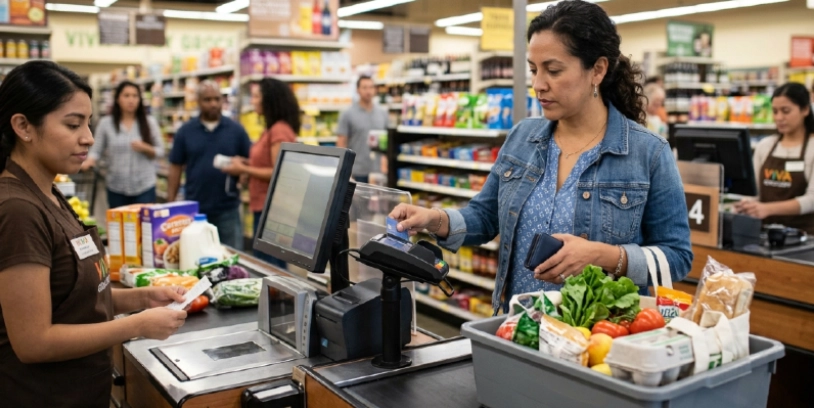
September grocery sales bounced back after a difficult August, as meat, seafood, and frozen foods posted strong results across U.S. retail. However, flat unit volumes show that shoppers still watch every dollar at the checkout.
“September was a bit of a comeback month for grocery retail following a tough August,” said Anne-Marie Roerink, principal at 210 Analytics. Her monthly report draws on Circana’s Integrated Fresh and MULO+ data for the four weeks ending Sept. 27.
According to the report, total food and beverage dollar sales climbed 2.1% from a year ago. Units, meanwhile, rose just 0.1%. In other words, inflation drove most of the dollar growth, while actual purchase volumes held steady.
Labor Day Gives September Grocery Sales a Lift
The holiday week delivered the month’s best performance, with unit sales up 1.0%. Mild Labor Day weather also helped grilling items. Hot dogs, for example, grew dollar sales 4.7% and pounds 0.3%.
By contrast, the third week of September saw units fall 1.4%. Produce weighed heavily on the totals. Excluding that department, unit declines run about half as steep, Roerink noted.
Beef Leads the Meat Department’s Comeback
Meat delivered one of the month’s clearest wins. Department sales reached $8.65 billion, up 1.5% from September 2025. Volume grew 1.0% to 1.75 billion pounds.
Fresh meat generated $6.26 billion, up 2.5%. Beef led the way, posting dollar and pound gains in all four weeks. Chicken told a different story. Flat pound sales, combined with deflation, pushed fresh chicken dollars down 1.2%.
Federal price data mirrors that split. The Consumer Price Index for beef and veal stood 3.5% above year-ago levels, the U.S. Bureau of Labor Statistics (BLS) reported Oct. 14. Chicken prices, by contrast, slipped 0.6% over the year. On a monthly basis, beef prices eased 1.0% from August.
Processed meat proved more subdued, slipping 1.1% to $2.40 billion. Still, dinner sausage stood out as a notable exception.
Related Article: Retail in Latin America: Optimism grows, prices climb
Seafood and Frozen Foods Ride Strong Momentum
Seafood turned in an all-around strong month. Shelf-stable seafood, sold in cans and pouches, grew fastest. Sales jumped 14.8% to $305 million, and pounds rose 2.3%. Sardines continue to bring new shoppers to the aisle, benefiting canned tuna and salmon as well.
Frozen seafood climbed 9.4% to $642 million. Moreover, all top five frozen species (shrimp, salmon, pollock, tilapia and crab) gained in dollars and pounds. Fresh and refrigerated seafood, the largest segment, rose 5.8% to $666 million, led by shellfish.
Pricing explains part of that growth. The BLS fish and seafood index rose 6.9% over the past year, including 8.9% for shelf-stable products and 8.5% for frozen items. Still, pound sales continued to grow, and Circana credits both inflation and demand for the gains.
Similarly, the frozen food department generated $6.9 billion, up 3.0% in dollars and 1.0% in units. Fruits and vegetables, processed meat and poultry, and desserts and baked goods all contributed to unit growth.
Produce Struggles as Salads Slowly Recover
On the other hand, produce remained the weakest link. Department sales fell 1.8% to $7.2 billion, and pounds dipped 0.5%. Circana data shows lower average prices per pound for both fruit and vegetables. Even so, melons, kiwis and sweet potatoes delivered double-digit pound gains.
The government’s figures paint a different picture. The CPI for fruits and vegetables rose 3.7% from a year earlier. The two measures differ, however. Circana tracks the average price per pound of what shoppers actually buy, while the CPI follows a fixed basket of goods.
Salads and leafy greens continued to feel the fallout from a summer cyclospora outbreak linked to lettuce, according to an Oct. 1 report in The Packer. Category sales totaled $761 million in September, down 16.0%. Encouragingly, weekly results improved steadily, and the gap narrowed to 14.1% by month’s end.
Bakery, Deli and the Cautious Shopper
Bakery sales slipped 0.9% to $3.7 billion, a smaller decline than in August. Cakes, cookies, breads and croissants grew units on the fresh perimeter. Tortillas also continued their strong run.
In the deli, momentum cooled somewhat. Deli cheese grew units 2.2%, but deli meat and prepared foods lost ground.
Grocery Inflation Cools as Fuel Costs Climb
Overall, food-at-home prices dipped 0.1% in September and rose 1.8% over the year, according to the BLS. Restaurant prices, meanwhile, climbed 3.5% annually.
Circana’s figures point in a similar direction. Average retail prices across food and beverages rose 2.2%. Center-store items averaged $4.17 per unit, up 3.5%, while perishables rose a modest 0.8% to $4.40.
Yet other household costs keep squeezing budgets. Gasoline prices jumped 34.2% over the past 12 months, and overall consumer prices rose 3.7%, BLS data shows.
What September Grocery Sales Mean for Retailers
Ultimately, shoppers keep making trips but buy less per visit. Households averaged 16.8 trips in September, essentially flat. Yet items per trip fell 1.9% to 8.7.
Shoppers also continue shifting dollars toward everyday-low-price formats. Meanwhile, supermarkets captured 37.2% of food and beverage spending in September, down from 42.5% in 2022.
For grocers, the September data points in two directions. Protein, frozen, and seafood categories are gaining momentum, while flat units and rising fuel costs signal that value still matters to shoppers.