
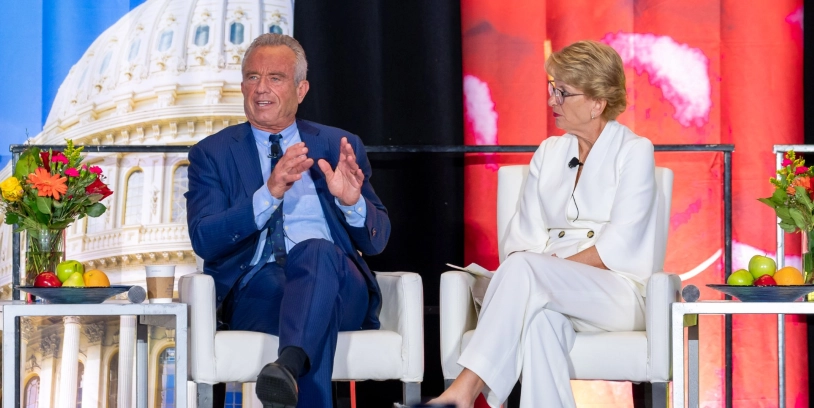
The fresh produce industry got a rare and powerful endorsement from the highest levels of the federal government this week. U.S. Secretary of Health and Human Services Robert F. Kennedy Jr. addressed growers, distributors, retailers, and policy advocates at the IFPA annual Washington Conference, held June 9–11 at the Grand Hyatt Washington.
The U.S. Secretary of Health and Human Services didn’t just show up; he came with a plan.
Kennedy Pledges $99B Federal Food Realignment
The secretary told attendees the USDA spends roughly $99 billion annually subsidizing food across federal programs, including the VA, military branches, and federal prisons.
“In the next six months, we will align these programs with the dietary guidelines. We’re going to drive a change in dietary culture,” Kennedy said.
That realignment includes SNAP, WIC, school lunch programs, Indian Health Service, and Head Start. The policy overhaul would mandate that public funding for those programs fully align with the newly released 2025–2030 Dietary Guidelines for Americans, guidelines that reaffirm fruits and vegetables as the foundation of a healthy diet.
The math behind Kennedy’s pledge is significant. The USDA alone spends about $405 million every day on food subsidies, making a dietary pivot at that scale one of the most consequential shifts in U.S. food policy in decades.
A Signal the Industry Has Long Waited For
IFPA CEO Cathy Burns framed the moment as a turning point, not just for the conference, but for an industry that has spent decades advocating for produce’s role in public health.
“This is a defining moment for our industry,” Burns said. “Having Secretaries Kennedy and Rollins and other administration and congressional leaders speak directly to fresh produce leaders sends an unmistakable signal: fruits and vegetables are not just part of the solution, they are at the heart of it.”
Burns acknowledged the full supply chain in her remarks. She pointed to growers, distributors, and processors as the backbone of a healthier food system. “We are proud to stand at the center of these important conversations,” she added.
Related Article: IFPA’s 2026 Fresh Produce Policy Agenda Sets Bold Industry Priorities
Simplifying Nutrition Guidance for Consumers
Beyond the federal program overhaul, Kennedy outlined plans to make nutrition guidance more accessible to everyday shoppers. He described a labeling initiative designed to help consumers quickly identify healthier choices without having to read entire ingredient lists. Under this system, fruits and vegetables would receive the highest rating.
Kennedy called the existing dietary guidelines document, 453 pages long, incomprehensible, noting that no ordinary consumer would ever read it. His administration aims to streamline that guidance into something actionable at the point of purchase.
The goal aligns directly with where the fresh produce industry already stands.
IFPA’s “All Day, Every Day” Campaign Takes Center Stage
The timing of Kennedy’s address was no coincidence. This year’s Washington Conference launched alongside IFPA’s new consumer campaign, Fruits & Vegetables: All Day, Every Day, a direct response to 2025–2030 Dietary Guidelines and a push to normalize produce consumption at every meal.
Only 1 in 10 Americans currently meets the CDC-recommended daily produce consumption levels. This is a sobering statistic that gives the campaign both urgency and purpose.
To drive that message beyond the conference halls, IFPA members took produce deliveries directly to Capitol Hill during their congressional visits. The move paired advocacy with action, reinforcing the campaign’s central argument: a healthier nation starts on the plate.
Industry Advocacy in Full Force
The Washington Conference has long served as the fresh produce industry’s most direct line to policymakers. The annual gathering brings together all segments of the industry, from growers and shippers to retailers, foodservice operators, and allied businesses, to engage with legislators on nutrition, food safety, and sustainability.
This year’s event carried added weight, with the Make America Healthy Again initiative gaining momentum within the administration. Now, the fresh produce sector finds itself positioned as a central player in the national health conversation.
IFPA’s 2025 policy agenda covers labor reform, food safety, access to nutrition, trade, and the Farm Bill. This broad platform reflects both the complexity of the supply chain and the scope of the industry’s ambitions.