
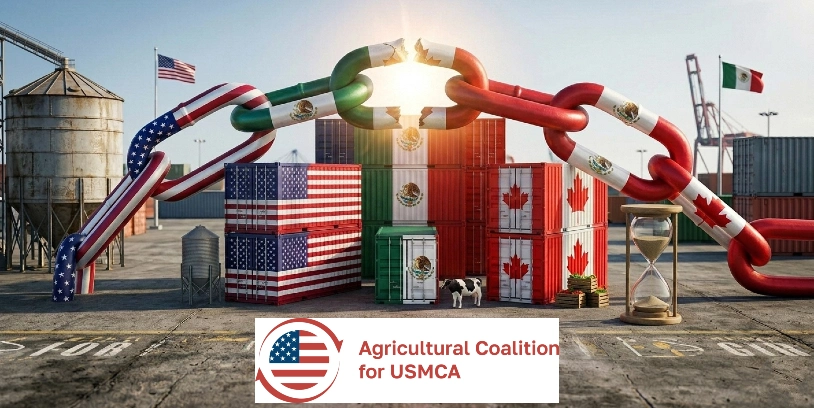
A powerful coalition is sounding the alarm. Nearly 160 food and agricultural organizations from the United States, Canada, and Mexico sent a joint letter demanding that their governments act swiftly on the USMCA renewal for food and agriculture before a critical July 1, 2026, deadline that reshapes the continent’s trading landscape.
The letter landed on the desks of three of North America’s most consequential trade officials. Ambassador Jamieson Greer at the Office of the United States Trade Representative, Canada-U.S. Trade Representative Dominic LeBlanc, and Mexico’s Secretary of the Economy Marcelo Ebrard each received a copy.
The U.S.-Mexico-Canada Agreement requires all three nations to convene a joint review by July 1, 2026. They must then choose: extend the pact for 16 years, terminate it entirely, or enter a cycle of annual consultations.
The stakes dwarf routine trade disputes. The USMCA governs a trading bloc of more than 500 million people, a $30 trillion GDP, and $1.7 trillion in annual trade volume, making it one of the largest in the world.
FOCUS POINT
| $285B Trilateral agrifood trade (2023) | 160 Signatory organizations | July 1 Review deadline, 2026 |
A $285 Billion Reason to Renew USMCA
The numbers tell an extraordinary story of integration. Since 2005, trilateral agrifood trade has tripled, reaching $285 billion in 2023 alone. Farmers, ranchers, and processors on all three sides of the agreement fueled that surge.
Yet that growth rests on a specific foundation. Removal of most tariff and quota barriers, paired with deep regulatory cooperation, built an agricultural supply chain that no single nation could replicate independently.
“USMCA strengthens the resilience of our integrated agricultural markets and over the past twenty years has made North America the most food-secure region in the world.”
— Joint Industry Letter, June 1, 2026
The Agricultural Coalition for USMCA, launched by the National Corn Growers Association, spearheaded coordination of the letter. Its signatories span every link of the food chain, from seed companies and grain handlers to seafood harvesters and retail grocers.
What Happens If USMCA Renewal Stalls?
The letter pulls no punches about the consequences of inaction. North America’s farmers and food businesses currently face a perfect storm of pressures: high input costs, low commodity prices, natural disasters, and geopolitical disruptions.
Letting USMCA lapse, or drift into a limbo of annual reviews, would inject fresh uncertainty into an already fragile environment. Businesses that need multi-year planning horizons cannot operate effectively without stable, predictable trade rules.
“Without this trade agreement, North America is more vulnerable to countries that employ trade-restrictive policies that negatively impact the movement of food from areas of surplus to deficit.”
— Joint Industry Letter, June 1, 2026
The coalition argues that USMCA does more than move goods across borders. Its sanitary and phytosanitary (SPS) provisions enforce science-based standards for agricultural commodities. Its technical barriers to trade (TBT) provisions knock down regulatory obstacles that inflate costs for producers and consumers alike.
Related Article: House Passes 2026 Farm Bill, Senate Battle Looms
National Security Hangs in the Balance
The letter frames food security as a matter of national security, not merely economics. Integrated North American supply chains reduce dependence on distant suppliers and foreign adversaries.
Preserving the full trilateral structure matters enormously here. Bilateral workarounds cannot replicate the network effects that USMCA generates across all three economies simultaneously.
“All three nations share the responsibility of protecting and strengthening this competitive advantage, which is essential not only to economic prosperity, but also to national security and regional stability.”
— Joint Industry Letter, June 1, 2026
Advocates stress that North America maintains a global competitive edge precisely because of these integrated standards. Countries employing trade-restrictive policies exploit any gap in that coordination. A weakened USMCA hands them that opening.
Industry Calls for Urgent Action Ahead of July Deadline
With fewer than 30 days until the mandated review date, the coalition urges its member governments to publicly commit to a full renewal. Uncertainty itself damages markets, deals stall, investments freeze, and supply chains fracture in anticipation of policy shifts.
The letter also addresses price sensitivity directly. Food costs remain elevated across the continent, and any trade disruption compounds the pressure on consumers already stretched thin.
“USMCA creates an environment that can mitigate trade challenges instead of spurring escalation. Price increases are difficult in any time period, but especially now.”
— Joint Industry Letter, June 1, 2026
The coalition stands ready to provide technical expertise throughout the negotiation process. Its members represent decades of cross-border trade experience and possess granular knowledge of where the agreement succeeds and where it could be strengthened further.
The joint letter bears the signatures of nearly 160 organizations across the United States, Canada, and Mexico, including the American Farm Bureau Federation, the National Corn Growers Association, the Canadian Cattle Association, the Consejo Nacional Agropecuario, and dozens of regional producer groups. The full letter was addressed to Ambassador Jamieson Greer (USTR), Minister Dominic LeBlanc (Canada), and Secretary Marcelo Ebrard (Mexico).