
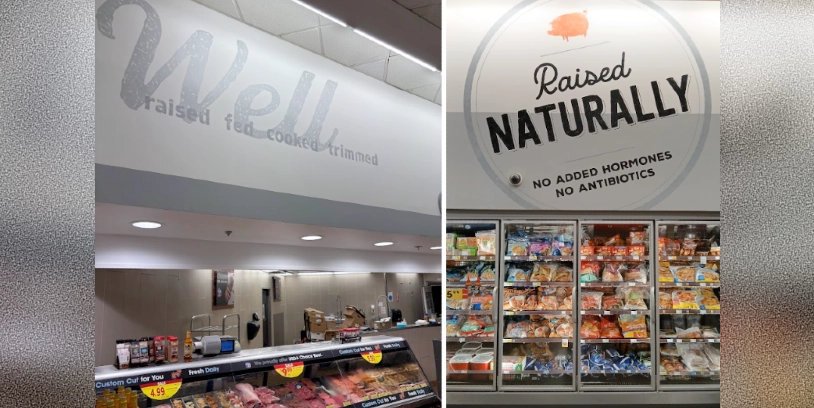
The Kroger Sued for False Advertising case is raising fresh concerns about transparency in supermarket meat departments, as Animal Outlook accuses the retail giant of misleading in-store marketing practices.
Filed in Los Angeles County Superior Court, the lawsuit targets The Kroger Company and its subsidiary Ralphs Grocery Company. The complaint alleges that signage in Ralphs stores promotes meat products as “well-raised” and “no antibiotics,” despite evidence suggesting those claims do not reflect actual sourcing.
The case invokes California’s Unfair Competition Law and False Advertising Law, placing Kroger’s labeling practices under legal scrutiny.
Kroger Sued for False Advertising over in-store messaging
At the center of the lawsuit against Kroger for false advertising are the large, prominent signs displayed at Ralphs stores in Southern California. Investigators documented phrases such as “well-raised” above meat counters and “no antibiotics” over refrigerated and frozen sections.
However, Animal Outlook argues that the products beneath those signs include conventional meat from major processors like Smithfield, Hormel, and Tyson, companies widely associated with industrial-scale farming.
The organization claims that Kroger leverages consumer interest in animal welfare and food safety without ensuring that products meet those expectations.
Ben Williamson, executive director of Animal Outlook, described the practice as “humane-washing,” accusing the retailer of using reassuring language to influence purchasing decisions.
Related Article: Grocery Outlet Faces Federal Securities Lawsuit
Investigators Cite Mismatches Between Claims and Products
The complaint details multiple store visits where labeling appeared inconsistent with product attributes.
At one location, a refrigerated case labeled “no antibiotics” contained pork products from several national brands. According to third-party reports cited in the lawsuit, those items likely do not meet antibiotic-free standards.
Similarly, investigators found frozen poultry products, including chicken and turkey, under the same claim. The lawsuit states that industry practices and company policies indicate antibiotics may still be used in production.
Meanwhile, “well-raised” signage appeared above fresh meat selections, including Kroger’s conventional private-label products. Animal Outlook alleges that those items fail to meet even the company’s own animal-welfare benchmarks.
Private Label Gaps Raise Additional Concerns
The Kroger Sued for False Advertising case also highlights differences within Kroger’s private-label portfolio.
The company outlines specific animal welfare standards for its premium Simple Truth brand, including space requirements, access to litter, proper lighting, and humane slaughter methods.
However, the lawsuit claims those standards apply only to that premium line. Other private-label products, often displayed under the same “well raised” signage, may come from suppliers that do not meet those criteria.
For beef, the complaint notes that Kroger does not provide defined animal welfare standards, further complicating the accuracy of in-store messaging.
Lawsuit Seeks Corrective Action and Policy Changes
Through the Kroger Sued for False Advertising lawsuit, Animal Outlook is asking the court to require immediate changes to Kroger’s practices.
The organization seeks injunctive relief requiring the retailer to either align its products with its advertised claims or remove the signage entirely. In addition, the lawsuit calls for corrective advertising to inform consumers that products in those sections may not meet antibiotic-free or animal welfare expectations.
The complaint also requests attorneys’ fees and legal costs.
Bryan W. Pease, attorney for Animal Outlook, stated that retailers must ensure their marketing accurately reflects the products they sell.
Broader Implications for the Supermarket Industry
The Kroger Sued for False Advertising case underscores growing risks for supermarket operators as consumers demand greater transparency around food sourcing.
Retailers have expanded premium and private-label offerings to capture demand for ethically produced food. However, inconsistent standards and unclear messaging can expose companies to legal challenges.
California continues to lead enforcement in this area, supported by strong consumer protection laws and voter-backed animal welfare measures.
As the lawsuit moves forward, grocers nationwide may need to reassess in-store signage, supplier standards, and labeling practices to maintain consumer trust and avoid similar disputes.
Photos provided by Animal Outlook.