
H-E-B again claimed the top spot in the dunnhumby grocery rankings, as U.S. consumers sharpened their focus on saving money amid rising essential costs.
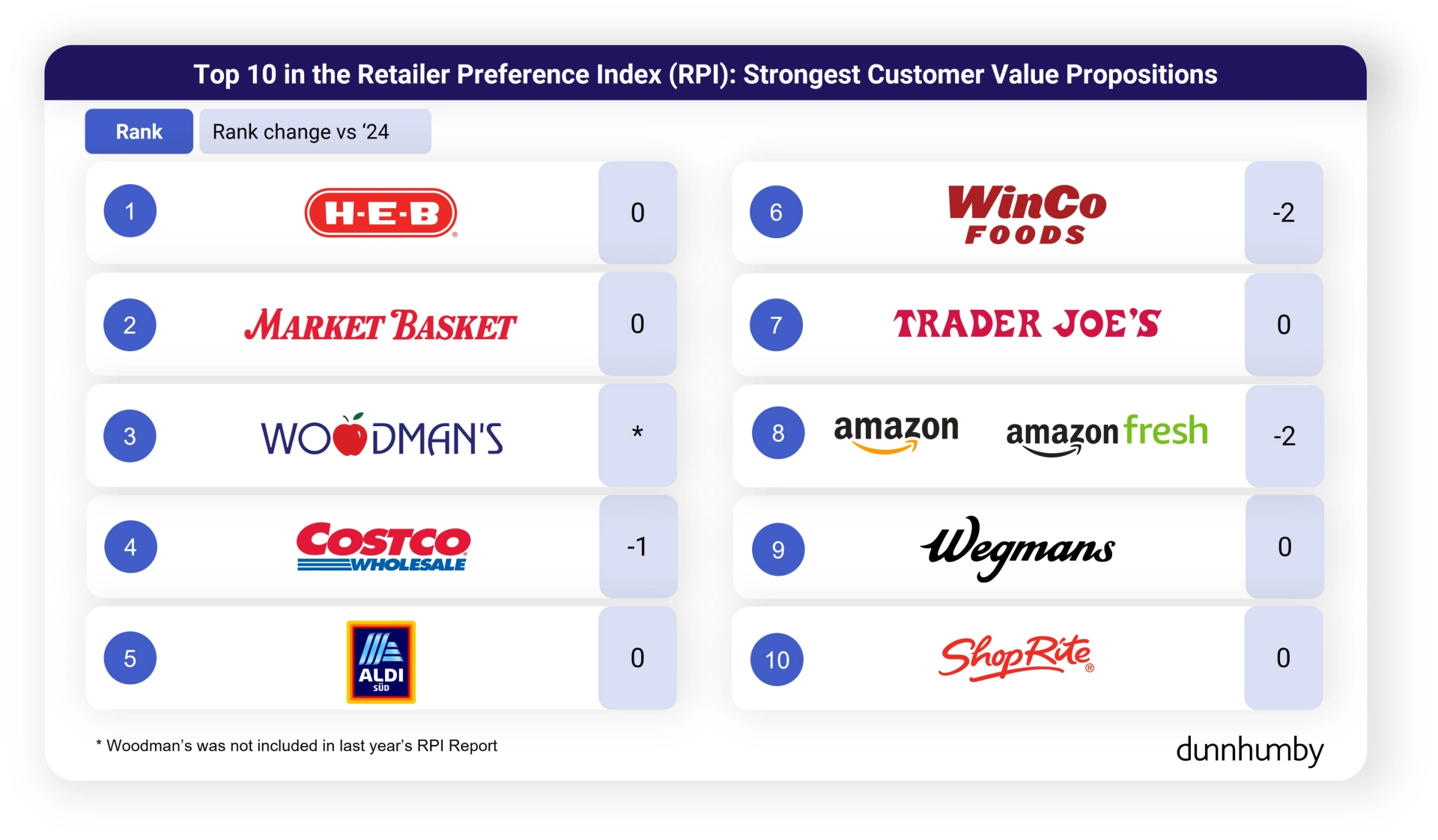
The Texas-based grocer ranked No. 1 in dunnhumby’s ninth annual Retailer Preference Index for U.S. Grocery, marking its fifth win in nine years. Market Basket placed second, while Wisconsin-based Woodman’s debuted in third place.
Notably, for the first time, all three top-ranked retailers are regional chains. The findings underscore how local operators continue to outperform national rivals by aligning closely with shopper priorities.
Costco finished fourth, followed by Aldi, WinCo Foods, Trader Joe’s, Amazon, Wegmans, and ShopRite, rounding out the top 10.
dunnhumby Grocery Rankings Highlight Savings Above All
The dunnhumby grocery rankings show that saving customers money now accounts for 41% of a retailer’s long-term success. That figure rose by three points from last year to a record high, according to the study.
Price, promotions, and rewards remain the most important pillars of customer perception among the five measured. Retailers that deliver consistent savings continue to post stronger financial performance and long-term market share gains.
“2025 threw a lot of curveballs at the U.S. consumer,” said Matt O’Grady, president of the Americas for dunnhumby. “Shopper confidence dropped as concerns about higher prices, fewer job opportunities, and stagnant wages eroded purchasing power.”
As a result, consumers across income levels are making more price-conscious decisions, shifting trust and value to the center of the retailer-customer relationship.
How dunnhumby Builds the Grocery Rankings
Unlike other industry lists, the dunnhumby grocery rankings combine hard financial data with customer perception insights. The index evaluates 81 of the largest U.S. retailers that sell everyday food and household items.
Financial performance data comes from Flywheel. Meanwhile, dunnhumby gathered shopper sentiment through a nationwide survey of more than 11,000 U.S. grocery consumers.
The model measures five drivers of customer value: price, promotions and rewards; quality; digital capabilities; operations; and speed and convenience. Together, those pillars show how well retailers convert shopper trust into sustained growth.
Related Article: H-E-B Names First Female President in Historic Leadership Transition
Consumers Under Pressure Reshape Grocery Competition
The report paints a stark picture of household stress. According to dunnhumby’s Consumer Trends Tracker, 56% of Americans cannot cover a $400 emergency expense, a figure that has worsened since late 2024.
In addition, 58 million Americans experience food insecurity and sometimes skip meals because of affordability challenges. That total exceeds Canada’s population.
Compared with other developed nations, U.S. shoppers place a higher priority on grocery savings. A global dunnhumby analysis links that behavior to greater insecurity around basic needs.
Consequently, retailers that fail to compete on price risk losing relevance, even if they offer strong digital tools or convenience.
Quality and Value Now Move Together
Another key takeaway from the dunnhumby grocery rankings is the importance of quality perception. Value-focused retailers such as Walmart and Aldi have narrowed the quality gap with traditional competitors.
As they improve their private-label offerings and fresh products, these chains expand their price advantage without sacrificing shopper trust. Because of this shift, quality now stands alongside affordability as a core competitive differentiator.
Retailers ranked in the first quartile benefited the most. Those chains delivered the strongest grocery revenue growth over the past year and outperformed rivals over the past five years.
Regional Grocers Gain Ground
H-E-B’s continued dominance reflects its ability to balance savings, assortment, quality, and experience. While competition for second place remains intense, the grocer remains firmly entrenched at the top.
Woodman’s rise proved especially notable. In its first appearance in the index, the chain surged to third place by excelling in price, promotions, rewards, and quality. It also ranked second overall in operations.
By contrast, Amazon dropped two positions, while Sam’s Club fell six spots. Their declines followed a reduced emphasis on digital performance in 2025. Neither retailer ranked in the top quartile for savings or quality, two pillars that matter most today.
As economic pressures persist, the dunnhumby grocery rankings suggest a clear rule: grocers that help shoppers stretch every dollar will continue to win loyalty.