
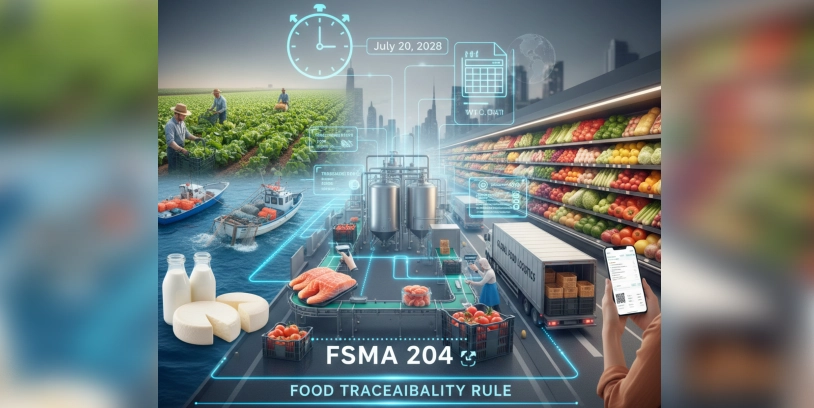
The drive toward food traceability is accelerating across the U.S. food industry, and it no longer hinges on federal enforcement timelines. Instead, retailers and wholesalers now lead the push, setting their own deadlines well ahead of the FDA’s Food Safety Modernization Act Section 204 compliance date.
That message was clear during a recent MorningNewsBeat interview featuring ReposiTrak Chairman and CEO Randy Fields and Affiliated Foods Inc., Amarillo President and CEO Randy Arceneaux. Both executives said market pressure, not regulation, now dictates how quickly suppliers must act on food traceability.
Retailers, they stressed, view end-to-end traceability as a business necessity rather than a regulatory box to check.
Retailers Drive Food Traceability Standards
Across the country, dozens of major retailers and wholesalers have already established internal go-live dates for food traceability. Those deadlines operate independently of the FDA’s enforcement timeline for FSMA 204.
As a result, retailers now require suppliers to meet company-specific traceability standards to maintain business relationships. In doing so, they have effectively created an industry-led framework that often goes beyond federal requirements.
Retailers have concluded that full-chain food traceability protects brands, customers, and operations. It also allows faster response to food safety incidents, minimizing recalls and reputational damage.
“Retailer requirements — not FDA enforcement — are dictating supplier timelines,” Fields said. “We’re already seeing 70 to 80 retailers and wholesalers putting stakes in the ground and setting their own deadlines. Walmart, Kroger, and Albertsons are among them.”
The FSMA 204 Food Traceability Rule is a landmark FDA regulation designed to significantly expedite the identification and removal of contaminated food from the market. It requires companies throughout the supply chain to maintain more detailed records for specific “high-risk” foods.
When Does it Go Into Effect?
The rule is technically already in effect, but the compliance deadline, the date by which companies must actually meet all requirements, has recently changed:
- Original Deadline: January 20, 2026.
- New Deadline: July 20, 2028.
- Why the delay? In 2025, the FDA (pushed by Congressional directive) announced a 30-month extension. This was done to give the food industry more time to update technology and ensure that supply chain partners (farms, distributors, and retailers) can share data effectively.
Related Article: FMI Welcomes FDA’s Food Traceability Extension
Suppliers Face Earlier, Harder Deadlines
For suppliers, the message has grown sharper: waiting is no longer an option.
Retailer-driven timelines often arrive years ahead of FSMA 204 enforcement. Suppliers that delay implementation risk losing shelf space to competitors already equipped to meet food traceability demands.
Fields estimated that roughly 80% of suppliers still struggle to implement traceability effectively. That gap raises urgency across the supply chain.
At the same time, suppliers must navigate fragmented requirements. Retailers often request traceability data in different formats and through other systems.
“A supplier has to figure out how to send different data to different customers in different ways every day,” Fields said. “It’s problematic.”
Consequently, complexity has become one of the most significant barriers to the widespread adoption of food traceability.
Why Partial Traceability Falls Short
Another challenge lies in how companies approach compliance. Some suppliers attempt to track only foods listed under the FDA’s FSMA 204 rule, hoping to limit scope and cost.
However, Fields said that the strategy fails at scale.
After extensive analysis, ReposiTrak concluded that applying food traceability across all products is more efficient than focusing on a limited list of regulated items. Selective tracking creates operational workarounds that many systems cannot handle consistently.
“Operationally, trying to isolate just those FDA-listed items creates complexity and workarounds that most systems cannot support,” Fields said.
As a result, broad, enterprise-wide food traceability has emerged as the more sustainable long-term solution.
Food Traceability Becomes an Industry Expectation
The shift signals a larger change in the food industry. FSMA 204 compliance is no longer a future regulatory requirement. Instead, food traceability has become a present-day expectation shaped by market realities.
Retailers increasingly view traceability as essential infrastructure, similar to food safety audits or quality controls. Suppliers that act early gain stronger partnerships, operational efficiency, and trust throughout the supply chain.
In contrast, companies that delay face shrinking opportunities and rising compliance pressure from customers, not regulators.
Technology Supports Scalable Compliance
The ReposiTrak Traceability Network allows suppliers to share data without additional hardware investments. It also validates every file through more than 500 automated checks, ensuring accuracy and consistency.
That approach, Fields said, helps companies respond faster during food safety events while meeting diverse retailer requirements through a single platform.
As FSMA 204 deadlines approach, industry momentum continues to build. The lesson has become clear across the supply chain: food traceability is no longer a future goal. It already defines how food businesses compete today.