
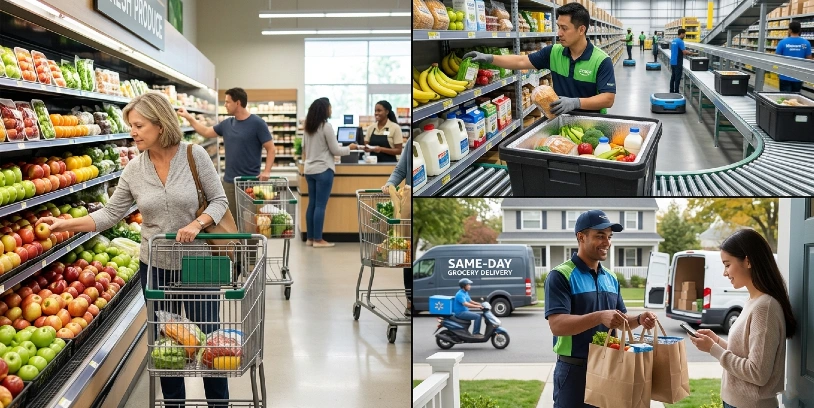
U.S. eGrocery hyper-growth shows no signs of slowing. For six straight quarters through early 2026, online grocery sales have jumped more than 20% year-over-year, beginning in late 2024, according to the Brick Meets Click Grocery Shopper Survey. Two fulfillment breakthroughs are fueling this growth and pushing traditional supermarkets to rethink their place in the market.
What’s Fueling eGrocery Hyper-Growth
Two distinct innovations sit at the center of this shift: ultra-fast delivery and sub-same-day ship-to-home of fresh groceries.
Together, these services are pulling more grocery spending online and eroding brick-and-mortar’s last stronghold: the quick-trip shopping run. With fresh groceries delivered in under an hour or shipped the same day, stopping at the local store is no longer necessary.
That behavioral shift is reshaping the entire competitive landscape.
Walmart and Amazon Widen the Gap
No two players have capitalized on this moment more aggressively than Walmart and Amazon.
Walmart now accounts for nearly 40% of total U.S. eGrocery sales, the largest share in the sector. Its rapid, one-hour delivery orders drive this growth. The speed advantage has proven decisive in locking in customer spending and expanding wallet share.
Amazon, by contrast, grew differently. The retail giant expanded the availability of fresh groceries across its same-day fulfillment network. Then, pushed even further by introducing sub-same-day options with cycle times that undercut the competition on freshness and speed.
The result: both companies now command dominant positions while regional and traditional grocers scramble to respond.
Related Article: Digital Grocery Shopping Is Reshaping the In-Store Experience
The Numbers Behind the Shift
The scale of the change is striking when measured against recent baselines.
Online’s share of total grocery spending climbed from less than 15% at the end of the third quarter of 2024 to more than 19% by the first quarter of 2026. Strip out ship-to-home, a service most regional grocers don’t yet offer, and the jump still runs from 12% to nearly 16% over the same stretch.
Speed is becoming the defining metric. During the first quarter of 2026, same-day eGrocery orders accounted for nearly 80% of all delivery orders and more than 30% of ship-to-home orders across retail formats. Ultra-fast fulfillment, within 1 hour or less, accounted for 18% of all delivery orders and 10% of ship-to-home orders.
Pickup continues to post healthy gains, but delivery and ship-to-home now grow nearly three times as fast, a gap that signals where consumer preference is heading.
A Critical Moment for Regional Grocers
The growth numbers present a stark question for the industry’s middle tier.
“Given this competitive activity, the big question for traditional grocers, and especially regionals, is how they will accelerate growth and remain relevant while protecting profit margins and the customer experience,” said David Bishop, partner at Brick Meets Click.
That question has real urgency. Regional operators who lack ship-to-home capabilities already trail the market average by several percentage points on online share. Without a clear roadmap, the gap widens each quarter as Walmart and Amazon deepen their fulfillment advantages.
To help address that gap, Brick Meets Click integrated growth opportunity mapping into its 2026 eGrocery performance benchmarking initiative, currently open to qualifying regional grocers that operate a first-party ecommerce site or mobile app.
What the Benchmarking Initiative Offers
The program goes beyond standard performance metrics. It evaluates the economic and strategic roles that third-party marketplaces play within a regional operator’s broader omnichannel strategy.
Participating banners remain anonymous and receive tailored recommendations based on performance gaps against top-performing peers. The assessment also covers current practices around customer acquisition, basket building, and retention, three levers that directly influence profitability in a competitive eGrocery environment.