
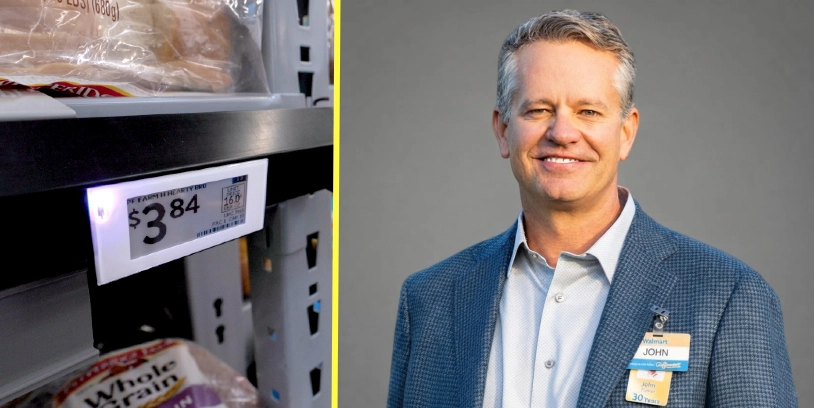
Walmart is pushing back against claims that its digital shelf labels could help the retailer charge some shoppers more than others. In a Sept. 25 letter on the company’s corporate website, President and CEO John Furner offered customers a simple promise: “We price the product, not the person.”
The message arrives at a tense moment for the grocery industry. Lawmakers, regulators and labor unions increasingly question whether electronic price tags, paired with shopper data and artificial intelligence, could open the door to so-called surveillance pricing. Furner’s letter aims to settle that question for the nation’s largest retailer.
Why Walmart Uses Digital Shelf Labels
Furner framed the technology as a practical upgrade rather than a pricing weapon. A shelf price should match what rings up at checkout, he wrote, and the electronic tags help stores deliver that consistency.
He also pointed to the burden on store employees. Swapping paper tags by hand, Furner said, is “a time-consuming and unrewarding task.” He knows this firsthand, having changed those tags himself over the years. Associates, he added, would rather spend that time helping customers.
The rollout itself is not new. In 2024, Abasto Media reported that Walmart planned to install the system Vusion Group developed in 2,300 stores by 2026. Associates update prices through a mobile app. Additionally, a “Stock to Light” feature flashes an LED on the tag to guide workers during restocking.
Three Commitments on Pricing and Data
Beyond explaining the hardware, Furner laid out three commitments. First, Walmart will not set different prices based on who a customer is or the time of day. “Your income, shopping history, urgency or what we think you could pay won’t change the price,” he wrote.
Second, the company will hold its digital tools to the same standard. That includes Sparky, Walmart’s AI shopping assistant. The retailer pledges not to use information shoppers share with Sparky to raise prices or hide cheaper options.
Third, Walmart promises to handle customer data responsibly. Shoppers decide whether to share extra details in exchange for more personalized help.
Still, Furner acknowledged that prices move. Walmart lowers them when it can pass along savings, and they sometimes rise when products cost more to buy or transport. Furthermore, he said company staff will continue to oversee pricing, and Walmart will test its technology against these pledges.
Related Article: Digital Shelf Labels: Is This Technology Worth It?
Digital Shelf Labels and Surveillance Pricing Fears
Nevertheless, skepticism persists across the industry. The United Food and Commercial Workers International Union, which represents 1.2 million workers, has called the tags a key step toward surveillance pricing, Abasto Media previously reported. Critics use that term for systems that tap personal data and AI to set individualized prices.
Food industry analyst Sylvain Charlebois described the practice as “dynamic pricing on steroids,” Global News reported.
Meanwhile, state lawmakers have moved quickly. Bills targeting digital shelf labels or surveillance pricing have surfaced in New York, Washington, Illinois, Tennessee and several other states, according to Abasto Media. In New York, one proposal would ban electronic shelf labels in grocery stores and pharmacies outright.
New Jersey went further. In July, its governor signed the Fair Price Protection Act, which prohibits surveillance pricing and halts statewide installation of electronic price tags, Abasto Media reported.
Federal Regulators Join the Debate
Washington has entered the conversation, too. In August, the Federal Trade Commission sought public comment on a proposed enforcement policy statement on personalized pricing. FTC Chairman Andrew Ferguson warned that businesses that fail to disclose such practices may violate the FTC Act.
Notably, Furner’s letter landed the same day the FTC closed public comments on the issue, TheStreet reported.
On the other side, some observers see the technology as harmless. An opinion piece in Empire Report New York argued that shelf prices stay public and visible to every shopper in the aisle, unlike hidden online algorithms.
What Walmart’s Pledge Means for Grocers
For supermarket operators, Walmart’s position could become a benchmark. Shoppers now have a clear public standard to measure other chains against. Moreover, some experts told Inc. that the pledge could create an opening for smaller businesses to compete on trust.
Ultimately, Furner closed his letter by focusing on the bond between Walmart and its shoppers. “Technology will keep changing,” he wrote. “Our responsibility to earn your trust and help you save money and live better won’t.”