
A coalition of 26 attorneys general and governors filed a federal SNAP benefits suspension lawsuit against the U.S. Department of Agriculture, claiming the agency’s decision to halt Supplemental Nutrition Assistance Program (SNAP) payments during the ongoing government shutdown is unlawful.
The lawsuit, filed in the U.S. District Court for the District of Massachusetts, argues that the USDA’s refusal to issue November benefits violates federal law and threatens to leave millions of Americans without food assistance. The states are seeking an emergency order directing the agency to use its existing contingency funds to keep benefits flowing.
“Millions of Americans are about to go hungry because the federal government has chosen to withhold food assistance it is legally obligated to provide,” said New York Attorney General Letitia James. “SNAP is one of our nation’s most effective tools to fight hunger, and USDA has the money to keep it running.”
States Argue USDA Has Funding to Prevent Crisis
The SNAP benefits suspension lawsuit asserts that the USDA has access to at least $6 billion in contingency reserves that Congress specifically approved to fund SNAP operations during lapses in appropriations. According to the complaint, the agency also controls additional reserves, including the Section 32 fund, which holds more than $23 billion and could be used to prevent hunger during the shutdown.
For decades, USDA maintained that SNAP operations must continue during funding gaps. During previous shutdowns—including under the Trump administration—the agency used contingency funds to ensure uninterrupted food assistance. The coalition says this precedent makes the current suspension “arbitrary and capricious.”
The lawsuit names Agriculture Secretary Brooke Rollins, the U.S. Office of Management and Budget, and the United States government as defendants.
The coalition is comprised of the attorneys general of Arizona, California, Colorado, Connecticut, Delaware, Hawaii, Illinois, Maine, Maryland, Massachusetts, Michigan, Minnesota, Nevada, New Jersey, New Mexico, New York, North Carolina, Oregon, Rhode Island, Vermont, Washington, Wisconsin, and the District of Columbia, as well as the governors of Kansas, Kentucky, and Pennsylvania.
Impact of SNAP Benefits Suspension
The suspension affects more than 42 million Americans who rely on SNAP each month, including children, seniors, and veterans. According to the complaint, 62% of SNAP recipients live in families with children, while more than a third include elderly or disabled individuals.
In New York alone, SNAP serves nearly 3 million people, providing about $650 million in benefits each month. Across all plaintiff states, millions could lose access to essential food assistance starting November 1.
The states warn that the suspension will trigger severe food insecurity and force families to depend on local food banks already struggling with shortages. California, Colorado, and Minnesota have announced emergency funding to support food pantries and offset the expected surge in demand.
USDA Accused of Policy Reversal
According to court filings, the USDA’s decision marks a major departure from its own policies. On September 30, the agency’s shutdown plan stated that SNAP’s “multi-year contingency funds” were available to fund participant benefits in the event of a funding lapse.
However, on October 10, USDA directed states to “hold” their November payment files due to a lack of available funds. Two weeks later, it formally suspended November benefits nationwide. The lawsuit alleges that the USDA failed to justify the reversal or to provide notice to the states, thereby violating the Administrative Procedure Act.
Related Article: SNAP Limits Could Cost Retailers $1.6B
States Cite Irreparable Harm
The plaintiff states claim they face significant financial and operational harm as they continue to administer SNAP without federal funds to issue benefits. Each state must keep processing applications, managing casework, and maintaining electronic benefit systems, even while benefits are frozen.
California’s government has already deployed the National Guard to assist food banks and fast-tracked $80 million in relief funds. Colorado’s governor requested $10 million in emergency appropriations to support hunger-relief organizations, while Minnesota allocated $4 million for local food shelves.
Beyond financial strain, the states argue that the federal suspension undermines public trust in SNAP and threatens the health and well-being of millions of residents. “SNAP has never failed in six decades,” said Massachusetts Attorney General Andrea Joy Campbell. “The USDA’s actions jeopardize a program that families depend on every day.”
The coalition is seeking a temporary restraining order requiring the USDA to use its contingency and reserve funds to restore benefits immediately. The plaintiffs argue that every day of delay causes irreparable harm, not only to households but also to state and local governments managing the fallout.
As of Tuesday, the USDA has not commented on the pending litigation. The outcome of the SNAP benefits suspension lawsuit could determine whether millions of low-income families regain access to federal food assistance before the shutdown ends.
However, U.S. Secretary of Agriculture Brooke L. Rollins published an opinion piece in Newsweek addressing Senate Democrats for holding out on funding for the Supplemental Nutrition Assistance Program (SNAP) by keeping the government shutdown.
“Instead of focusing on reopening the government and keeping programs like SNAP and WIC functioning, or air traffic controllers and law enforcement officers paid, or the military funded, Senate Democrats are holding firm on propping up failed government programs with billions in health care subsidies that benefit corporations over people,” said Secretary Brooke Rollins. “It’s long past time to stop voting against the American people. Reopen the government. Fund these programs. End the theatrics and put the well-being of the American people first.”
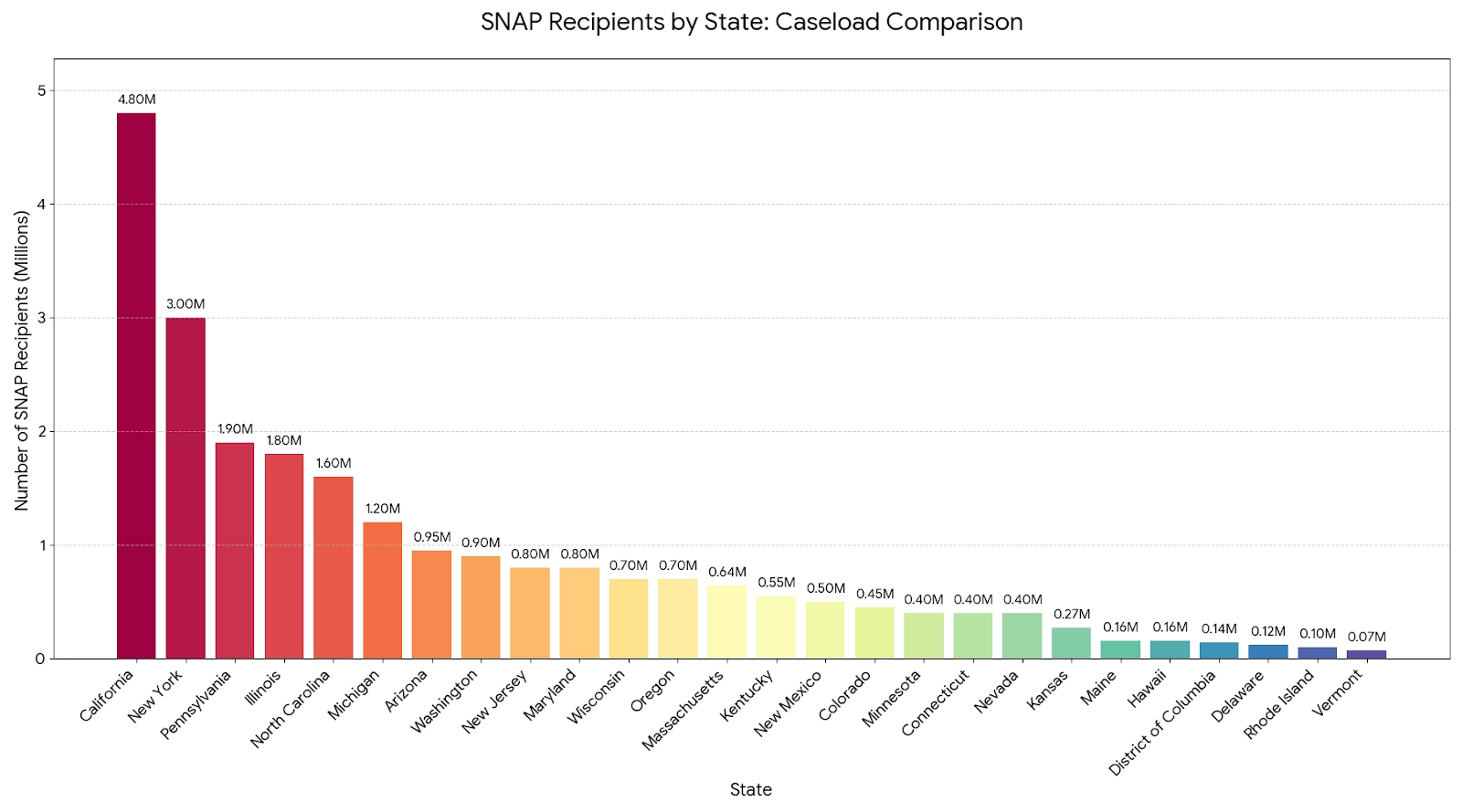
SNAP Recipients in Each Plaintiff State Who Will Be Affected by the Suspension of Benefits
| State | Number of SNAP Recipients | Notes / Context |
| California | 4.8 million | Benefits are administered through the Department of Health and Human Services. |
| New York | Nearly 3 million | Includes 1 million children and 600,000 older adults; about 7% disabled recipients. |
| Pennsylvania | 1.9 million | Among the largest SNAP populations in the coalition. |
| Illinois | About 1.8 million | Administers SNAP through the Department of Human Services. |
| North Carolina | Around 1.6 million | Reflects the high cost of living and food prices. |
| Michigan | Over 1.2 million | Distributed approximately $220 million monthly in SNAP benefits. |
| Arizona | Roughly 950,000 | Managed through the Department of Economic Security. |
| Washington | Nearly 900,000 | Includes a high proportion of families with children. |
| New Jersey | About 800,000 | SNAP serves residents across all 21 counties. |
| Maryland | Over 800,000 | Roughly 1 in 8 residents depend on SNAP. |
| Oregon | Over 700,000 | About 1 in 6 Oregonians receive food assistance. |
| Wisconsin | Approximately 700,000 | Includes both urban and rural households. |
| Massachusetts | Around 640,000 individuals | Represents roughly 9% of the state’s population. |
| Kentucky | About 550,000 | Reflects elevated need in rural regions. |
| New Mexico | Around 500,000 | Benefits reach about 24% of the state’s population (one of the highest rates). |
| Colorado | Roughly 450,000 | State notes sharp increases in participation during economic downturns. |
| Minnesota | Over 400,000 | Describes the program as critical for rural and urban low-income families. |
| Nevada | Over 400,000 | Significant participation among working families. |
| Connecticut | About 400,000 | Noted as critical to food security for low-income families. |
| Kansas | Over 270,000 | (No specific context provided) |
| Maine | Roughly 160,000 | Serves about 12% of state residents. |
| Hawaii | Around 160,000 | Represents approximately 10% of the state population. |
| District of Columbia | About 140,000 | One of the highest per capita participation rates in the nation. |
| Delaware | About 120,000 | SNAP provides critical nutrition support for low-income households. |
| Rhode Island | Around 100,000 | Notes reliance on federal support to combat food insecurity. |
| Vermont | Nearly 70,000 | Represents approximately 10% of state population. |