
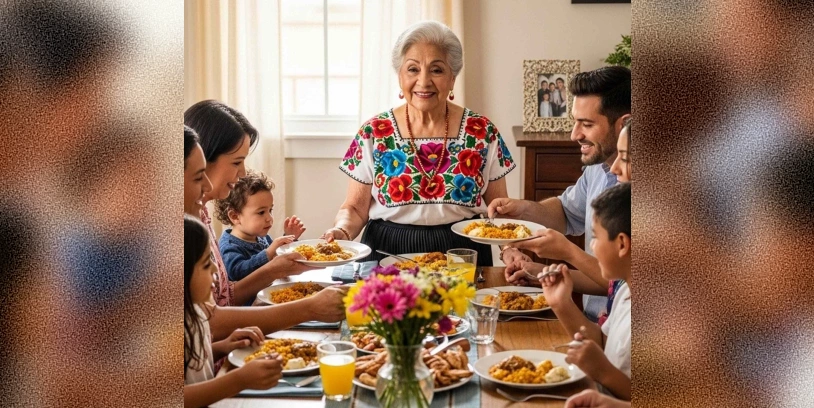
November is here, and Hispanics in the food industry are helping fill millions of Thanksgiving tables. Across the U.S., families are getting ready for the holiday.
In many Hispanic homes, the turkey probably won’t sit alone. Tamales, rice, plantains, salsas, breads and desserts will surround it. Those dishes speak of Mexico, Central America, the Caribbean and South America.
We have made an American tradition our own. Yet we haven’t given up the flavors, memories and customs that define who we are.
That table offers a snapshot of a country that blends cultures and embraces new traditions. But before dinner, it’s worth asking a question. What had to happen for each dish to reach the table?
“Behind every food item lies an immense human chain that deserves recognition.”

A Chain That Starts in the Fields
Consider the turkey, vegetables, rice, fruit, and drinks we will share that night. Each product traveled a long chain before it arrived. That journey began in a field, a production plant, a distribution center, a warehouse,e or a store.
The chain links people who harvest, produce, package, and transport food. It connects them with those who buy, store, distribute, and sell it. It also includes those who launch businesses, run operations, develop products, analyze markets, make decisions, innovate,e and lead.
Hispanics in the Food Industry, By the Numbers
From the farm to the boardroom, Hispanics in the food industry are leaving their mark. The numbers help put that presence in perspective.
Hispanics make up more than 20% of the U.S. population, according to the Census Bureau. In 2025, 32.7 million Hispanic or Latino workers held jobs, Bureau of Labor Statistics data show.
Their presence stands out most at the start of the supply chain. In 2025, Hispanics accounted for 28.2% of workers in agriculture, forestry, fishing, and hunting. In crop production alone, that share climbed to 35.8%.
Across the Food Chain
| 35.8% | Hispanic share of crop production workers |
| 28.2% | Share in agriculture, forestry, fishing and hunting |
| 30.1% | Share in food manufacturing |
| 23.3% | Share in supermarkets and grocery retailers |
| 29.7% | Share in food services and drinking places |
| 32.7 million | Hispanic or Latino workers employed, all industries |
| 2.8 million | Hispanics in management occupations, all industries |
Yet our contribution doesn’t end in the fields. That same year, across the U.S. economy, 8.8 million Hispanics worked in professional, management, and related occupations. Among them, 2.8 million held management positions.
We support production and operations. But we also shape entrepreneurship, knowledge, strategy, innovation, and leadership.
Related Article: Christmas Gift Baskets With Latin Products for Women
An Act of Gratitude
Thanksgiving offers the perfect occasion to say thank you. It also invites a deeper look at the industry that makes our meal possible. After all, an immense human chain stands behind every food item, and it deserves recognition.
Today, Hispanics play an increasingly prominent role in the food industry. We bring our talent, values, and work ethic to a society we are now part of.
“We have made an American tradition our own without giving up the flavors,
memories, and customs that define who we are.”
Recognizing Hispanics in the food industry goes beyond gratitude. It also reveals where the sector is heading. It is a sector where different cultures, talents, and traditions meet, blend, and open new possibilities.
Roots And a Shared Future
So this Thanksgiving, before giving thanks for the meal, let’s pause. Let’s reflect on all the hands, ideas, and decisions that brought that food to our table.
Let’s also be grateful for what that table represents. It is a gathering place where cultures, flavors, and traditions coexist without losing their identity. There, Hispanics have found room to share who we are and contribute our talents. And we do so in a society we also feel is our own.
Perhaps that is another reason to give thanks. We can preserve our roots while building, alongside others, a future that belongs to us, too.