
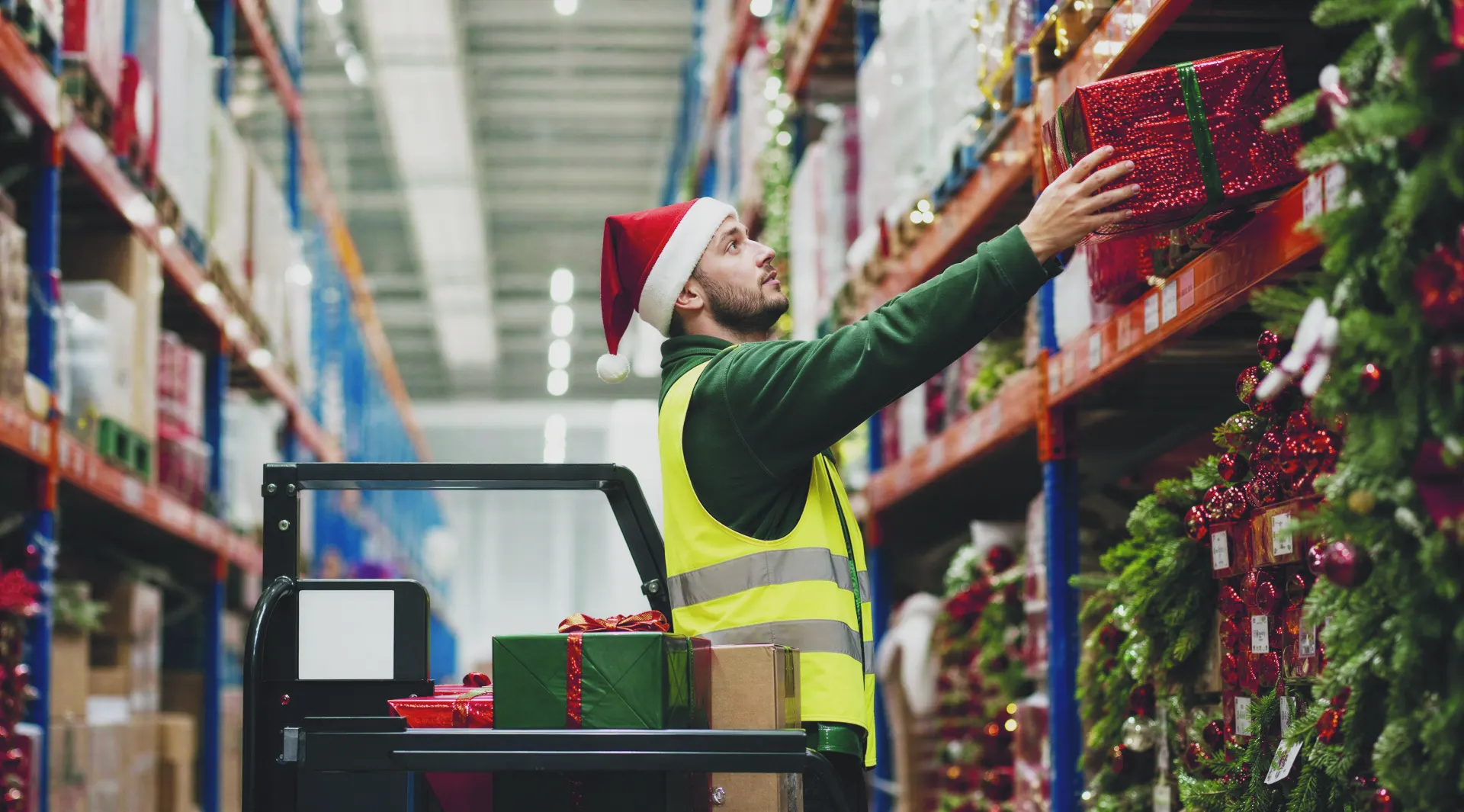
Retail-ready displays may be the independent supermarket’s best ally this Christmas. Once again, we have reached one of the most important seasons for our stores.
Christmas transforms our businesses. Traffic rises, we add seasonal products, and we multiply our promotions. In addition, extra displays appear in virtually every department.
However, those of us who spent years in supermarket operations know another pattern well. When our teams are busiest, we send even more extra work to the store.
New products arrive, along with different cases, special promotions, marketing materials, and displays. Someone has to receive, open, sort, and assemble them. Then they must place them on the sales floor and keep them stocked.
So why do we keep doing in-store work that could arrive done from the factory or distribution center?
For many years, we have worked to make manufacturing more efficient and to improve distribution centers. We also optimized routes and cut delivery times.
Still, one last stretch exists that may not have received enough of our attention. It runs from when the supermarket receives the case to when it reaches the shopper’s hand. That is where a huge opportunity lies.
“One last stretch remains: the one between the case the supermarket receives
and the shopper’s hand.”
More Products Aren’t Enough
Today, one of the biggest challenges in independent retail is not finding products. On the contrary, there are thousands.
Manufacturers and distributors constantly visit our stores. There, they pitch new brands, flavors, sizes, and promotional opportunities.
The problem starts afterward, with very concrete questions. Where do we put the product, how much space does it need, and who builds the display?
Also, how many cases should we buy, and how will we restock it? And what do we do with leftover inventory when the promotion ends?
These questions matter even more for new or seasonal items.
In earlier Retail Academy columns, we have talked a lot about managing our space properly and improving displays. We also stressed analyzing assortments and watching how our customers’ baskets have changed.
Now we must take one more step. Product innovation only has real value when we turn it into strong in-store execution.
That’s why manufacturers, distributors, and retailers must start thinking less about shipping cases. Instead, we must think much more about shipping sales solutions.
Related Article: The New Identity of the Hispanic Supermarket
Retail-ready displays
We increasingly find packaging and logistics alternatives designed to simplify operations at the point of sale. These include concepts like Retail Ready Packaging or Shelf Ready Packaging.
This packaging lets a case reach the shelf and open easily. That way, the case practically becomes part of the product display itself.
We also find the familiar floor displays, trays, sidekicks, and counter displays. On top of these come promotional units or complete displays that may arrive pre-assembled or even fully loaded.
The idea behind retail-ready displays is quite simple. They aim to cut the number of steps between receiving a product and our customers being able to buy it.
Traditional Case
| Receive > | Open > | Sort > | Assemble > | Place > | Restock |
Retail-Ready Display
| Receive > | Place > | Sell |
Fewer steps between the backroom and the shopper.
A traditional case serves a logistics function essentially. A retail-ready solution, by contrast, also serves a commercial function.
This difference may seem small. However, multiply it by hundreds of items, dozens of employees, and thousands of labor hours over a year. Then it takes on another dimension.
Large chains have substantial merchandising, planogram, restocking, and execution structures. For them, this solution may mean efficiency.
For many independent supermarkets, however, it may mean even more. In fact, it can help them compete better with fewer resources.
Multiproduct displays
Personally, I find another evolution even more interesting. Why must a display necessarily hold just one product?
Likewise, why do we keep building so many promotions solely around the manufacturer’s logic rather than the shopper’s?
Suppose a manufacturer has four different products. Traditionally, the retailer might have to buy a full case of each item to build a display.
That means bigger investment, more inventory,y and more storage space. It also means greater risk, especially for a small store.
The alternative could be a single display or logistics unit holding different products. Each one would arrive in carefully planned quantities.
Instead of buying full cases of A, B, C, and D, we receive one A+B+C+D retail-ready display. It arrives ready to go straight onto the sales floor.
Before: Four Full Cases
| Case A | Case B |
| Case C | Case D |
Now: One Display
| A + | B + | C + | D |
One logistics unit replaces four full cases.
This way, we no longer design logistics around how the manufacturer produces. Instead, we design it around how shoppers buy and how retailers sell.
Christmas Says it Best
Think about the year-end holidays. At Christmas, our customers don’t buy isolated categories; they buy occasions.
They prepare a dinner, host relatives, and bake desserts. They also throw parties and shop for gifts.
At Christmas, our customers don’t buy isolated categories; they buy occasions.”
So why can’t we build our logistics solutions around those occasions too? And within our multicultural market, we can go much further.
Three displays for this Christmas
- Holiday Baking: brings together the products needed to make desserts.
- Holiday Entertaining: combines products for family gatherings and celebrations.
- Latino Christmas: groups items with strong shopping affinity, even across different categories or cultures.
The opportunity is huge because our communities already shop this way. I explained this recently when writing about the new shopping basket.
Shoppers long ago stopped respecting many of the boundaries we keep creating inside our stores.
In a single basket, we find American, Mexican, Central American, Caribbean and European products. Alongside them sit private labels, premium products and value items.
If shoppers already mix categories and cultures, our merchandising solutions should do the same.
Good merchandising for all
For years, we have talked a lot about helping independents compete. But competing doesn’t mean requiring them to copy a chain’s exact processes with fewer resources.
After all, that chain operates hundreds or thousands of stores. Competing means, instead, developing tools suited to the independent’s reality.
An independent supermarket has to control labor costs and keep shelves stocked. It must also receive merchandise, serve customers, and manage promotions.
On top of that, it resolves dozens of operational issues every day. That’s why every process we can simplify has value.
When the manufacturer prepares a display properly from the start, that display can reduce handling and ease restocking. It can also ensure consistent presentation and get the promotion to the sales floor much faster.
Here, manufacturers and distributors must take on greater responsibility.
Time is Inventory, Too
During seasons like Christmas, another factor also becomes critical: speed. A seasonal product has a limited selling window.
Picture a seasonal product that has already reached the store’s backroom. There, it waits several days for someone to assemble, sort, or move it to the floor. Meanwhile, we lose part of its selling life.
“A seasonal product has a limited selling window.”
That’s why we should watch a very simple metric much more closely. It is the time between receiving a product and having it truly available to our customers.
Let’s Make Selling Easier
For a long time, we optimized manufacturing and, later, transportation. After that, we transformed our distribution centers with technology, automation, and better inventory management systems.
Perhaps it’s time to optimize that last yard as well. In other words, the space between the merchandise the store receives and the product our customer finally finds.
For our independent supermarkets, retail-ready displays can simplify that last stretch. And that can make an enormous difference.
What Independents Gain
- Less time handling cases.
- Lower inventory risk.
- Better displays.
- Faster execution.
Above all, they gain time for something no case or system can replace: serving our customers.
This Christmas, perhaps the best gift manufacturers and distributors can give independent retailers is not another new product. The real gift is making it easier to sell the products we already have.