
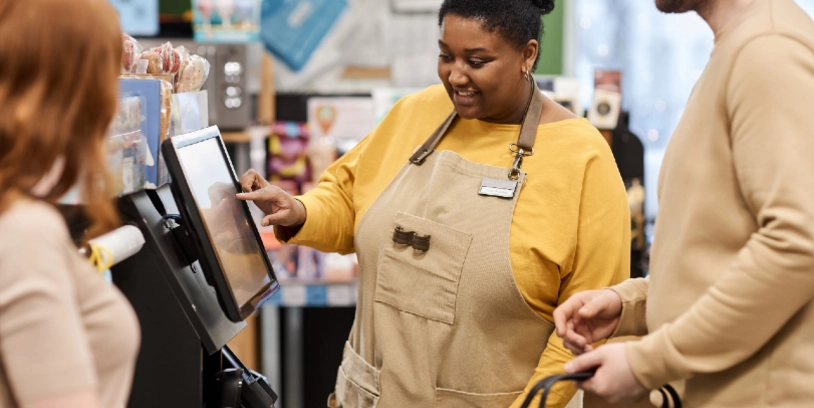
Smart stores blend AI, scales, and kiosks with human warmth to embrace technology without alienating traditional shoppers. Walking into an average supermarket in the United States today is like stepping into a silent laboratory. Scales that recognize products, hybrid checkout lanes that combine self-service with staff assistance, touchscreen kiosks next to the meat counter, and artificial intelligence systems that adjust prices in real time.
The digital transformation of the food retail industry is moving fast, but not all shoppers are keeping pace.
That is precisely the central challenge of the so-called “smart store”: incorporating technology without alienating the traditional customer—the one who values a greeting from the butcher, a recommendation from the baker, or simply the assurance that a human being will answer their questions.
A Revolution That Began at the Checkout
The digitization of the sales floor is nothing new. It began years ago with self-checkout lanes and has evolved into handheld scanners, Scan&Go-type mobile apps, facial recognition for payments, and cashier-less stores.
This is documented in an academic review published in the journal Foods (MDPI, 2024), authored by researchers from the Silesian University of Technology (Poland) and Celal Bayar University in Manisa (Turkey), which traces the technological evolution of the food retail industry from the traditional counter to augmented reality.
The study identifies clear benefits of self-service: it reduces wait times, gives shoppers autonomy, and frees up staff for other tasks. But it also documents a pattern that any store manager will recognize: not everyone adopts it equally.
According to the research, older consumers use self-service technologies less frequently, have less confidence in using them, and miss human interaction more than younger shoppers.
Recent market data confirm this generational gap. A 2025 survey by The Feedback Group, a consumer research firm cited by media outlets such as Grocery Dive and Chain Store Age, found that shoppers who use staffed checkout lanes report higher satisfaction (4.45 out of 5) than those who use self-checkout (4.29). The same study confirms that baby boomers and the Silent Generation continue to prefer the traditional supermarket as their primary shopping format.
Related Article: AI in Supermarkets Is Not Here to Erase Jobs, It’s Here to Transform Them
The dilemma isn’t “technology yes or no”
A common mistake, industry experts point out, is to view digitization as a replacement for staff rather than a complement.
In its 2025 Retail Experience Report, NCR Voyix found that 77% of shoppers prefer self-checkout for its speed. Still, nearly 20% of those who avoid these technologies do so because they prefer interacting with an employee. In other words, technology does not divide customers into “modern” and “old-fashioned” groups, but rather into groups with different needs depending on the moment of purchase.
The solution that leading chains—from Stop & Shop and Giant to Meijer—are adopting is the hybrid model: maintaining staffed checkout lanes, adding self-service areas, and, above all, using technology as a tool to support employees rather than as a replacement for them.
The Case of the Counter: Ordering Without Waiting in Line
The clearest example of this philosophy can be found in the meat and bakery sections. Supermarket chains in the United States and Europe have installed touchscreen kiosks that allow customers to order a specific cut of meat or a custom cake without physically waiting in line at the counter.
The customer continues shopping while the order is being prepared and picks it up when it’s ready.
According to the specialized website Kiosk Marketplace, this format replaces the traditional laminated photo album used to order cakes, reducing errors such as omitting a detail on a handwritten form. And in Germany, the Edeka chain tested a similar kiosk in 2026 at its Uetersen location: customers place their orders on the screen, receive a printed receipt, continue shopping, and pick up their order at a designated spot, as reported by AV Magazine.
The result doesn’t eliminate the butcher or the baker—it frees them from taking orders one by one so they can devote more time to preparing orders and serving customers directly at the counter.
Kiosk provider Aila Technologies, which works with Ahold Delhaize (Stop & Shop, Giant) and Meijer, describes this approach as a way to reallocate staff from “taking orders” to “fulfilling orders,” improving productivity without sacrificing human contact at the point of delivery.
What the Numbers Say
The efficiency data is compelling. According to estimates from the self-service kiosk sector compiled by the Local Express platform, these systems can increase transaction throughput by 35% to 50% during peak hours. And in the field of artificial intelligence applied to inventory, a study by St. Mary’s University (San Antonio, Texas, 2026), focused on LSTM-type demand forecasting models, documented a 42.9% reduction in forecasting error compared to traditional methods, as well as a decrease of up to 24.3% in stockouts and 19.4% in storage costs.
These operational benefits, however, occur behind the scenes: in the back room, with the algorithm, the smart scale, or the automatic restocking system. The visible customer experience—the one that determines whether they return—continues to depend on the balance between the screen and the person.
The store of the future, then, does not replace people with screens, but one that uses screens so that people—both employees and customers—have more time for what technology still cannot offer: an honest recommendation, a cooking tip, or simply a smile at the counter.
5 Insights to Apply in-Store
- 77% of U.S. shoppers choose self-service for speed, according to NCR Voyix (2025), but the satisfaction gap is 4.45 vs. 4.29 in favor of staffed checkout lanes, according to The Feedback Group (2025).
- 35% to 50% is the increase in transaction throughput reported by self-service kiosks during peak hours (Local Express).
- The use of kiosks in bakeries reduces errors in handwritten orders and eliminates the need for physical catalogs (Kiosk Marketplace).
- 19.9% of consumers who avoid self-service do so because they prefer to interact with an employee (Capital One Shopping Research, 2026).
- Baby boomers and the Silent Generation continue to choose traditional supermarkets as their primary shopping format, over discount stores (The Feedback Group, 2025).