
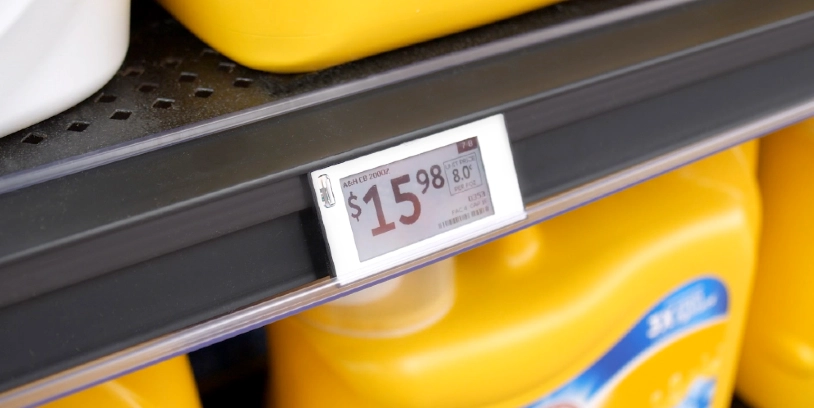
The expansion of Walmart’s digital shelf labels has triggered sharp criticism from labor leaders and renewed calls for federal and state regulation of digital pricing technology in retail stores.
The United Food and Commercial Workers International Union (UFCW) said Walmart’s plan to install digital shelf labels across its more than 5,200 U.S. stores could accelerate controversial pricing practices. Union officials argue the technology may allow retailers to change prices instantly and potentially raise costs during periods of high demand.
The criticism arrives as lawmakers in Washington and several states review legislation that could restrict or ban the use of electronic shelf labels, also known as digital price tags.
However, Walmart stated that prices are the same for all customers in any store and are uniform regardless of demand, time of day, or who is shopping. The retailer reiterated that digital shelf labels, or DSLs, simply modernize the way prices are displayed on shelves.
Union Warns Walmart Digital Shelf Labels Could Enable “Surveillance Pricing”
UFCW leaders say the rollout of Walmart digital shelf labels represents a key step toward what they call “surveillance pricing,” a system that uses data analytics and artificial intelligence to adjust prices dynamically.
Ademola Oyefeso, UFCW international vice president, said the technology could give retailers unprecedented power to change prices based on real-time demand.
According to Oyefeso, stores could raise prices before a winter storm or during peak shopping hours, leaving customers with fewer protections against sudden increases.
The union also argues that digital price tags could undermine traditional price transparency. Shoppers historically relied on fixed price labels on store shelves. However, electronic labels allow retailers to update prices instantly across an entire store.
As a result, critics say consumers may struggle to track price changes while shopping.
Lawmakers Consider Federal and State Restrictions
Meanwhile, lawmakers have introduced several proposals to regulate or ban digital price-tag systems.
At the federal level, senators Ben Ray Luján of New Mexico and Jeff Merkley of Oregon introduced the Stop Price Gouging in Grocery Stores Act. The proposal seeks to curb price manipulation practices tied to advanced retail technologies.
In the House of Representatives, lawmakers Rashida Tlaib of Michigan and Val Hoyle of Oregon lead a companion bill.
At the same time, state legislators have begun pushing their own measures. Bills that target digital shelf labels or surveillance pricing have surfaced in New York, Oklahoma, Washington, Arizona, Nebraska, Maryland, New Jersey, Iowa, Illinois, and Tennessee.
Supporters of the legislation argue that regulations must keep pace with rapidly evolving retail technology.
Related Article: Digital Shelf Labels: Is This Technology Worth It?
Retailers Accelerate Adoption of Digital Shelf Labels
Despite the controversy, major retailers continue to expand the technology.
Walmart has announced plans to install digital shelf labels in all its stores over the next year. According to the company, DSLs are designed to ensure accurate, consistent pricing while helping associates save significant time by eliminating the manual task of price changes. The result is more time for what matters most: serving customers.
Other grocers have already experimented with the technology. Kroger began installing digital shelf labels in select stores in 2018 and expanded the system to roughly 500 locations by 2023.
Regional grocer Schnucks also plans to deploy the labels across its 115 stores in the St. Louis region.
Retail technology providers often promote digital shelf labels as a way to streamline operations. They argue that the systems reduce pricing errors, improve inventory management, and support faster promotions.
However, critics remain skeptical about how retailers might use the technology in practice.
Debate Intensifies Over Pricing Transparency
The debate over Walmart digital shelf labels also intersects with a broader national discussion about data-driven pricing.
In 2024, the Federal Trade Commission launched an investigation into surveillance pricing practices under former chair Lina Khan. Regulators sought to examine how companies use consumer data to adjust prices.
The agency released initial findings in January 2025 outlining how artificial intelligence and consumer data could influence retail pricing strategies.
Shortly afterward, the FTC ended the inquiry following the transition to the Trump administration.
Nevertheless, consumer advocates and labor groups continue to warn that digital pricing technology could change how retailers set prices.
They argue that digital shelf labels could be the final piece of infrastructure needed for fully automated price adjustments.
Grocery Workers Raise Job Concerns
Beyond pricing issues, the UFCW also warns that Walmart’s digital shelf labels could affect grocery store workers.
The union represents more than 800,000 grocery workers across North America and says automation could reduce the number of traditional store roles.
Historically, store clerks handled price labeling and promotional updates. Digital labels automate that work.
Union officials say employees may instead face increased pressure to explain sudden price changes to shoppers who notice differences at checkout.
For that reason, labor groups say lawmakers must establish safeguards before retailers fully adopt the technology.