
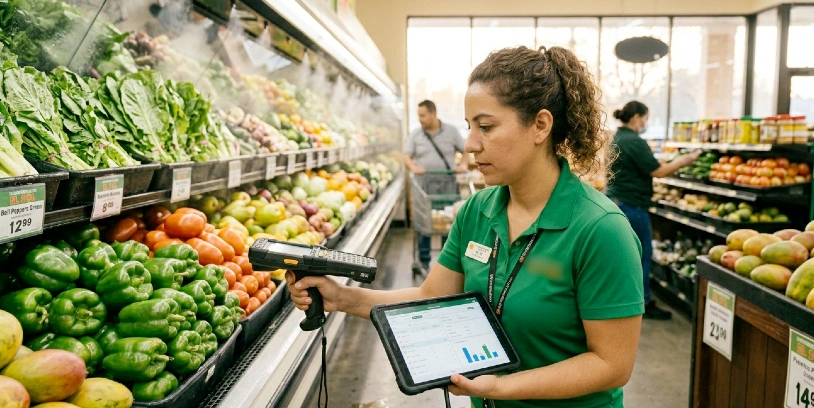
Fresh inventory management technology from Logile delivered a 1,070% ROI for Vallarta Supermarkets, transforming the Southern California grocer’s approach to fresh production.
A new ROI case study by Nucleus Research confirmed the results. Vallarta recovered its full investment in just 15 months.
The report credits Logile’s AI-powered platform for driving more than $10 million in attributable profit over three years. The technology reshaped demand forecasting, spoilage reduction, and production planning across multiple fresh departments.
The Problem: Disconnected Systems Hurt Fresh Operations
Before adopting Logile, Vallarta relied on several separate, disconnected systems to plan and execute fresh food production. That fragmented approach created real business problems.
Inaccurate demand forecasting led to overproduction. Overproduction drove spoilage. Meanwhile, store teams lacked visibility into execution across departments, including produce, bakery, taqueria, and seafood.
“Before Logile, we didn’t have a consistent way to connect demand, production, and execution across fresh,” said Steve Netherton, CIO and VP of Continuous Improvement at Vallarta Supermarkets.
The Solution: A Unified Fresh Inventory Management Platform
To close those gaps, Vallarta expanded its use of Logile’s platform across its store network. The retailer deployed several integrated modules — Production Planning, Recipe Management, Scale Management, Grind, and Yield.
Together, these tools created one unified system. That system now supports forecasting, in-store execution, and labor coordination across all fresh operations.
Vallarta rolled out the technology in deliberate phases, department by department. This staged approach allowed teams to test and refine new workflows without disrupting day-to-day store operations.
Store teams could then focus production on high-demand items, reduce overproduction of slower sellers, and improve consistency in fresh food preparation.
Related Article: How AI in Retail Enhances Shopping and Store Efficiency
Dramatic Results Across Every Fresh Department
The numbers tell a compelling story. Fresh inventory management gains were felt across every major department at Vallarta.
Sales climbed across the board. The taqueria department led all categories with a 15% increase in sales. Seafood followed with a 9% gain, while bakery rose 1.6% and produce increased 1.1%.
Spoilage and shrinkage dropped. Inventory levels fell. And Vallarta cut software costs by 15% by consolidating legacy systems into a single platform.
Critically, the retailer achieved all of this without cutting in-store staffing. Instead, labor efficiency improved by aligning tasks more precisely with real-time production needs.
Analysts Take Notice of the Operational Innovation
Nucleus Research analyst Evelyn McMullen highlighted Vallarta’s disciplined rollout as a key driver of results.
“By thoughtfully rolling out the solution and embedding it into daily execution, the company turned better forecasting and production planning into measurable financial and operational gains,” McMullen said.
The findings reflect a broader industry shift. Grocery retailers increasingly move beyond basic automation toward AI systems that plan and act with purpose.
Logile founder and CEO Purna Mishra framed the results in the context of that larger trend. “Vallarta’s results show how AI that adapts in real time and works alongside store teams can help retailers move from reactive fresh operations to more predictive, disciplined execution with measurable financial impact,” Mishra said.
What This Means for Fresh Grocery Retail
Vallarta’s case offers a concrete blueprint for fresh grocery operators struggling with spoilage, inconsistent production, and disconnected planning tools.
Fresh inventory management, when executed with discipline and supported by AI, delivers quantifiable returns. The Vallarta experience proves that smarter forecasting does not just cut waste, it actively drives sales growth.
For a regional grocer competing against national chains, that combination of cost savings and revenue gains represents a significant competitive advantage.
Logile, founded in 2005, continues to expand its Connected Workforce platform across the retail industry. The company integrates demand forecasting, labor scheduling, task execution, fresh item management, and food safety into a single AI-driven system.