
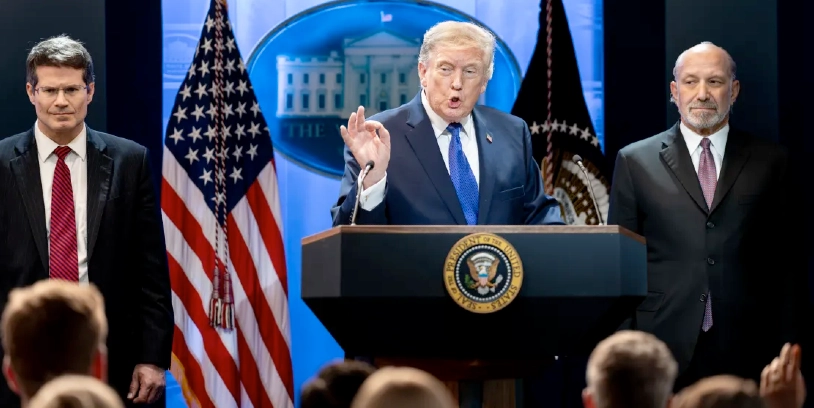
President Donald Trump announced a global tariff increase from 10% to 15% on Saturday, only one day after the U.S. Supreme Court struck down his earlier use of emergency powers to impose tariffs under the International Emergency Economic Powers Act (IEEPA). The ruling invalidated most of the duties he had implemented since 2025 and forced the administration to pivot toward other trade authorities.
Trump initially responded to the decision by signing an executive order under Section 122 of the Trade Act of 1974, reinstating a 10% global tariff. Hours later, he escalated that figure to 15% in a social media post, calling the Supreme Court’s opinion “ridiculous, poorly written, and extraordinarily anti-American.”
Court Rejects Emergency Tariffs Under IEEPA
On Friday, the Supreme Court ruled 6–3 that Trump had exceeded his authority by invoking IEEPA to justify wide‑ranging tariffs on nearly all U.S. trading partners. The justices determined that the law did not permit unilateral, indefinite tariff changes because the Constitution grants Congress the power to Tax. The decision nullified nearly all global duties except select sector‑specific tariffs on products such as autos and semiconductors.
Trump sharply criticized the decision, attacking the majority of justices during a press conference and again online. The ruling not only dismantled tariff structures built over several years but also opened the door to potential lawsuits from businesses seeking repayment of approximately $133 billion in tariffs previously collected under the invalidated rules.
Related Article: Supreme Court Strikes Down Trump Tariffs
Section 122 Becomes Administration’s New Trade Tool
Trump invoked Section 122 of the 1974 Trade Act to justify the new global tariff increase. The statute allows a president to impose up to 15% in temporary import surcharges for 150 days to address serious balance‑of‑payments deficits or currency instability. No president had previously used Section 122 to enact broad tariffs, making Saturday’s action unprecedented.
According to the law, the tariffs will automatically expire after 150 days unless Congress approves an extension. It remains uncertain whether the administration could reissue the same tariffs immediately after expiration or whether the courts would accept such a move.
Meanwhile, the White House confirmed that certain imports—including some critical minerals, metals, and energy products—will receive exemptions under Section 122, mirroring earlier commodity‑specific carve‑outs.
Impact on U.S. Trade Partners and North America
The global tariff increase will not affect products compliant with the Canada‑United States‑Mexico Agreement (CUSMA), meaning many North American goods remain exempt from the 15% surcharge. However, several sectoral tariffs imposed under Section 232 of the Trade Expansion Act—such as levies on steel, aluminum, copper, and wood products—will stay in place.
For many major trading partners, the new tariff structure represents a sharp reduction from the rates imposed before the Supreme Court ruling. Prior to Friday’s decision, imports from Japan and European Union member states faced duties as high as 15%, while Mexico, Canada, China, India, and Brazil often saw even higher levels. The new 15% rate, therefore, equalizes and, in many cases, lowers overall tariff burdens.
More Tariff Actions Expected
Trump signaled that his administration plans additional measures in the coming months, including “several Section 301 and other investigations” targeting what he called unfair trade practices. He emphasized he will not seek new tariff authority from Congress, instead relying on existing statutes such as Sections 122, 301, and 232 to reshape U.S. trade policy. This strategy suggests a broader shift toward legally tested tools following the Supreme Court’s narrowing of the administration’s latitude under emergency powers.
As global markets react, analysts warn that the global tariff increase may trigger economic retaliation, uncertainty among import‑dependent U.S. industries, and renewed diplomatic tensions. Still, Trump maintains that the move marks a legally compliant step toward what he calls “Making America Great Again,” setting up another chapter in an already turbulent era of U.S. trade policy.