
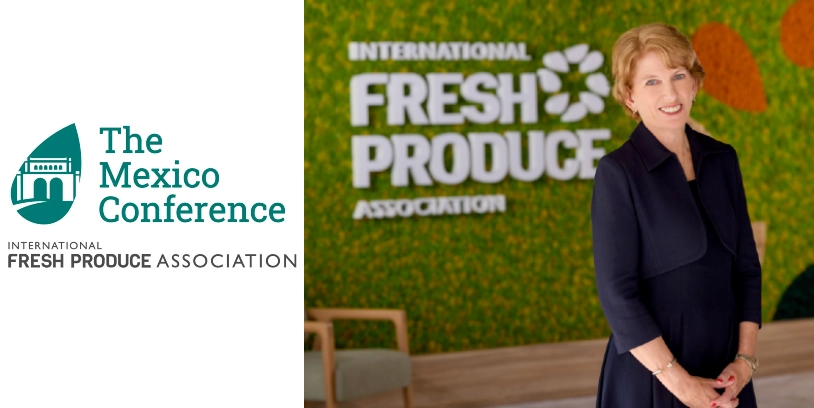
Ahead of The Mexico Conference in Guadalajara, on May 13-14, Abasto Media spoke with Cathy Burns, CEO of the International Fresh Produce Association, to discuss the key issues shaping the fresh produce and floral industries across Mexico, North America, and beyond.
From trade dynamics and supply chain resilience to the growing importance of data-driven decision-making, Burns shares insights into the challenges and opportunities facing the sector and why this moment matters for industry leaders across the region.
Abasto Media: Why is it important for IFPA to have a strong presence in Mexico and across Latin America right now?
Cathy Burns: Mexico is a key trading partner for the U.S. and many other regions, and, given the turbulence we’ve seen the past year in global trade flows, it’s critical that we bring the produce and floral supply chain together to discuss the impact policy, market access, operational pressures, and trends can have on the business landscape.
IFPA exists to serve the entire global supply chain, and Mexico is a place where that mission becomes very tangible.
Trade policy, sustainability realities like water, and workforce challenges are not abstract topics; they are hurdles that produce and floral companies are facing every day. The Mexico Conference is designed to connect those realities with the people who can act on them.
AM: How does The Mexico Conference reflect IFPA’s commitment to serving the entire global supply chain?
CB: The conference is designed for all links in the supply chain: growers, exporters, importers, retailers, logistics providers, and solution providers.
The focus is on bringing the community together to strengthen relationships, make deals, and provide decision-ready insights. In collaboration with our Mexico Council and in-country representative, IFPA is here to help our members in Mexico grow their businesses.
AM: What are the most pressing trade issues facing produce and floral businesses operating across North America today?
CB: Uncertainty is the biggest challenge. We’ve seen this in tariffs and non-tariff barriers, market access, and policy changes that disrupt cross-border flows.
Businesses need predictability and a clear view of what’s coming so they can manage risk and keep our industry’s perishable products moving to consumers. IFPA is laser-focused on addressing trade challenges through advocacy and on efforts to grow fresh produce and floral consumption.
Related Article: IFPA’s 2026 Fresh Produce Policy Agenda Sets Bold Industry Priorities
AM: How is IFPA working to ensure fair, predictable, and science-based trade policies that support cross-border supply chains?
CB: When it comes to trade, IFPA believes in science-based trade policies and transparent, rules-based trading systems.
Last year, we advocated for exemptions for all fresh produce and floral products, particularly to protect the USMCA. We are also part of the Agricultural Coalition for USMCA, which conducted an economic analysis of the agreement, underscoring its value to all three nations.
We are focused on targeted improvements that preserve market access, provide long‑term certainty, and support a strong, integrated North American trade environment.
IFPA’s model integrates world-facing advocacy with industry-facing support because members need both: they need their voice represented where decisions are made and discussions are held, and they need clear insight into what those decisions mean operationally.
At The Mexico Conference, we will connect global advocacy work—including developments across North America and beyond—to real-world implications for members doing business in Mexico. That’s the core of the value: advocacy plus translation into business decisions.
AM: What role do data and insights play in helping IFPA members make better business decisions in today’s market?
CB: Data and insights provide context and certainty during uncertain times. Right now, leaders are making decisions in a high-velocity environment.
Data helps leaders prioritize the risks and opportunities that matter most and decide faster and with more confidence. This need for data and clarity is one of the reasons IFPA developed its Global Intelligence Engine, which provides personalized insights in response to questions about industry and consumer research and trends. It’s available to anyone within an IFPA member company.
AM: The Mexico Conference is known for connecting buyers and sellers – why are those in-person relationships so critical in today’s business environment?
CB: Fresh is a relationship business, and relationships are even more valuable when uncertainty is high.
In-person conversations surface context that you can’t get on a screen: what members are prioritizing, where they see risk, and where there’s room to build something new.
The Mexico Conference intentionally creates those moments, from networking to business roundtables, so retailers and suppliers can move faster and more confidently together.
AM: Looking ahead, what gives you the most optimism about the future of the fresh produce and floral industry in Mexico and across the region?
CB: I’m optimistic because the industry is solving hard problems with creativity and urgency, and Mexico is a place where that energy is very visible.
We see global connections and relevance in the makeup of The Mexico Conference itself, and in the agenda’s focus on innovation, sustainability, and trade realities. That combination of connectedness and problem-solving capacity is exactly what builds long-term competitiveness.
AM: If there’s one message you’d like the industry in Mexico to take away from this year’s conference, what would it be?
CB: My message is simple: this is a moment for decision-makers. This conference is designed to help leaders bring clarity to the environment they’re operating in, trade, sustainability, workforce, and market dynamics, and to connect with the leaders across the supply chain who can help turn that clarity into growth. IFPA is committed to delivering that value not just at the event, but year-round.