
A major shift is reshaping the American grocery landscape. New data from Consumer Edge reveals that specialty and discount retailers are capturing grocery market share, while traditional supermarkets struggle to hold on to shoppers across every income level.
Consumer Edge released its U.S. Grocery Outlook 2026 this week. The report draws on transaction-level data to map where — and why — consumers are redirecting their food dollars in an increasingly competitive retail environment.
Grocery Market Share Shifts as Spending Declines
Overall grocery spending dropped approximately 3% year-over-year on a 12-month basis ended Feb. 28, 2026. However, Consumer Edge cautions against reading this as a simple pullback in consumer appetite.
Shoppers are not spending less across the board. Instead, they are becoming more deliberate, gravitating toward retailers that offer a clear value proposition — either unbeatable price or a distinctive, curated experience.
That behavioral shift is rewriting the competitive rankings across the sector.
Trader Joe’s Leads the Pack
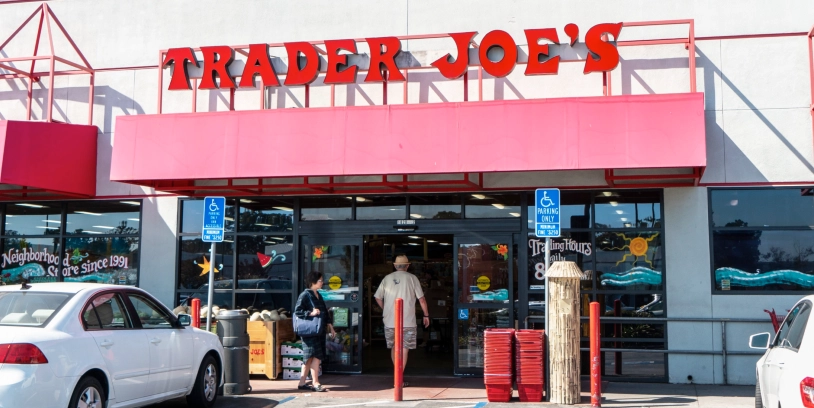
Trader Joe’s emerged as the grocery sector’s standout performer. The specialty chain grew more than 3% year-over-year, outperforming the broader grocery market by 6 percentage points.
The brand’s appeal spans demographics. Gen Z shoppers drove double-digit year-over-year growth, signaling strong momentum with the next generation of grocery buyers.
Loyalty metrics further reinforce Trader Joe’s edge. The chain posted a 35% customer retention rate four quarters after a shopper’s first purchase — surpassing both ALDI and Wegmans on that key indicator.
Its gravitational pull extends beyond its own customer base. Sprouts Farmers Market shoppers allocate 48% of their specialty grocery spending to Trader Joe’s. Wegmans shoppers direct 47% of their specialty dollars there as well.
Related Article: How Hispanic Grocers Can Win More Mainstream Shoppers
Specialty Grocers Win Across Income Groups
The specialty grocer subsector, which includes Trader Joe’s, Whole Foods, and Wegmans, is not just winning affluent households. Consumer Edge data shows growth coming from low-, middle-, and high-income shoppers alike.
That broad-based appeal marks a notable shift. Specialty retail was once considered a premium niche. Today, it attracts a wide swath of consumers who prioritize quality, experience, or unique product assortment regardless of budget.
Traditional Supermarkets Caught in the Middle
Meanwhile, conventional supermarkets are losing ground across the income spectrum. Chains like Publix and Safeway face pullbacks across all shopper segments, with the steepest declines among lower-income consumers.
Michael Gunther, SVP of Research & Market Intelligence at Consumer Edge, put it plainly. “Traditional supermarkets are caught in the middle, and the data suggests that pressure isn’t going away,” he said.
Gunther added that the grocery retailers best positioned for 2026 are those with a distinct identity and a loyal, returning customer base.
Discount Grocers Hit a Plateau
Discount grocers rode a powerful wave from early 2022 through mid-2024. Retailers such as ALDI, Lidl, Food 4 Less, and Grocery Outlet captured a meaningful share of the grocery market as inflation-weary consumers traded down.
Yet that momentum has stalled. Consumer Edge data shows the discount grocer’s share has leveled off since mid-2025. Whether this segment reignites will depend largely on food inflation trends and how aggressively specialty grocers continue to attract deal-conscious shoppers.
Sprouts Intensifies the Competitive Pressure
Sprouts Farmers Market is aggressively expanding and disrupting established players. The chain has grown its Texas store count by more than 12% annually over the past three years and now operates 477 stores across 24 states.
Sprouts plans to open at least 40 more locations in 2026. That expansion is already denting Whole Foods’ home turf. In Austin, Texas, where Whole Foods was founded, the share of Whole Foods shoppers who also visit Sprouts climbed from 29% in March 2024 to 33% by February 2026.
What This Means for the Industry
The Consumer Edge report sends a clear message to food retailers: a middle-of-the-road strategy no longer cuts it. Shoppers today demand a reason to be loyal.
Grocers that lack a sharp, recognizable identity face an uphill battle. Those that own a clear lane, deep value, a specialty assortment, or an exceptional private label are taking the lead.
The grocery market share battle of 2026 is far from over. But the data makes one thing clear: the center of the store, and the center of the market, is rapidly hollowing out.