
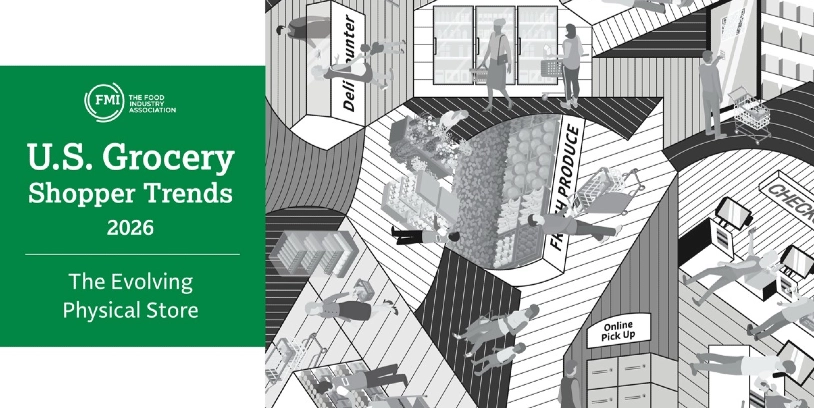
U.S. shoppers will not abandon brick-and-mortar grocery stores anytime soon. The FMI—The Food Industry Association, has just released its report, “U.S. Grocery Shopper Trends 2026″, confirming that in-store grocery shopping remains a central element of American life.
The research, developed with The Hartman Group, found that shoppers continue to find real value, meaning, and enjoyment in physical retail locations.
Furthermore, the findings challenge assumptions that digital convenience has overtaken traditional store visits.
Shoppers Visit Over Five Store Banners Monthly
Consumers aren’t loyal to just one retailer; they shop broadly and strategically. On average, Americans visit 5.4 separate store banners each month for grocery items.
Gen Z shoppers lead the pack, hitting 6.7 different banners monthly.
Millennials follow closely, visiting 6.1 separate banners within the same timeframe.
Against that backdrop, FMI President and CEO Leslie G. Sarasin highlighted the competitive implications for food retailers.
“Shoppers tell us they seek stores with certain personality traits that meet their household needs,” Sarasin said.
For example, one store might offer entertainment, while another delivers bulk options or bargain hunting.
As a result, Sarasin urged retailers to define their stores’ personalities and use them to build loyalty.
What Shoppers Would Miss About In-Store Grocery Shopping
Beyond convenience, the emotional and practical stakes of in-store grocery shopping run surprisingly deep for consumers.
When asked what they’d miss, 48% cited the ability to select products in person.
Additionally, 22% said they’d miss human connection, and another 22% would miss enjoyable experiences.
Some 21% pointed to a broader product selection, while 20% highlighted lower in-store costs.
Discovery ranked next, with 17% valuing the spontaneous finds that physical shopping enables.
Finally, 15% noted they’d simply miss the ease that a well-organized store provides.
Related Article: Grocers’ New Role in Deli-Prepared Foods
Technology Enhances, But Doesn’t Replace, the in-store grocery shopping Experience
Even as shopping habits evolve, digital tools now blend seamlessly into the modern grocery shopping journey.
Notably, 77% of shoppers use digital technology before entering a store. Meanwhile, 71% actively use technology while navigating aisles and making purchase decisions.
Yet technology serves as a complement, not a substitute, for the in-store grocery shopping experience.
In fact, 54% of Americans still always shop in person at their primary grocery store. Only 15% split their visits equally between in-store and online channels.
Store Design Drives Repeat Visits and Customer Loyalty
For retailers, the report suggests that thoughtful store design remains a major competitive advantage.
Retailers who intentionally design their environments earn stronger, longer-lasting shopper loyalty. Clean, efficient, simple, and non-overwhelming store layouts consistently bring consumers back.
Likewise, shoppers return to stores whose identity aligns with their specific household needs.
Mass retailers attract bulk buyers, while specialty stores draw shoppers seeking cultural products.
Commenting on the findings, Steve Markenson, FMI’s vice president of research and insights, emphasized the consistency of positive sentiment.
“In-store grocery shopping remains a positive and purposeful experience for Americans,” Markenson said.
Grocery Spending Climbs as Shopping Frequency Holds Steady
At the same time, grocery spending continues to rise even as shopping frequency remains relatively stable.
U.S. households currently spend an average of $169 per week on groceries, as of February 2026.
Individual shoppers make 1.6 trips per week, a figure consistent across both men and women. However, households with children push that number higher, averaging 1.8 trips weekly.
In total, U.S. households collectively make 2.8 grocery shopping trips per week.
When it comes to where consumers shop most often, supermarkets continue to dominate. Supermarkets lead all retail formats, with 77% of Americans primarily sourcing groceries there.
Mass stores follow at 67%, with club stores, dollar stores, and online-only retailers rounding out the mix.
Ultimately, the data makes one thing clear: in-store grocery shopping remains essential, resilient, and deeply human.