
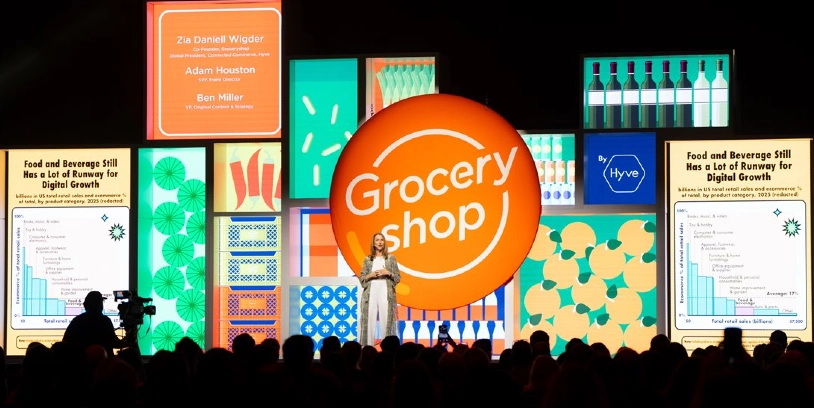
More than 4,000 grocery industry executives gathered in Las Vegas last week for Groceryshop 2026, which Abasto Media attended. The top message was hard to miss: AI in grocery is no longer a back-office project. It is becoming the front door to the grocery store.
The Cart is Being Rebuilt
Instacart CEO Chris Rogers opened the conference with a bold claim.
“I believe that AI is going to transform grocery more than any other technology shift to date, and I also think that grocery is going to be the category out of every retail category that’s most transformed by AI,” he said.
Rogers described a shopper who no longer builds a list item by item.
Instead, she asks an AI assistant for a week of healthy family meals on a set budget. She gets a finished cart based on her preferences, prices, and what is in stock.
Now picture that shopper asking for pozole for Sunday, tamales for Nochebuena, or a week of Dominican dinners for a family of six.
If the AI doesn’t understand the difference between queso fresco and queso blanco or doesn’t know your store carries three brands of sazón, it will send her somewhere else.
That is both the risk and the opportunity.
AI assistants can only recommend what they can read.
For Hispanic grocers, this means complete bilingual product descriptions, accurate ingredient and origin information, and clear tagging for regional specialties.
The retailer that cleans up its item file in Spanish and English now will be the store the AI agents find later.
Related Article: The Smart Store: Balancing Tech and Human Warmth
Start Small with AI in Grocery and Keep People in Charge
Yael Cosset, Kroger’s chief digital officer, offered a useful framework for smaller operators.
Kroger thinks about AI in three stages: assisted, augmented, and autonomous.
“The goal is not autonomy everywhere,” Cosset said. “The goal is using the right level of AI based on risk, repeatability and the need for human judgment.”
Kroger is building agents that sort through the dozens of daily notifications store teams receive and surface only what matters most.
That is a sensible first step for a regional chain or independent, too.
Start with repeatable tasks like demand forecasting for produce and carnicería, shift scheduling, or ordering for holiday peaks.
Leave the judgment calls to the people who know the neighborhood.
Cosset also made a point that should resonate in every tienda and supermercado.
“At our core, the human connection to a customer or fellow associate will never be replaced by AI. Instead, AI will give our associates more time and insight to create that connection.”
The butcher who knows the right cut for carne asada and the cashier who asks about a customer’s mother are competitive advantages.
AI should protect them, not replace them.
Trust and the Family Table
Cosset emphasized that “the grocery winners in the age of AI will be the retailer who can earn our trust, your trust, all of our trust in satisfying the family dinner.”
He even said grocers should hold back on fully automated refills because “there is still a significant level of emotional connection between the customer and what they are doing for meals for their family.”
Few retailers understand that emotional connection better than Hispanic grocers.
Food is culture, memory, and family.
Use AI to make the trip easier, but keep the experience personal.
Five Takeaways for Hispanic Grocers
- Clean up your product data in Spanish and English so that AI assistants can find and recommend your items.
- Start with assisted AI on repeatable tasks like forecasting and scheduling before moving to agents.
- Protect the human touch that sets your stores apart.
- Build a simple customer feedback loop and act on what you hear.
- Compete on total value with fair online pricing, SNAP access, and loyalty connected to digital channels.
The giants have bigger budgets.
Hispanic retailers have something harder to copy: a deep understanding of their shoppers and the foods that matter to them.
Retailers that pair that knowledge with the right tools for AI in grocery will be the ones agents and families choose.