
Grocery loyalty programs are becoming shoppers’ strongest tool against rising holiday food prices.
Meanwhile, families say they would cut almost anything before cutting back on the holiday feast.
That’s the takeaway from FMI’s new report, U.S. Grocery Shopper Trends 2026: Holidays.
FMI – The Food Industry Association conducted the study with The Hartman Group. The online survey reached 1,467 U.S. grocery shoppers from Sept. 21-28.
Price Worries Rise, But So Does Confidence
Holiday price anxiety is climbing. In fact, 45% of shoppers are extremely or very concerned about rising holiday food prices.
That figure jumped 8 points from fall 2025.
Still, shoppers feel more in control of their budgets. The share reporting a lot or some control over grocery spending rose 13 points since August.
Average weekly grocery spending, meanwhile, held steady at $172. FMI’s U.S. Grocery Shopper Sentiment Index now stands at 72, near its historical high.
“Food is what holds the holidays together.”
— Leslie G. Sarasin, president and CEO, FMI – The Food Industry Association
Shoppers, Sarasin added, “will protect the holiday meal even if it means trimming elsewhere.”
Federal data help explain the mixed mood. Bureau of Labor Statistics data show grocery prices rose 1.8% through September.
However, food-at-home prices then climbed 0.4% in October, the agency reported Nov. 10.
The Holiday Feast Stays Off The Chopping Block
Shoppers clearly rank food above other seasonal expenses.
After a fun, harmonious time with loved ones (67%), a great homemade feast (52%) defines holiday success.
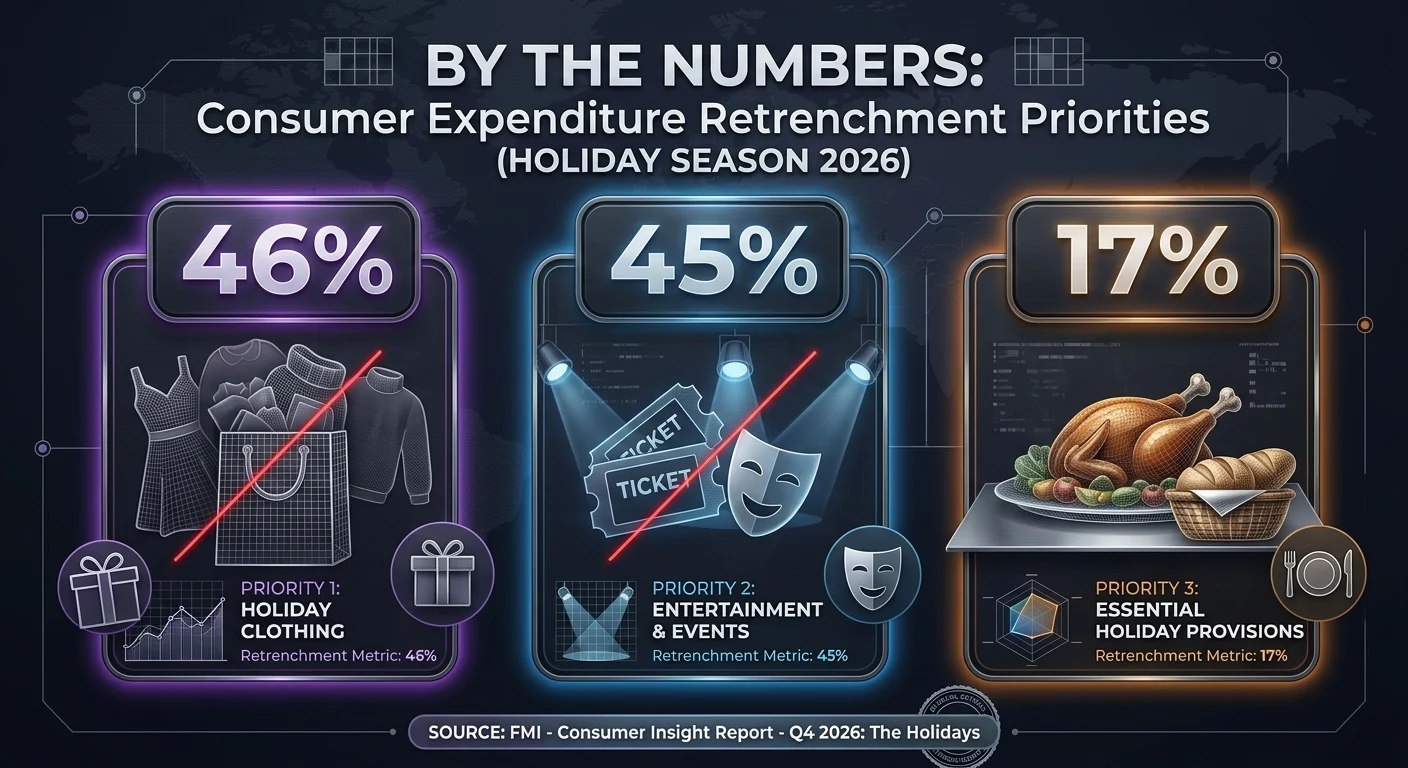
When budgets tighten, only 17% would cut back on holiday meal food. By contrast, 46% would trim holiday clothing, and 45% would skip shows and events.
Scratch Cooking Returns to the Thanksgiving Table
Thanksgiving kitchens will be busier this year.
Among shoppers planning a turkey, 59% will make it from scratch at home. That’s a 16-point jump from 2025.
Meanwhile, freshly prepared turkey fell 10 points to 19%.
Traditional staples gained ground, too. Turkey (68%), mashed potatoes (63%), stuffing (62%), and a warm vegetable side (50%) all rose versus last year.
Moreover, the meal remains a team effort. Where at least one dish is homemade, 95% of shoppers plan to help prepare it.
Notably, 90% feel excited about the prep, nearly matching the 89% excited about the holiday itself.
That demand arrives as turkey supplies recover. Producers are sending about 3% more birds to market this year, Farm Progress reported.
Retailers are also advertising frozen whole turkeys at roughly 2,500 stores, more than last year.
Related Article: Retailers Invest in Tech & In-Store Experience
Shoppers Adapt to Out-Of-Stocks and Embrace AI
Some anxiety lingers on store shelves. About 24% of shoppers are extremely or very concerned about holiday food out-of-stocks.
Yet half would make a different familiar dish, while 35% would try a new recipe.
Technology is also reshaping holiday planning. Weekly AI use among shoppers rose to 27%, up from 19% a year ago.
What’s more, 65% would like to use AI to help plan holiday meals. Most want help finding new recipes (34%) or festive ideas (27%).
Why Grocery Loyalty Programs Matter This Season
This is where retailers have the most to gain.
Asked how grocers could ease Thanksgiving prep, shoppers put loyalty member holiday discounts first, at 36%.
Special displays for the holiday meal (29%) and for specific dishes (25%) followed.
Indeed, FMI’s data show grocery loyalty programs already deliver real value. Where a program exists, 71% of shoppers have joined it at their primary store.
Among members, 95% find their program at least somewhat valuable. Nearly three in four (74%) call it extremely or highly valuable.
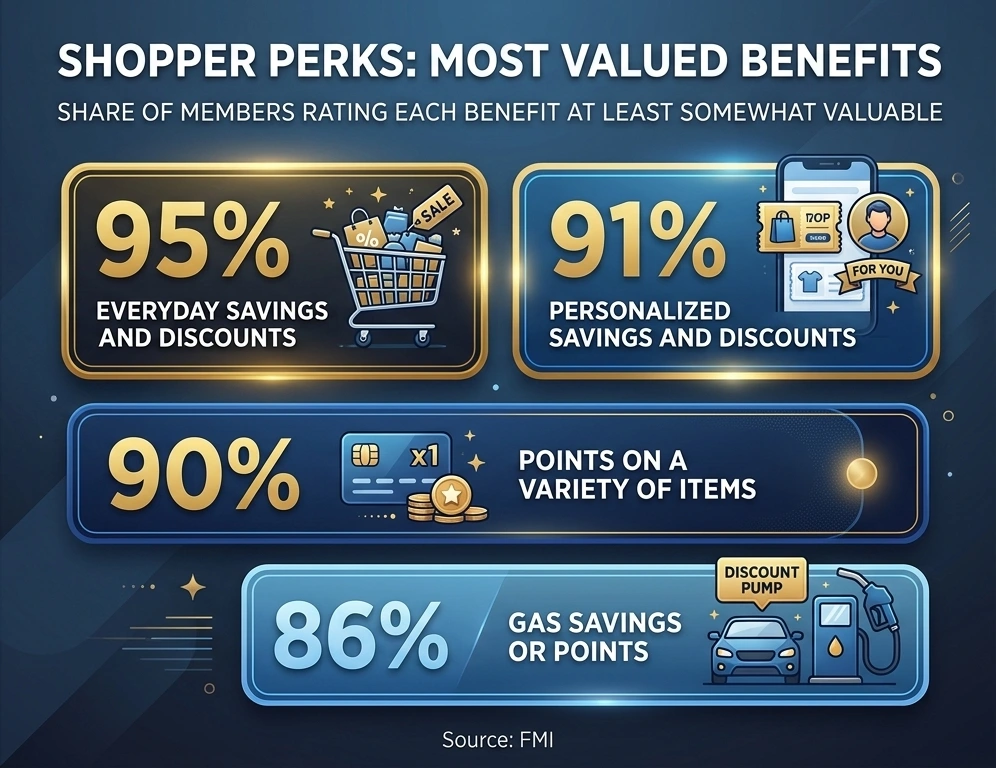
Savings-focused perks lead the list. General everyday savings are also the most-used benefit.
When forced to choose, 47% prefer general savings, 30% prefer personalized offers, and 23% have no preference.
Loyalty also lifts the shopping experience. Shoppers who see their program as essential rate their primary store higher, 85% versus 79%.
They are also more likely to love or like grocery shopping, 50% versus 37%.
A Loyalty Gap Retailers Can Close
Yet the report reveals a clear opportunity. Demand for grocery loyalty programs also outpaces availability.
Among shoppers whose primary store lacks a program, 68% are extremely or very interested in having one.
Additionally, the households that could save the most often miss out. Where programs exist, 58% of shoppers earning under $35,000 are members.
In comparison, 78% of those earning $150,000 or more have joined.
Awareness is part of the problem. Among non-members, 18% didn’t know the program existed, and 28% gave no particular reason.
“Loyalty programs are delivering exactly what shoppers need right now.”
— Leslie G. Sarasin, FMI – The Food Industry Association
The next step, Sarasin said, is reaching lower-income households and younger consumers.
Those shoppers, she added, need to “know these savings are available and find them easy to use.”
The Bottom Line for Grocers
For retailers, the message heading into the season is clear.
Shoppers will protect the holiday table, and they expect their stores to help them pay for it.
Consequently, retailers that make grocery loyalty programs easy to find and join could win trips and trust.
The full report is available at FMI.org/GroceryTrends.