
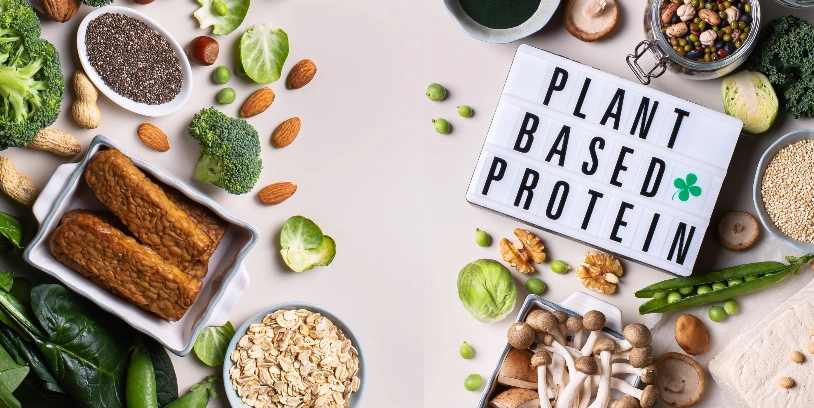
Future Market Insights revealed that the global plant-based protein market is entering a high-growth phase, driven by increasing demand for functional, application-ready protein systems and the mainstream adoption of protein-enriched food and beverage formats.
Market analysis projects that the industry will reach $22 billion in 2026 and hit $49.9 billion by 2036. High-performance protein systems drive this expansion by delivering consistent taste and texture in high-throughput manufacturing.
The shift from standalone protein ingredients to integrated, performance-driven systems is redefining supplier strategies and creating new value pools across beverages, bakery, ready-to-eat foods, and nutritional applications.
Quick Stats: Plant-based Protein Market
The market size projection for 2026 is USD 22.0 billion, but for 2036 is USD 49.9 billion. The growth rate would be 8.5% CAGR in the next ten years.
- Soy Protein would be the Leading Product Type with 36.4% share.
- Key Growth Countries: United States, United Kingdom, Germany, France, Spain
- Key Players: Glanbia Plc., ADM, Cargill, Kerry, Roquette, Ingredion, Tate & Lyle
Execution-Driven Demand Reshaping Market Dynamics
Procurement strategies are increasingly focused on performance reliability and supply continuity. Buyers are prioritizing:
- Consistent sensory performance (taste, texture, mouthfeel)
- High dispersibility and heat stability
- Scalable and traceable supply chains
- Reduced formulation variability
Manufacturers are shifting toward isolates and engineered blends that deliver repeatable functionality across applications such as beverages, snacks, and ready-to-eat meals.
Related Article: Shoppers Prioritize Health & Protein in their Basket
Product and Segment Trends
Market segmentation highlights a transition toward high-functionality proteins:
- Soy protein (36.4%) leads due to its mature supply chain, neutral taste, and broad functionality
- Isolates (41.2%) dominate form segments due to higher protein density and better process control
- Conventional proteins (78.0%) remain dominant due to cost efficiency and scalability
Engineered protein systems are increasingly replacing basic concentrates, especially in performance-critical applications.
Functionality, Processing, and Innovation
Modern food manufacturing demands proteins that can withstand:
- High-temperature processing
- Shear-intensive production environments
- Shelf-life stability requirements
- Complex formulation matrices
Suppliers are investing in enzymatic modification, functional blending, and application-specific solutions to meet these needs. This is accelerating the shift toward application-ready protein systems rather than commodity ingredients.
Protein System Engineering Driving Value Creation
The next decade of growth will be defined by the conversion of protein ingredients into complete systems that deliver:
- Texture and structure in meat analogues
- Stability in beverages
- Functional consistency in bakery and snacks
- Clean taste in high-protein formulations
Companies capable of integrating taste, texture, and nutrition into unified solutions are expected to maintain pricing power despite commodity pressures.
Supply Chain and Procurement Trends
Supply assurance is becoming a critical decision factor due to:
- Europe’s structural protein deficit
- Dependence on imports for plant proteins
- Volatility in raw material availability
Buyers are adopting:
- Multi-origin sourcing strategies
- Long-term supply agreements
- Supplier partnerships with technical support
Suppliers offering continuity, documentation, and formulation expertise are gaining a competitive advantage.