
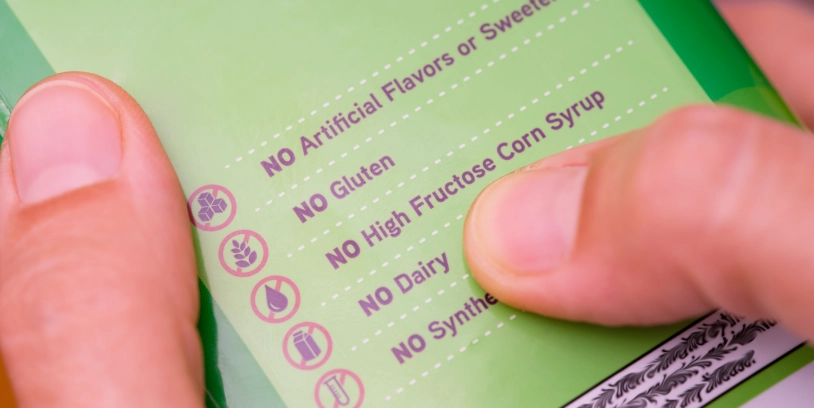
The no artificial colors labeling policy announced by the Food and Drug Administration gives food manufacturers greater flexibility. Brands can now label products as “no artificial colors” even when using natural, non-petroleum colorants.
The move represents a clear break from previous FDA guidance. Under prior rules, any added color barred companies from making the claim, regardless of whether the color came from natural or synthetic sources.
For manufacturers, the change reshapes labeling strategy and product positioning. It also affects reformulation timelines across the food and confectionery sectors.
The FDA outlined the update in a letter to industry. The agency said it will exercise enforcement discretion for these voluntary labeling claims.
In doing so, officials framed the decision as a way to improve consumer clarity while enabling companies to move away from petroleum-based synthetic dyes.
“This is real progress,” Health and Human Services Secretary Robert F. Kennedy Jr. said, adding that the policy lowers barriers to reformulation and aligns with broader public health objectives.
A Strategic Shift in FDA Labeling Policy
More broadly, the updated no artificial colors labeling approach marks a strategic regulatory adjustment that could influence product development decisions for years.
For decades, FDA interpretations shaped how manufacturers formulated and marketed products. Those constraints weighed heavily on categories where color consistency drives sales.
According to FDA Commissioner Marty Makary, labeling naturally derived colors as “artificial” created unnecessary friction and discouraged innovation.
By revising that interpretation, the agency aims to remove a constraint that limited the adoption of alternative color sources.
Alongside the labeling update, the FDA approved beetroot red as a new color additive. The agency also expanded authorized uses of spirulina extract.
Together, these actions broaden the range of natural options available to manufacturers seeking to replace petroleum-based dyes.
With these decisions, the FDA has approved six new food color options under the current administration.
Related Article: FDA Approves Natural Food Colors, Moves to Ban Petroleum Dyes
Industry Weighs Market Opportunity and Operational Risk
In response, large food manufacturers have largely welcomed clearer federal labeling direction, noting that national standards reduce regulatory uncertainty and limit exposure to inconsistent state requirements.
Trade groups also argue that clearer no artificial colors labeling supports transparent brand messaging. They cite sustained consumer demand for simpler ingredient statements.
For many brands, reformulation now carries potential marketing upside alongside regulatory compliance.
However, segments of the confectionery industry remain cautious, emphasizing that approved synthetic dyes are safe when used as intended and play an important functional role.
In particular, trade associations stress that bright, uniform color remains essential in many candy categories.
From a technical standpoint, experts note that natural colorants often behave differently during processing.
They may degrade under heat or light, vary by crop yield, or require higher inclusion rates, factors that can raise costs and complicate large-scale production.
Natural Color Approvals Accelerate Industry Transition
Against this backdrop, the FDA’s actions build on a broader regulatory initiative announced in April 2025.
At that time, the agency outlined plans to phase out petroleum-based synthetic dyes from the U.S. food supply by the end of 2027 and committed to working with industry throughout the transition.
Since then, several major manufacturers have announced voluntary reformulation pledges, many targeting the removal of specific FD&C colors.
To support transparency, the FDA also launched a public tracker to monitor industry progress.
Kyle Diamantas, the FDA’s deputy commissioner for human foods, said the agency is accelerating approvals for alternative color sources while maintaining strict safety and purity requirements.
In parallel, the FDA issued additional guidance highlighting compliance resources for manufacturers that use or produce color additives.
Implications for Retailers, Suppliers and Brands
Looking ahead, retailers may see broader use of “no artificial colors” claims across multiple categories, potentially reshaping shelf presentation and category messaging.
While products may still contain colorants, those ingredients will increasingly come from natural, non-petroleum sources.
For manufacturers, the revised no artificial colors labeling framework offers greater commercial flexibility, but also raises expectations around reformulation execution and cost control.
Ultimately, brands must balance functionality, sourcing and consumer trust as approved natural color options continue to expand.
For the food industry, the policy marks a turning point in how color regulation intersects with marketing, product development and long-term strategy.