

Consumers are getting an early start on back-to-school shopping. According to the annual survey from the National Retail Federation and Prosper Insights & Analytics, 62% of shoppers already started buying for the school year by early July. While this figure drops slightly from 67% at the same point in 2025, it remains significantly higher than the 55% that retailers reported in 2024.
“Affordability is a concern for families and a top priority for retailers as we enter the back-to-school season,” said NRF Chief Economist and Executive Director of Research Mark Mathews. “Shoppers are keeping value front and center as they look for ways to make their dollars go further. Retailers are responding with a strong assortment of products, promotional events and more convenient shopping options, helping families find what they need while saving time and money.”
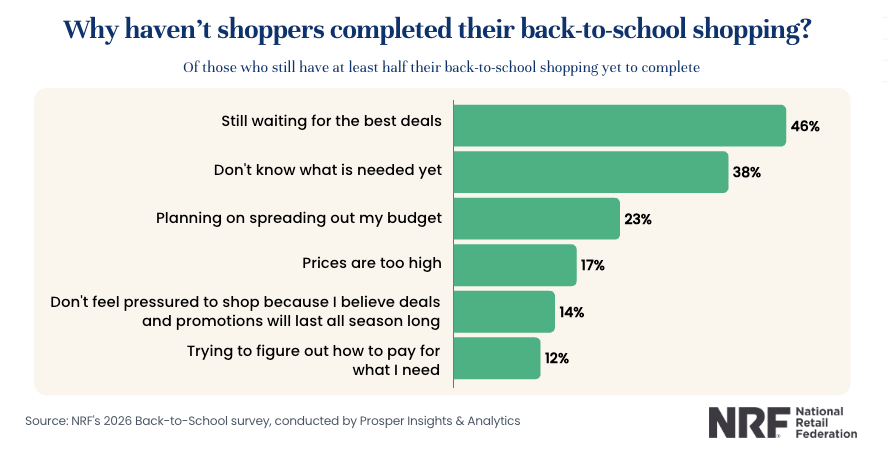
Many consumers are delaying purchases until later in the season or spreading out their shopping to manage their budgets. Among those who have not yet purchased at least half of their back-to-school items, 46% say they are waiting for the best deals to finish their shopping, while 23% are spreading their budgets.
Looking at shopping destinations, only half (50%) plan to purchase items online, down from 55% last year. Other leading destinations include department stores (47%), discount stores (44%) and clothing stores (39%).
Back-to-school shopping, college edition
College students and their families expect to spend a record $103.5 billion on back-to-school shopping this year, surpassing $100 billion for the first time and beating last year’s $88.8 billion. Shoppers plan to spend an average of $1,437.79, up from $1,325.85 in 2025 and breaking the previous record of $1,366.95 set in 2023.
Electronics remain the top college spending category, with consumers planning to spend an average of $341.95, totaling $24.63 billion in sales. Rounding out the top spending categories are $194.00 for dorm or apartment furnishings ($14.0 billion total), $182.39 on clothing and accessories ($13.1 billion total), $153.91 on food ($11.1 billion total) and $133.34 on personal care items ($9.6 billion total).
“The rise in college spending is being driven by increased purchasing plans across multiple categories,” Prosper Executive Vice President of Strategy Phil Rist said. “The percentage of consumers planning to purchase electronics has increased significantly this year, while several other categories are also attracting more shoppers than previous years.”
Related Article: Busy Parents Are Buying More Groceries Online Than Most Consumers
Back-to-school online shopping
While it remains the leading shopping destination, only 41% plan to shop online this year, marking the lowest level since 2016 (38%). Other popular shopping destinations include department stores (33%), discount stores (33%) and college bookstores (25%).
Since 2003, NRF has conducted a comprehensive survey on back-to-school shopping trends. This year’s research included 7,677 consumers and was fielded July 1-8 with a margin of error of plus or minus 1.1 percentage points.
As the leading authority and voice for the retail industry, NRF provides data on consumer behavior and spending for key periods such as holidays throughout the year.