
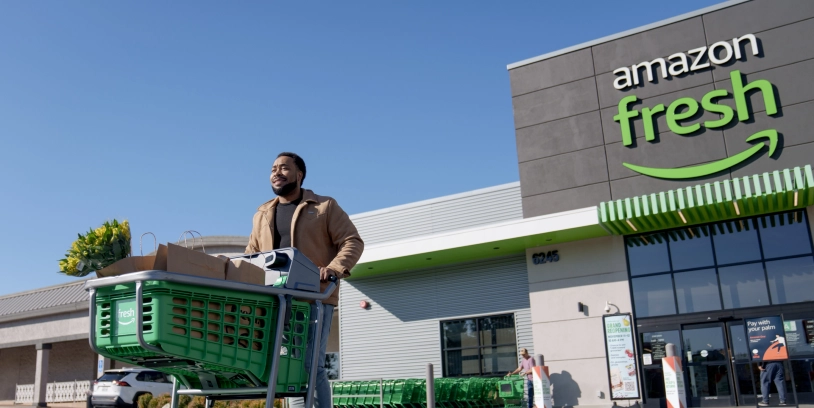
Amazon is pulling back from brick-and-mortar retail with Amazon Fresh and Go stores closing their doors. With this decision, the e-commerce giant is refocusing its grocery strategy on online delivery and on expanding Whole Foods Market.
The decision marks a decisive shift toward faster fulfillment, digital convenience, and store formats with stronger long-term economics.
Over the past two decades, Amazon has steadily expanded its grocery business online. Today, the company ranks among the top three grocery retailers in the United States, reporting more than $150 billion in gross grocery sales and serving over 150 million grocery customers annually.
Online Grocery Delivery Drives the Strategy
As consumer habits evolve, Amazon is betting heavily on online grocery delivery. Millions of customers across more than 5,000 U.S. cities and towns can now shop for groceries online through Amazon Fresh, Whole Foods Market, and partnerships with regional retailers such as Weis Markets, Winn-Dixie, and Metropolitan Market.
At the same time, speed has become a critical differentiator. In 2025, Amazon expanded its Same-Day Delivery service nationwide to include perishable groceries. Customers can now order fresh produce, meat, dairy, and frozen foods alongside household essentials, all delivered within hours and backed by the company’s Freshness Guarantee.
According to Amazon, perishable grocery sales through Same-Day Delivery have increased fortyfold since early 2025. In markets where the service operates, fresh items now account for nine of the ten most-ordered products.
Related Article: Practical Guide to Adapting Your Online Store to the Hispanic Consumer
Ultra-Fast Delivery Tests Convenience Limits
Building on that momentum, Amazon has begun testing Amazon Now, an ultra-fast delivery service designed to deliver thousands of essential items, including fresh food, in about 30 minutes or less.
The service aims to replicate the convenience of a neighborhood convenience store while eliminating the need for an in-person visit. Amazon has launched the pilot in several cities and plans further expansion depending on customer response.
Whole Foods Market Emerges as the Physical Growth Engine
While Amazon steps away from its Amazon-branded physical grocery formats, it is doubling down on Whole Foods Market. Since acquiring the chain in 2017, Amazon has expanded Whole Foods Market to more than 550 locations and reported sales growth exceeding 40%.
Customer traffic has reached record levels, and comparable-store sales growth continues to outpace the broader grocery industry. To build on that performance, Amazon plans to open more than 100 new Whole Foods Market stores over the next several years.
The company is also expanding Whole Foods Market Daily Shop, a smaller-format concept focused on quick trips and everyday essentials. The format currently operates five locations, with five additional stores planned by the end of 2026.
Innovation Continues Beyond Store Closures
Although Amazon Fresh and Go stores closing their doors signals the end of those formats, Amazon emphasized that the stores played a key role in advancing retail technology.
Amazon Go locations served as innovation hubs for Just Walk Out technology, which enables checkout-free shopping. Today, the technology operates in more than 360 third-party locations across five countries and is also used in over 40 Amazon fulfillment centers across North America.
The company plans to expand the technology further within its operations in 2026, allowing employees to access meals and essentials without checkout delays.
Amazon said it will continue testing new physical retail concepts, including Amazon Grocery stores and “store within a store” experiences inside select Whole Foods Market locations. Looking ahead, the company is exploring a supercenter-style concept that combines groceries, household essentials, and general merchandise under one roof.
For now, Amazon Fresh and Go stores closing their doors underscore a clear message: Amazon is narrowing its focus to scalable grocery models that align with customer demand for speed, convenience, and value.