
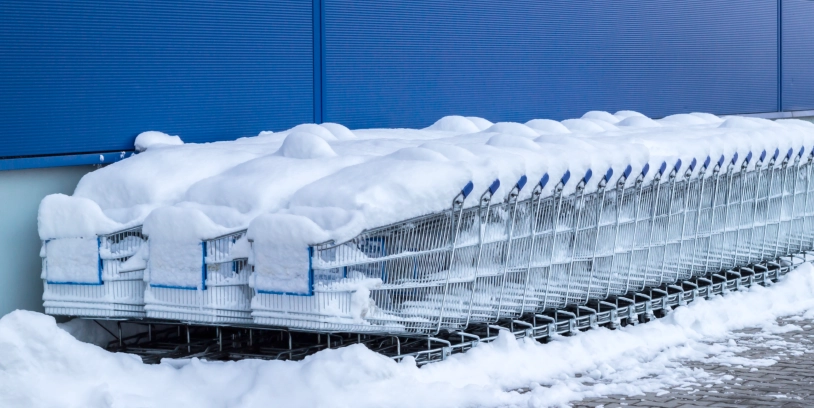
A powerful storm that swept across much of the United States over the weekend triggered widespread grocery supply disruptions, delaying deliveries, thinning inventories, and forcing supermarkets to adjust operations as snow, ice, and frigid temperatures made travel hazardous, according to The Washington Post.
Retailers from Texas to New England scrambled to keep shelves stocked as customers rushed stores ahead of deteriorating conditions. At the same time, trucking delays and store closures slowed the flow of goods just as demand surged.
Heavy Demand Empties Shelves
In the days leading up to the storm, shoppers cleared grocery aisles of staple items such as bread, milk, eggs, bottled water, and canned foods. Many stores reported sales levels more typical of major holidays than a midwinter weekend. Connecticut Insider noted, “Even after the storm passed, stores struggled to restock essentials, with many shelves remaining empty Monday morning.”
Retail analysts say such buying behavior remains predictable during severe weather, but the scale of this storm compounded the pressure. When roads close and demand spikes simultaneously, even well-prepared supply chains feel the strain. “Our stores experienced record traffic and product depletion,” said Maria Gonzalez, a store manager in Hartford, Connecticut, quoted in Connecticut Insider. “We’re working around the clock to bring inventory back.”
Transportation Bottlenecks Slow Deliveries
Icy roads and whiteout conditions stalled freight movement across key distribution corridors. Long-haul drivers faced closures on major interstates, while regional routes became impassable in several states. According to The Independent, “Hundreds of trucks were forced to idle in parking lots as the storm blanketed 26 states, disrupting deliveries.”
As a result, distribution centers held products they could not safely move. Stores that normally receive daily shipments waited longer between deliveries, prolonging out-of-stock conditions.
Related Article: The Retail Academy: Annual Supply Planning
Store Hours Adjusted for Safety
Many supermarket chains reduced hours or closed locations temporarily to protect employees and customers. In Houston, H-E-B adjusted opening times, while Kroger closed several locations early, according to The Sun. “We prioritize the safety of our employees and customers above all,” a Kroger spokesperson said.
Retailers urged customers to shop responsibly and avoid overbuying, stressing that measured purchases help stabilize supply during recovery periods.
Delivery Services Paused Across the Nation
Across the country, grocery delivery platforms suspended service in affected areas. The Washington Post reported that snow-packed streets and untreated neighborhoods created unsafe conditions for drivers, prompting companies to halt operations until municipalities cleared roads. “We apologize to customers for delays,” said an Instacart representative. “Safety is our top priority.”
Even after weather conditions eased, delivery backlogs continued to slow the return to normal service levels.
Technology Helps, But Limits Remain
Large grocery chains leaned on forecasting tools and logistics software to anticipate disruptions. Some rerouted shipments, staged inventory closer to high-risk regions, or adjusted ordering algorithms ahead of the storm. Still, experts warn that technology cannot overcome closed roads or unsafe working conditions. “AI can help route trucks more efficiently, but it can’t melt ice,” said logistics consultant James Howard, quoted in The Sun.
Recovery Will Take Time
Although conditions began improving in some regions early this week, full recovery will not happen overnight. Restoring inventories requires multiple delivery cycles, particularly for fresh and refrigerated products. Retailers say lingering cold temperatures could continue to slow transportation and extend grocery supply disruptions into the coming days.
For consumers, empty shelves serve as a visible reminder of how quickly weather can upend everyday logistics. For grocers, the storm offers another stress test in an era of growing climate volatility and operational uncertainty.