
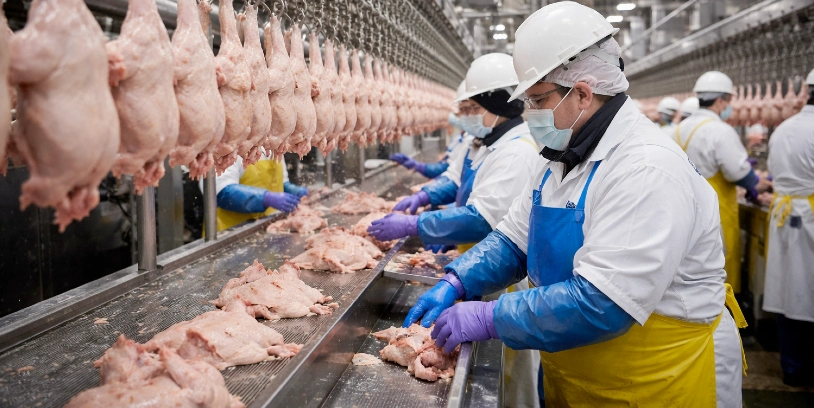
The USDA line speed rule has sparked a fierce debate over food costs, worker safety, and supply chain stability. The U.S. Department of Agriculture this week proposed changes to federal regulations that would allow poultry and pork plants operating under modern inspection systems to increase production line speeds.
Officials say the move will lower food costs and strengthen the supply chain. However, labor leaders warn it could endanger workers and undermine food safety.
Secretary Brooke Rollins framed the USDA line speed rule as a practical reform grounded in years of operational data. She said the department aims to remove outdated bottlenecks that drive up production costs for processors and, ultimately, grocery prices for consumers.
“As Secretary, my responsibility is to ensure that American families have access to affordable, safe, and abundant food,” Rollins said in a statement. She added that the proposal aligns regulations with “proven, real-world capabilities” while maintaining federal oversight.
USDA Line Speed Rule Targets Regulatory Barriers
Under the proposed USDA line speed rule, eligible poultry and pork establishments could operate at speeds supported by their equipment, processes, and food safety records. Importantly, the Food Safety and Inspection Service would continue to station inspectors in every facility. Moreover, inspectors would retain the authority to slow or stop production if they cannot perform their duties effectively.
USDA officials argue the changes would replace years of waivers, pilot programs, and temporary measures with predictable, long-term standards. As a result, processors would gain regulatory certainty and reduce compliance confusion.
In addition, the proposal would eliminate certain worker safety attestations that USDA says fall outside its statutory authority. The department contends this adjustment would cut redundant paperwork without weakening oversight.
The announcement fits within the broader Trump administration agenda to reduce regulatory burdens, expand domestic production, and stabilize supply chains. Officials insist that affordability and food safety can coexist. They point to decades of inspection data that, in their view, support modernized line speeds under controlled conditions.
UFCW Condemns USDA Line Speed Rule
Yet the reaction from labor advocates proved swift and sharp. The United Food and Commercial Workers International Union, which represents hundreds of thousands of meatpacking and food processing workers, blasted the USDA line speed rule as dangerous and short-sighted.
Mark Lauritsen, director of the union’s Food Processing, Packing and Manufacturing Division and an international vice president, said the proposal prioritizes corporate profits over worker safety.
He argued that USDA studies released last year found that higher line speeds increase injury risks in poultry and pork plants. According to Lauritsen, the new proposal ignores those findings and fails to address long-standing safety concerns.
Furthermore, he warned that non-union workers are more vulnerable because they lack contract protections, safety committees, and shop stewards. Without speed limits and adequate staffing, Lauritsen said, injury rates could climb. In turn, that could slow production rather than lower prices.
Related Article: GOP Reps Push USDA to Reconsider SNAP Stocking Rules
Food Safety and Rural Impact Concerns
Beyond worker injuries, UFCW leaders raised concerns about food safety. They contend that faster line speeds, combined with what they describe as pressure on inspection resources, could compromise oversight.
“The safety of our food depends on the safety of the workers who process it,” Lauritsen said.
Additionally, the union cautioned that uncapped line speeds could contribute to plant instability. If injuries spike or compliance falters, facilities could face shutdowns. Such closures, union officials said, would hit rural communities particularly hard, since meatpacking plants often anchor local economies.
Lauritsen invoked the grim conditions described in Upton Sinclair’s The Jungle, arguing that the proposal risks reversing decades of progress in labor standards.
A Defining Debate Over the Food Supply
The USDA line speed rule is now in the federal rulemaking process, during which stakeholders will submit public comments before the department finalizes any changes. Therefore, the coming months will likely feature intense scrutiny from industry groups, labor unions, and consumer advocates.
On one hand, USDA officials maintain that modern inspection systems and data-driven policies can deliver efficiency without sacrificing safety. On the other hand, union leaders insist that speed increases inherently raise risks for workers and potentially consumers.
At stake lies more than regulatory language. The outcome could shape the balance between cost control and workplace protections across the nation’s meatpacking sector.
As food prices remain a top concern for households, policymakers face mounting pressure to act. Still, whether the USDA line speed rule ultimately lowers grocery bills or fuels new controversy will depend on how regulators address the safety concerns now front and center.