
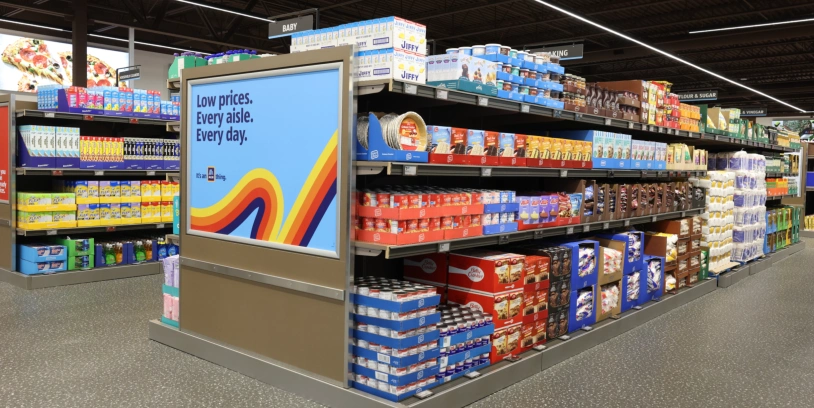
Independent supermarkets are bracing for impact as ALDI price cuts return to grocery aisles this fall, deepening a challenge that’s already reshaping the industry.
On September 23, the discount store chain launched its savings campaign for customers, offering price cuts on its products totaling an estimated $86 million. This initiative complements the chain’s already highly competitive low-price model. According to the company, nearly one-third of the chain’s typical in-store assortment now costs less than it did last year.
A Fall Price War Takes Shape
This round of ALDI price cuts targets items shoppers reach for most this season. Honeycrisp apples now sell for $1.99 per pound. That’s 35% below last year’s price and the lowest in more than five years, per the release. Kirkwood chicken breast family packs match that price point, marking their cheapest everyday cost since 2022.
Other markdowns hit Brussels sprouts, butternut squash, French beans, and a range of apples and potatoes. The discounts run through at least November 3.
“At ALDI, value is a year-round promise, not a promotion,” said Scott Patton, the company’s chief commercial officer, in the press release.
That promise now touches hundreds of products. Coffee, mixed nuts, paper towels, and protein shakes all carry lower price tags than in 2025, the company said.
Related Article: Grocers Sue NYC Over City-Funded Stores
Independent Grocers Feel the Squeeze
For independent supermarkets, these price cuts are more than a seasonal promotion. They represent a structural threat.
The discounter already claims the lowest prices among national grocery chains, saving American shoppers roughly $10.2 billion a year, according to the release. Small operators cannot match that scale.
The chain now runs more than 2,600 U.S. stores. In 2025, it planned to open roughly 225 locations, following about 120 openings in 2024. This year alone, it plans more than 180 additional stores.
That expansion isn’t slowing down. The retailer expects to operate nearly 2,800 U.S. stores by the end of 2026, keeping it on pace for about 3,200 by 2028.
Meanwhile, larger rivals are retreating. Kroger and Albertsons, the country’s two largest pure-play grocers, are both closing unprofitable stores even as this discounter keeps building. Independent grocers, with far thinner margins than either chain, face an even steeper climb.
Industry coverage has flagged the trend for months. Trade publication Supermarket News has noted that ALDI, alongside Trader Joe’s and Lidl, is giving traditional grocers a run for their money.
Growth Fueled by Consumer Demand
This expansion isn’t happening in a vacuum. It’s riding a wave of consumer trade-down behavior.
By the end of 2025, the chain operated 2,614 U.S. locations, making it the third-largest grocery chain by store count, trailing only Walmart and Kroger. Inflation and elevated grocery prices continue to push cost-conscious shoppers, including higher earners, toward its private-label, value-driven model.
That shift matters for independent grocers competing on the same shelves. When budget-focused customers migrate en masse, local stores lose foot traffic they can’t easily win back.
The company is also fueling growth through acquisition. It’s converting former Winn-Dixie and Harveys locations, adding roughly 80 more conversions this year, per the release.
What Comes Next for Local Grocers
Independent supermarkets aren’t without options. Many compete on service, specialty products, and community ties that a stripped-down discount model doesn’t offer.
Still, the math grows harder every quarter. As new distribution centers open in Florida, Arizona, and Colorado, supply-chain efficiency will likely widen the price gap further.
For now, shoppers benefit from the competition. Independent grocers, however, will need sharper differentiation strategies to survive the ongoing ALDI price cuts.