
How can Hispanic retailers capitalize on generational trends and seasonal spikes through a smarter confectionery retail strategy to claim their share of a $62 billion future?
Imagine this: A customer walks into your store. They check prices and skip the expensive organic products to save a few dollars.
But then they reach the checkout line and spot a bag of freeze-dried gummy bears or classic Mexican chocolate.
The hand reaches out. The product lands on the conveyor belt.
In a year defined by “careful spending,” the candy aisle has become the ultimate economic anomaly.
According to the National Confectioners Association (NCA), nearly 100% of households made a candy purchase in 2025.
For the modern retailer, this isn’t just about selling sugar—it’s about building a confectionery retail strategy around “affordable luxury.”
The numbers are staggering. The State of Treating 2026 report reveals that U.S. confectionery sales reached a record $55 billion last year.
Despite inflation and market jitters, chocolate, gum, and candy aren’t just surviving—they’re thriving.
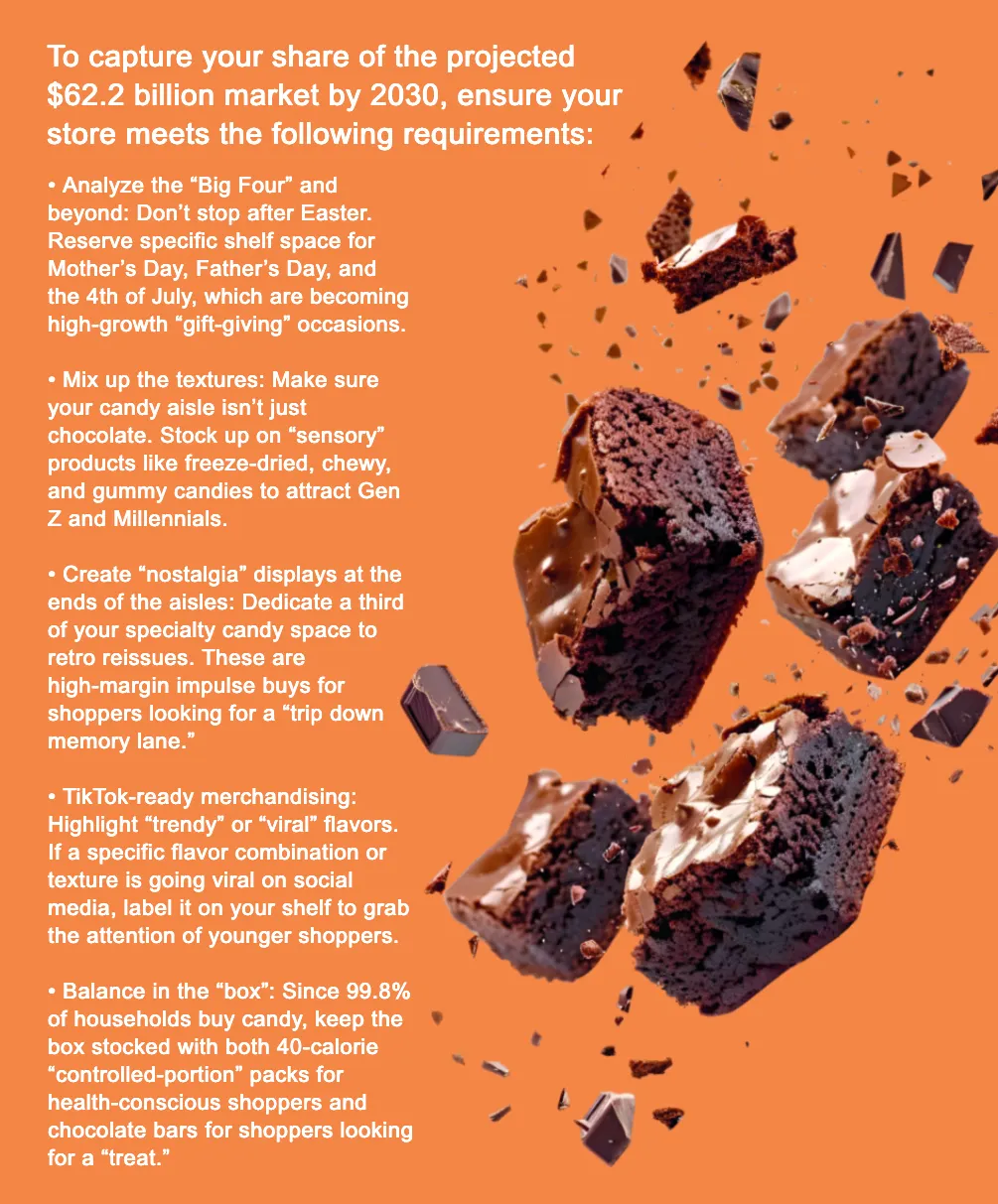
With projections indicating it will reach $62.2 billion by 2030, the message for retailers is clear: optimize your confectionery retail strategy for the “intentional” shopper of 2026, or leave money on the table.
Related Article: Spending on Snacks and Candies Shifts in 2026
The Generational Shift: Shaping Your Confectionery Retail Strategy Around Milk Chocolate vs. the “TikTok Effect”
The report highlights a massive shift in who buys what.
Boomers remain loyal to milk and dark chocolate classics, which still dominate over 50% of the market.
However, younger demographics are moving the needle in another direction.
- The rise of gummies: Non-chocolate candies now account for nearly 41% of the market share.
- The Gen Z factor: To capture Millennials and Gen Z, think texture and novelty. Freeze-dried candies and “unexpected” flavor combinations are booming, driven largely by TikTok discoveries.
- “New” is old: A third of consumers seek nostalgia, and exact “retro” relaunches are in high demand, bridging the gap between generations.
The Success Checklist: Building a Winning Confectionery Retail Strategy
Based on the 2026 “State of Treating” report
Winning During the “Big Four” Seasons (and Beyond)
Seasonal sales accounted for 63% of all confectionery revenue in 2025.
While Valentine’s Day and Halloween remain the giants, the modern retailer must look toward “second-tier” holidays.
The report shows significant growth in gifts for Mother’s Day, Father’s Day, and the 4th of July.
These represent golden opportunities for Hispanic retailers to create displays that pair sweets with traditional family celebrations.
“Today’s Americans make their purchasing decisions with greater intent,” says John Downs, president and CEO of the NCA.
For retailers, that “intent” is a vote of confidence.
Candy isn’t a mindless purchase; it’s a calculated moment of joy that averages just 40 calories a day for the typical consumer.
As we look toward a $62 billion future, the question isn’t whether people will continue to buy candy.
Rather, the real question is whether they’ll find what they saw on social media yesterday on your shelf today.